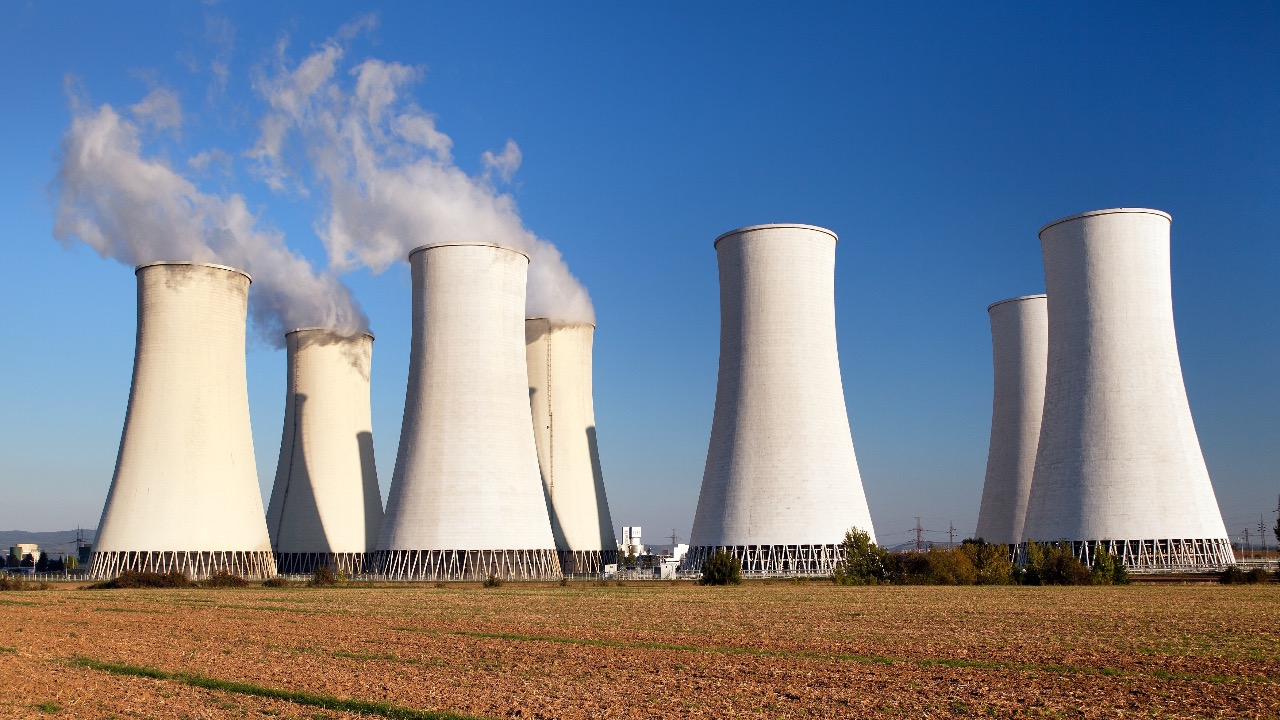
For the United States to compete with China and Russia on nuclear energy, it must work with allies to accelerate nuclear expansion at home, in Eastern Europe, and in emerging markets.
The United States is at the front end of a new Cold War, but this time the critical role of atom splitting has been transmuted. Rather than relying on nuclear fission to deliver security in the form of a nuclear bomb, its value now lies in the ability to supercharge cutting-edge technological advancements, such as artificial intelligence (AI).
While the United States had a clear advantage over its competitors in nuclear bomb production at the start of the first Cold War, they eventually caught up. Now, Russia and China have the upper hand in nuclear energy deployment and export, and the question is whether the United States can overtake these competitors.
To be successful, the US government, its allies, and the private sector will need to disentangle the multiple opportunities, geopolitical imperatives, and differing technologies and timelines. They need to create an interconnected, strategic approach to nuclear reactor and fuel deployment that achieves near-term progress while protecting the markets of the future.
Three Spheres of Nuclear Expansion
There is no shortage of support for nuclear power in America. It commands tens of billions of dollars in federal financing, spanning everything from large reactor deployment to producing exotic fuels for next-generation reactors. Its economic, energy security, and geopolitical importance have generated virtually seamless bipartisan agreement in an otherwise splintered political environment. The Trump administration has unleashed a thicket of Executive Orders to boost the nuclear sector.
Despite this spigot of cash and commands, and the ratcheting political pressure for nuclear energy to succeed, it is difficult to see how this frenzy of nuclear activity results in real achievements on a predictable timeline. Neither the United States nor its allies have produced a streamlined strategy that will ensure success.
However, there are three intersecting spheres of nuclear expansion that should form the foundation of that roadmap, each having unique geopolitical imperatives, technology composition, and timelines.
Expanding Nuclear Energy in Eastern Europe
The geopolitical foundation of the push to expand nuclear power in Eastern Europe is to decouple from Russian energy dependence. The war in Ukraine has been a game-changer for Europe. It demonstrated the reality of a brutally expansionist Russia, its unreliability as an energy provider, and its willingness to use energy as a weapon.
Eastern Europe is a region well-suited for large gigawatt (GW) sized reactors. Several Eastern European nations already operate Russian reactors. But virtually all of them are now seeking American or South Korean fuel conversions and reactors as they maintain and expand their nuclear output.
Poland has contracted with Westinghouse to build three AP-1000 reactors (over one GW each), while the Czech Republic has chosen to build two Korean APR-1400 (1.4 GW each).
Other nations are pursuing similarly sized reactors, including Bulgaria, Romania, Slovakia, and Slovenia. The United States has already been successful in removing China as a potential nuclear partner with Romania. While there is also interest in small modular reactors (SMRs), these are likely a later prospect.
Eastern European governments have made clear that they are price-sensitive and demand on-time, on-budget delivery. That will be a challenge for both Westinghouse and Korea Electric Power Corporation (KEPCO). But the resolution of their intellectual property dispute, while controversial, can ensure strong cooperation, the supply of an adequate workforce, and construction efficiency in the Eastern European market.
The primary American strategic objective in Eastern Europe is to lock down the expansion of the large reactor market and keep Russia and China out. But it must work with allies to deliver the reactors on time and on budget while building a stronger supply chain. And it needs to ensure that a future SMR wave is controlled by the United States and its allies.
Advancing Nuclear Energy in America
America has decided that winning the AI race with China is an absolute geopolitical imperative, and the Trump administration is determined that the industry will have the substantial power it needs to emerge as the winner.
There are two streams of nuclear technology that are moving forward to meet this need.
1. Small modular and advanced technology reactors
Most attention has been focused on small modular and advanced technology reactors. These are generally categorized as being 300 megawatts (MW) or less per unit, deployable in modular packages to customize power output for the user (several can be linked together), have passive safety systems if an accident occurs, and in many designs, are fueled or cooled with exotic materials (ceramic uranium balls, molten salt, gas, and lead).
These unique features, when compared to traditional, large reactors, have attracted substantial interest and financial support from major technology companies that are leading the AI revolution.
Amazon has committed to invest $500 million in X-Energy to produce five GW of new nuclear power. Google has signed an agreement with Kairos Power to purchase 500 MW of power from its advanced reactors. OKLO claims it has 14 GW of commitments for its Aurora reactor, which will serve data centers, utilities, the industrial sector, and government. The company has been backed by Sam Altman, the CEO of OpenAI.
A major challenge for small and advanced reactor companies is their timeline for deployment. In the United States, only NuScale Power has regulatory approval for its reactor. Many others are likely a decade away from deployment. There are also serious concerns about whether the exotic fuels required for these novel reactor designs can be delivered on time.
And questions are skyrocketing about whether the AI data center boom is already headed for a bust. The stock market has pulled back based on this fear.
Then there is the reliability of output. The historical record indicates that advanced-type reactors operated in the United States, Germany, France, and Japan have all faced serious operational challenges.
2. Large nuclear reactors
The alternative to SMRs as the AI backbone is the traditional large reactor.
Hyperscalers such as Microsoft and Google have agreed to purchase power from existing reactors that will be restarted in Pennsylvania and Iowa. Meta has agreed to buy 20 years of power from the Clinton plant in Illinois. Michigan is taking a closed reactor out of mothballs. And South Carolina is on the way to completing two partially built reactors at VC Summer. Others may follow.
New, large reactors, like the Westinghouse AP-1000, have a distinct advantage over SMRs because they have been licensed by the Nuclear Regulatory Commission (NRC) and have been built in the United States and overseas. The AP-1000 has a capacity factor of over 92 percent. And Westinghouse has presumably learned hard lessons from the painful cost and schedule overruns at the Vogtle and Summer plants, an experience that will pay dividends in the future. The
The Trump administration has committed $80 billion to the construction of 10 GW of AP-1000 power in the United States. And at least one administration energy official has indicated that the US government could buy and own “as many as 10 large nuclear reactors” using Japan’s commitment to invest $550 billion in the United States.
The challenge for the AP-1000 is that utilities and investors are hesitant to commit to new construction and the cost risks. They see natural gas as the primary power for data centers in the near term. And there is trepidation on Wall Street, despite their rhetorical support for nuclear energy expansion.
Having anticipated caution from utility companies, the Trump administration is advancing a dual-track strategy for reactor deployment by identifying federal land for construction. A number of small reactor developers are already using the national laboratories as homes for their reactor developments. Under some conditions, these reactors would not require NRC approval but could be approved by the Departments of Energy or Defense.
One example of the potential combination of federal land and the AP-1000 is Fermi America’s Project Matador. It plans 10 AP-1000s for deployment in Amarillo, Texas, adjacent to federal land on which the Pantex nuclear weapons disassembly plant is located (but still within the plant’s site boundary). That can ease the regulatory pathway for reactor construction and concentrate energy output.
The AI national security imperative and the energy that will be demanded make the United States a land of opportunity for nuclear expansion. However, there are significant headwinds for new nuclear deployment in the United States. And whether the focus is on small or large reactors, it is very unlikely that any new nuclear build will materialize before the early 2030s. At that point, the data center energy demand may have substantially weakened.
Therefore, the objective for the United States is to underscore the national security importance of its nuclear power build-out and secure a concrete commitment to construct a set of new large and small reactors. That will require a purchaser for the power, and if AI flags, and the utilities have cold feet, the alternative may be the US government.
Capturing Emerging Markets in the Global South
The geopolitical imperative to capture emerging nuclear markets is strong. It blocks authoritarian competitors like Russia and China from key markets, it creates a 100-year-long energy partner, and it provides the power these nations need as their populations and economies grow. But these are the places where the least amount of strategic and creative thinking has been done.
The Global South is an imprecise term, but it encompasses many nations that seek to expand their economies, ensure steady, reliable electricity, and manage growth in populations and migration to urban centers. This places pressure on energy production, and many of these countries are not well-suited for a large GW-sized nuclear reactor. They could better use SMRs. The lower power output, ability to be located away from water (for some designs), and safety advantages make them appealing in countries with limited and disaggregated electric grids.
Russia has a significant advantage in cultivating these nations. It has signed over 15 nuclear power agreements with African nations since 2017, while the United States has signed two (Ghana and Kenya). In Asia, the United States is more competitive with Russia, both having agreements with nuclear export-friendly Vietnam and Indonesia.
China, while not yet exporting nuclear reactors to emerging economies, is capturing their energy infrastructure through the Belt and Road Initiative (BRI), which now has 149 countries in its orbit. Some of these are target markets for future nuclear power.
Russia and China are already operating SMRs. Russia has a floating SMR and a land-based version under construction. It also has an agreement to export two others to Uzbekistan. China is operating a High-Temperature Pebble Bed SMR commercially and has another conventionally cooled small reactor under construction.
The operation of these reactors domestically will provide Russia and China with the ability to demonstrate to potential purchasers that these technologies work. This is important for potential sales. And it is a step the United States and its allies also will need to make. But since no commercial SMR is under construction or operating on American territory, and won’t be until after 2030, the United States is well behind its competitors in SMR export potential.
However, the United States has made significant strides in locking down Saudi Arabia as a reactor export market for the AP-1000. The nations inked a joint declaration that stated “American companies will be the Kingdom’s civil nuclear cooperation partners of choice.”
There are many hurdles to overcome with Saudi Arabia, including completing a binding nuclear cooperation agreement that is approved by Congress and addressing the critical issue of uranium enrichment. It is also important to ensure that South Korea will be a partner in the project as the Saudi’s desire. But the recent progress is a plus for US nuclear power.
Transforming the joint declaration with Saudi Arabia into a binding nuclear agreement is likely to demand the Trump administration’s full attention, but it shouldn’t consume all the oxygen. The objective for the emerging economy category is to capture markets for American SMRs and prepare those nations for nuclear operation in an expedited manner.
America hasn’t done a great job in this area and continues to rely on the slow, incremental process of capacity building that rarely reaches a conclusion, and its export financing is weaker than the opportunities. Instead, the United States and its allies need to consider some creative options, including Energy Security Compacts, reactor-exporter Build-Operate-Transfer models, and an expansion of the resources and remit of the Development Finance Corporation and the Export-Import Bank. Then there is the looming potential to combine Middle Eastern sovereign wealth funds with the Organization for Economic Co-operation and Development (OECD) nation export agency financing to create a super-pool of resources that can support broad nuclear deployment in emerging economies. That can solidify a new, responsible energy security coalition with rippling geopolitical benefits in the new Cold War.
About the Author: Ken Luongo
Kenneth Luongo is the president and founder of the Partnership for Global Security (PGS) and the Center for a Secure Nuclear Future.
Image: Daniel Prudek/shutterstock