Last Saturday night, the New York Philharmonic played a concert splashed with color. It began with a work by Lera Auerbach, written in 2010 or so. (The history of this work is slightly complicated.) I will discuss it in a future chronicle, for the print magazine.
The concert was conducted by Stéphane Denève, whose full-time job is in St. Louis—he is the music director of the SLSO, the St. Louis Symphony Orchestra. He is a very good conductor. He is also . . .
Well, you remember Bramwell Tovey, I trust. He was the Englishman who conducted the Philharmonic’s “Summertime Classics” series. I often referred to him as “your genial host.” He would take the microphone and sprinkle English charm over the audience.
Denève is your genial host too, only he sprinkles French charm. What’s more, he is chivalrous: the kind of chevalier to kiss the hands of female violinists.
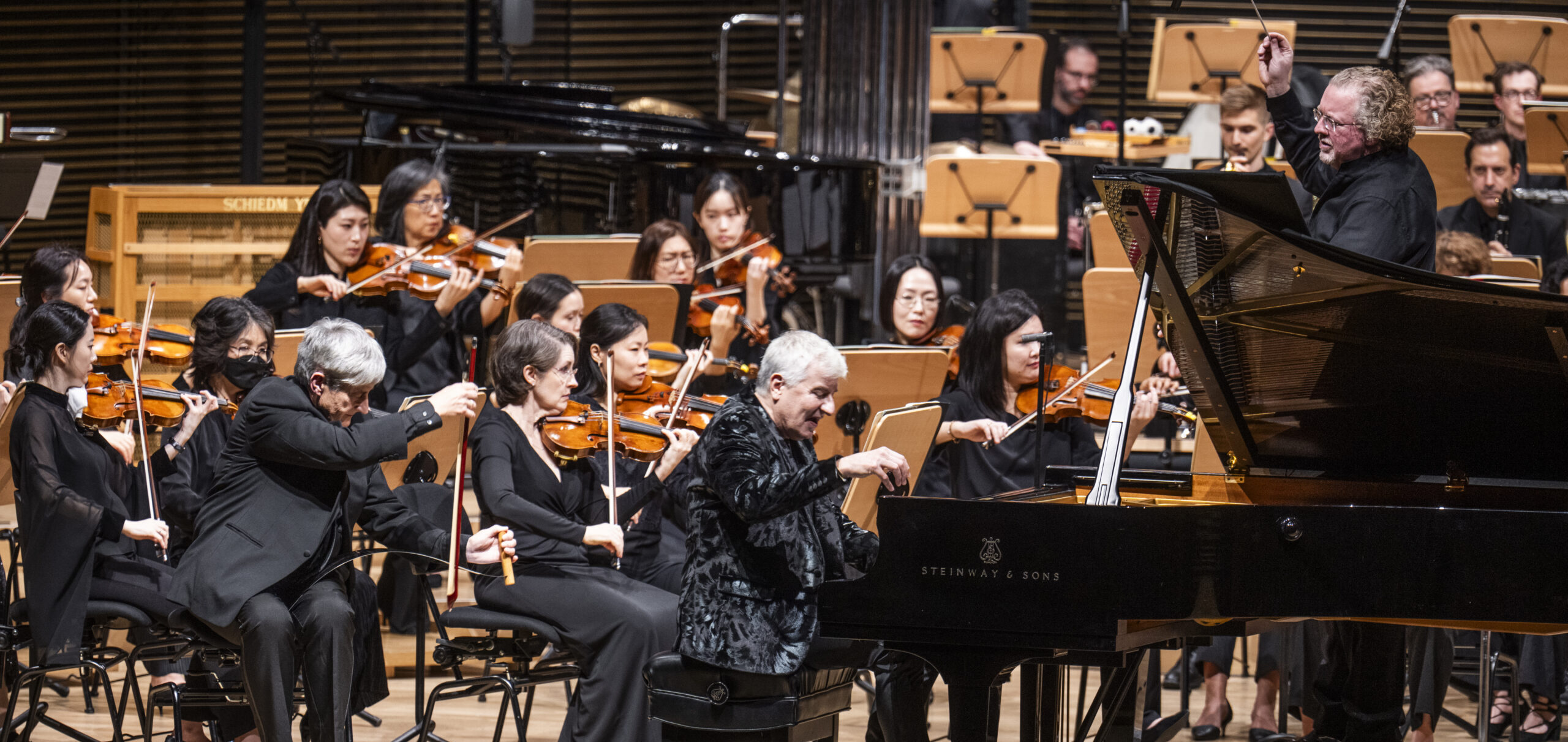
There was a concerto on this program: the Piano Concerto of Aram Khachaturian, written in 1936. Where has it been? It used to be very, very popular. But it had not been programmed by the New York Philharmonic since the 1960–61 season. (Leonard Pennario was at the piano, Siegfried Landau on the podium.)
William Kapell, the dynamic American pianist, made it a “jukebox hit.” In a later era, Alicia de Larrocha, the Spaniard, played it very well.
Our soloist on Saturday night was a Frenchman, Jean-Yves Thibaudet. While playing your genial host, Maestro Denève described him as “the most American of French pianists.” Why? Perhaps because of Thibaudet’s affinity for Gershwin.
No offense, but the Khachaturian Piano Concerto can sound trashy when played trashily. The trick is not to play it trashily. Thibaudet is an excellent pianist for this concerto. He imbues music with dignity, curbing bombast along the way.
I think of his playing of the “Egyptian” Concerto (Saint-Saëns).
Thibaudet has an enviable technique, as he proved on Saturday night. It is a relaxed technique, producing fluid octaves and the like. You rarely see Thibaudet hindered by tightness. Also, he has a knack for lending the right weight to a note. He allows no lumps in the porridge (unless he wants them there).
Of his musicality, what can I say? That he is suave, élégant, raffiné? (The temptation is to write in French when writing about Jean-Yves Thibaudet.)
I could quarrel with some of the things he did in the Khachaturian. The middle movement is marked “Andante con anima.” I believe the music could have used more anima. But Thibaudet sang nicely, as he does in the middle movement of the Ravel concerto (the G-major). To Khachaturian’s final movement, he lent a touch of jazz, pleasing and apt.
Throughout the concerto, all forces were in tune with one another. Conductor, orchestra, and soloist were in tune not only in pitch but also in spirit. Making a welcome contribution on the oboe was Erin Hannigan. (Three guesses as to her ancestry.) Another welcome contribution was made by Barret Ham, on the bass clarinet. You could feel that instrument—its buzz—in your bones.
Thibaudet would play an encore, and Denève took a seat in the back of the orchestra, in order to hear it. I like seeing conductors do this. In another recent concert of the New York Philharmonic, David Robertson did the same.
What Thibaudet played was the little, fleet polichinelle of Villa-Lobos. This was a go-to encore for Artur Rubinstein. I think he played it as often as Vladimir Horowitz played “Träumerei” (Schumann).
Thibaudet played it differently from Rubinstein. The Frenchman was cat-like, subtle, shivery. Rubinstein was more—dare I say “butch”? In any case, both great.
By the way, Rubinstein played the Khachaturian concerto with the New York Philharmonic in the 1943–44 season, with another Artur, Rodzinski, conducting.
After intermission on Saturday night, there were two works. I wish to emphasize this. Typically, there is one long work after intermission. It was kind of refreshing to have two (shorter ones).
First came a 1972 work by Einojuhani Rautavaara, the Finn. I thought of my friend Fred Kirshnit, the late music critic, who had a friend who pleaded ignorance when it came to modern music. Said this friend, “I don’t know a Rautavaara from a rutabaga.”
The Rautavaara work was Cantus Arcticus, written for the Arctic University of Oulu. It is also known as the “Concerto for Birds and Orchestra.” Olivier Messiaen was not the only composer devoted to things avian.
Denève and the orchestra rendered this work with tender loving care—while avoiding sentimentalism and condescension. It was a lovely experience, this birdy concerto.
The concert ended with an “audience favorite,” the Pines of Rome, by Respighi. Over the generations, the New York Philharmonic has had the reputation of being a “bright and brilliant” orchestra. By golly, it played the Respighi that way.
Christopher Martin, the principal trumpet, sang beautifully, onstage and off. Anthony McGill was haunting on his clarinet. I could go on, naming other principals. But the truth is, the whole orchestra was “focused,” like a soloist of many parts.
Grant that we like and value all four sections of the Pines of Rome. But “can we talk,” as Joan Rivers used to say? We all wait for the final section, that stroll, or march, down the Appian Way. When it builds right, it is thrilling, and it did, and it was.
There are so many humdrum nights in a concert hall—most of them, maybe. But in David Geffen Hall on Saturday night, there was magic, I swear. Starting with the Lera Auerbach.