It is unclear what Poland will gain from the Stryker vehicles, as its army is not trained to use them and they could displace other armored vehicles in Warsaw’s inventory.
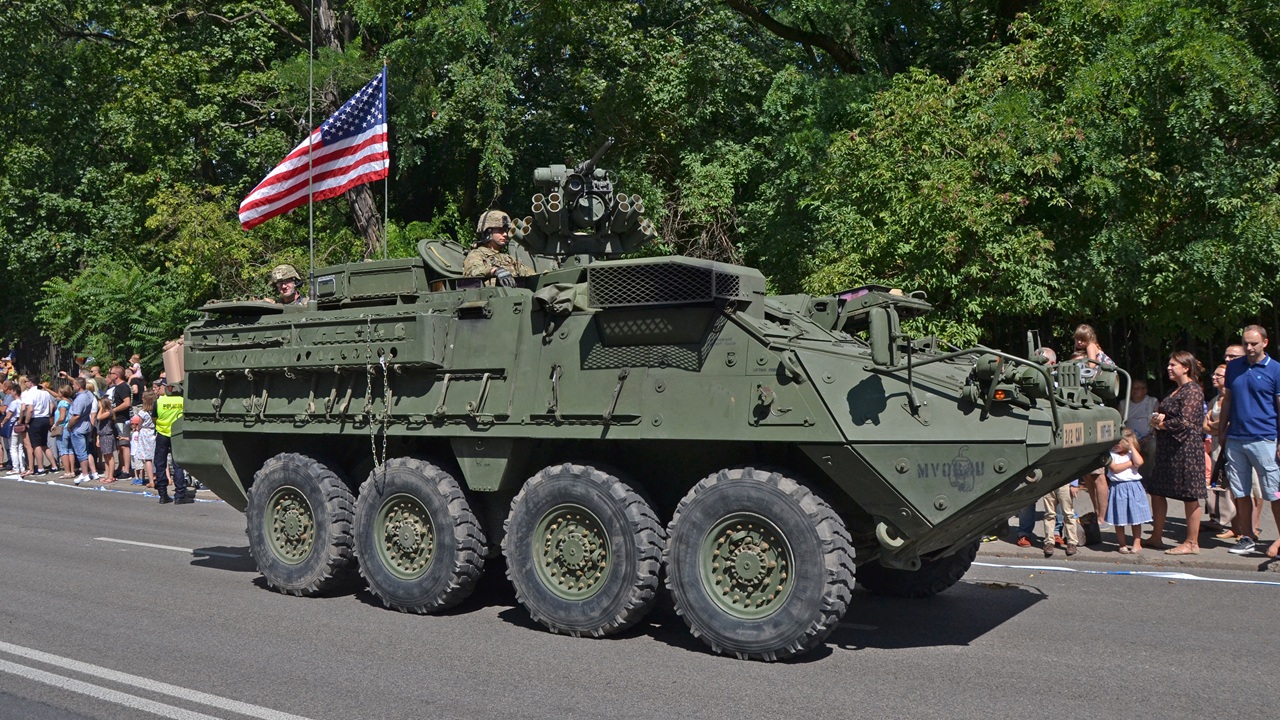
Critics of government waste shouldn’t just look at the United States military’s annual budget, but also at what it does with some of the equipment after that equipment is past its useful life. Aging military equipment due for replacement are often sold as surplus to US allies at a steep discount—often literally for pennies on the dollar. Earlier this month, for instance, NATO member Poland was given the opportunity to purchase 250 Stryker armored vehicles for a single dollar, or less than half a cent per vehicle!
Polska Zborjna first reported that the United States offered to sell the wheeled armored personnel carriers (APCs) as the Pentagon has sought to reduce its presence in Europe. Rather than paying to ship the vehicles home, it was decided to sell them to Warsaw for the ceremonial figure.
“After a preliminary analysis, we agreed that the military will check their technical condition and assess their suitability for our armed forces — is this good material for training, operational operations, or do we need this type of equipment?” Polish Deputy Prime Minister and Minister of National Defense Wladyslaw Kosiniak-Kamysz explained to the news outlet. “I’m open to a positive recommendation regarding the usefulness of this equipment.”
Warsaw has been seeking to significantly bolster its military due to concerns that Russia could continue its westward expansion if it achieves victory in Ukraine.
The Polish government has invested heavily, securing deals with South Korea for the K-2 Black Panther main battle tank (MBT), which will also be produced domestically under license. In addition to the South Korean vehicles, Warsaw closed a previous deal with Washington for 366 M1 Abrams MBTs, including 116 refurbished M1A1s, which have already been delivered, and 250 new M1A2 SEPv3 variants. Deliveries of the latter tanks will continue throughout 2026.
The Stryker Is One of America’s Most Useful Armored Vehicles
The Stryker and M1 Abrams have been integral parts of the US Army’s current force structure and were developed to operate together in combined arms assaults.
The 8×8 wheeled APC was initially developed in the late 1990s as a platform to form the backbone of new medium-weight brigade combat teams (BCTs) that were created to strike a balance between heavy armor and infantry. There are currently 18 variants of the vehicle produced by General Dynamics Land Systems, most of which are built on a standard chassis to reduce logistical footprint.
In addition to its primary APC role, specialized variants were developed, including models armed with medium- and large-caliber weapons for direct fire on enemy forces. One version is also equipped with a 120mm mortar to provide indirect fire support. The Stryker was first introduced in 2003, and the vehicles were deployed in combat operations in Iraq.
Ten flat-bottom variants have been produced, including the Infantry Carrier Vehicle (ICV), Mobile Gun System (MGS), Reconnaissance Vehicle (RV), Mortar Carrier (MC), Commander’s Vehicle (CV), Fire Support Vehicle (FSV), Engineer Squad Vehicle (ESV), Medical Evacuation Vehicle (MEV), Anti-tank Guided Missile (ATGM) Vehicle and Nuclear Biological Chemical Reconnaissance Vehicle (NBCRV). As those models proved vulnerable to improvised bombs, the Army has phased out vehicles fitted with a “V-shaped” bottom, similar to the military’s Mine-Resistant Ambush-Protected Vehicles (MRAPs).
There are also seven Double-V-Hull (DVH) variants, including ICV, CV, MEV, MC, ATGM, FSV, and ESV, as well as an additional configuration of a modified ICV platform integrating a 30mm cannon.
Powered by a Caterpillar C7 engine delivering 350 hp, the 8×8 wheel Stryker platform has an operational range of 500 km (310 miles) and a top speed of 97 km/h (60 mph). Though not providing the firepower or armor of a main battle tank (MBT), the Stryker can operate in snow, mud, and sand, though its off-road mobility is more limited.
If the deal is finalized, the 250 Strykers would be handed over to the Polish military rather than returned to the United States.
What Would Poland Actually Do With Stryker IFVs?
Several issues will need to be resolved, including the fact that the Polish military has no experience with the Stryker, which could require additional training. The bigger concern may be that these aren’t brand-new vehicles or even refurbished models, but rather equipment that the United States military doesn’t consider worth the cost of bringing back from Europe.
That could mean not all 250 are close to combat-ready, and it is unclear how Warsaw will obtain spares and support equipment to keep the vehicles running. Unlike aid to Ukraine, where vehicles can be used on the front lines and then abandoned, Poland has sought reliable vehicles that can be used for years or longer.
There has also been speculation that the vehicles would affect domestic production of similar models.
“The Strykers will fill a spot in the Polish army’s requirements that have been earmarked for the Rosomak IFVs and potential future carriers, limiting the need for domestic orders. The army currently has more than 900 Rosomak IFVs, which are now produced in-country as a modified version with the ZSSW-30 turret,” Breaking Defense explained.
However, Polish officials have dismissed the idea that accepting the Strykers would result in the cancellation of any IFVs. Instead, Warsaw may have additional vehicles, possibly those that can be relegated to secondary roles.
The Navy Is Also Selling Aircraft Carriers for 1¢—for Good Reason
The Strykers aren’t the only vehicles that the Pentagon has sold on the cheap. As noted, in October 2021, the United States Department of Defense (DoD) reached a deal with International Shipbreaking Limited in Brownsville, Texas, to sell the former USS Kitty Hawk (CV-63) and USS John F. Kennedy (CV-67) for less than the price of a piece of Bazooka bubble gum.
Several factors account for the apparent steal, including the enormous expenses in time and money associated with recycling the warships. There is also the fact that the US Navy couldn’t sell the carriers to a foreign power over fears it could reveal details of their construction to a potential adversary. Although each was conventionally powered, the carriers’ layout, including the bulkheads, may be too similar to that of the current nuclear-powered supercarriers.
So selling the carriers for just a penny each could be considered a good deal for the Navy, given the hundreds of millions of dollars it costs to recycle its nuclear-powered carriers.
About the Author: Peter Suciu
Peter Suciu has contributed over 3,200 published pieces to more than four dozen magazines and websites over a 30-year career in journalism. He regularly writes about military hardware, firearms history, cybersecurity, politics, and international affairs. Peter is also a contributing writer for Forbes and Clearance Jobs. He is based in Michigan. You can follow him on Twitter: @PeterSuciu. You can email the author: [email protected].
Image: Shutterstock / meowKa.