Most of us agree, at least in principle, that a stronger commitment to free speech on our campuses and in public life would be a welcome improvement over the tense and constrained environment we have endured for too many years. Yet conditions seem only to be worsening. The murder of Charlie Kirk on an American public university campus, as he engaged in the kind of peaceful, substantive debate we claim to want to foster, marked a new and horrifying low. Disturbingly, it was not received as such by a significant number of Americans, including some vocal academics who objected to Kirk’s being allowed to speak at all and who expressed open satisfaction at his removal from the scene. Many of the rest of us can only hope that this episode, and the growing acceptance of political violence, do not trigger a downward spiral that ultimately eviscerates the practice of free speech altogether.
It will take more than eloquent declarations to restore free speech on our campuses. What is required is a renewed commitment, especially from academic leaders, to the habits of mutuality on which free speech depends but which it cannot, by itself, sustain.
Finally, a reason to check your email.
Sign up for our free newsletter today.
I am reminded of a cartoon from the 1970s showing a lone man leaning out from a 70th-floor balcony in a bleak urban landscape, surrounded by tall, featureless buildings with empty balconies. His face swollen with anger, he shouts through a bullhorn into the deserted city below: “This is an alternative point of view to a CBS News editorial!” He speaks freely, but in vain, because he speaks into a void. The cartoon captures the futility of free speech in a world where no one is listening.
How should we think about the necessary preconditions of mutuality that undergird the practice of free speech? One way to gain insight is to consult a thinker not usually associated with debates over free expression: the Cambridge philosopher and political theorist Michael Oakeshott. He resists easy characterization, though his leading American interpreter, Timothy Fuller, aptly describes him as “the preeminent antagonist of all those today who wish to reduce the meaning of life to political action.” That formulation points to a recurring theme in Oakeshott’s work: the elusive but essential form of discourse he called “conversation.”
What is a conversation? Oakeshott called it “an unrehearsed intellectual adventure”—a setting in which “thoughts of different species take wing and play round one another,” without an arbiter, “not even a doorkeeper to examine credentials.” Most strikingly, he contends that “it is the ability to participate in conversation, and not the ability to reason cogently, to make discoveries about the world, or to contrive a better world, which distinguishes the human being from the animal and the civilized man from the barbarian.” From this perspective, the central task of education is to initiate students into “the skill and partnership of this conversation.”
A remarkable claim! Yet it is worth asking whether it is mere coincidence that so much of our cultural and intellectual life feels arid at a moment when the art of conversation appears to have withered. People have not stopped communicating—indeed, they incessantly bombard one another with digital content—but they have largely lost the capacity to converse. Too often, even the invitation to “have a conversation” about some contested matter is little more than a courteous prelude to a sermon explaining why you are right and I am wrong.
What is so special, then, about conversation? A hint of larger meaning can be found in the word’s etymology, which goes back to the Latin conversari, “to live with, and keep company with.” The principle of mutuality is a key element in a proper understanding of conversation. It is not for nothing that we speak, as Aristotle did, of conversational “partners.”
Little attention is paid to the mutuality or partnership of speech in such landmark free-speech documents as the University of Chicago’s “Report of the Committee on Free Expression,” otherwise known as the Chicago Principles. The statement leaves an important problem unaddressed. It is significant that the document is called the “Report of the Committee on Free Expression”—not of “Free Speech,” or, for that matter, of “Freedom of Inquiry” or “Freedom of Conscience.” So, too, does the Woodward Report, published in December 1974 by a Yale committee headed by the eminent historian C. Vann Woodward. Still one of the best guides to the virtues of academic freedom, its official title is the “Report of the Committee on Freedom of Expression at Yale.”
But “expression” is not quite the right word for what most needs defending. The ultimate justification for free speech is inseparable from the fact that it is speech that we permit to be free. Speech—discursive language, what the ancient Greeks called logos—possesses a special dignity. It is the human gift par excellence. Through words, we engage in rational deliberation: we work things out together, solve problems, and articulate and apply moral and practical principles. Speech is what allows us to function as “political animals,” in Aristotle’s sense—not merely creatures who coexist, but beings capable of deliberating together about the common good. As Aristotle himself puts it in Book I of the Politics:
[W]hy man is a political animal in a greater measure than any bee or any gregarious animal is clear. . . . [M]an alone of the animals possesses speech (logos). The mere voice, it is true, can indicate pain and pleasure. . . . but speech is designed to indicate the advantageous and the harmful, and therefore also the right and the wrong; for it is the special property of man in distinction from the other animals that he alone has perception of good and bad and right and wrong and the other moral qualities, and it is partnership (koinonia) in these things that makes a household and a city-state.
Animals share with us a capacity for expression, even rudimentary forms of language, but not the ability to speak with analytical precision—to hold things at arm’s length, discuss them cogently, make judgments among them, and incorporate those judgments into the life of a self-governing community. Aristotle’s point is that it is this capacity for “partnership” that makes such a community possible. We might add that it is also what makes conversation possible. Our initiation into language is inseparable from our initiation into human culture, with its webs of meaning and patterns of mutuality that shape our souls. Speech, in this sense, is a partnership, not a monologue.
One of the chief things that speech does is to create and occupy a middle ground between thought and action, a sort of buffer zone where we can hold things out before us, externalize the internal, and consider together, with detachment, different courses of action. We can project those courses into the future, and speculate on their likely effects, before acting on any of them, perhaps comparing them with similar actions undertaken in the past. The very idea of free speech depends on its being securely situated within, and largely confined to, this transitional zone. Speech that poses a “clear and present danger” is proscribed precisely because it violates this understanding: it is no longer deliberation but incitement to action and thus falls outside the buffer zone where speech can, and must, remain free.
We engage in this sort of provisional thinking all the time, as when we deliberate together in considering competing scenarios, whether Plan A is better than Plan B, which plan will have what consequences, and which simulation or imaginative projection is likely to give us a more accurate reading of future events, and thus a more effective plan of action. It is the singular virtue of speech that it makes possible such activity in the middle ground between thought and action. Whether we’re planning a trip to the grocery store or plotting an invasion of Normandy, it is speech that provides us with space for doing that.
This understanding of speech—as a refuge for provisional thought and speculative reflection—closely parallels Oakeshott’s description of the university as a place offering “the gift of an interval,” as he put it in his 1949 essay “The Universities.” It is a setting in which one may “put aside the hot allegiances of youth without the necessity of acquiring new loyalties to take their place.” One can bracket the dogmatisms of one’s own culture, step outside Plato’s cave, and sample the light of other suns.
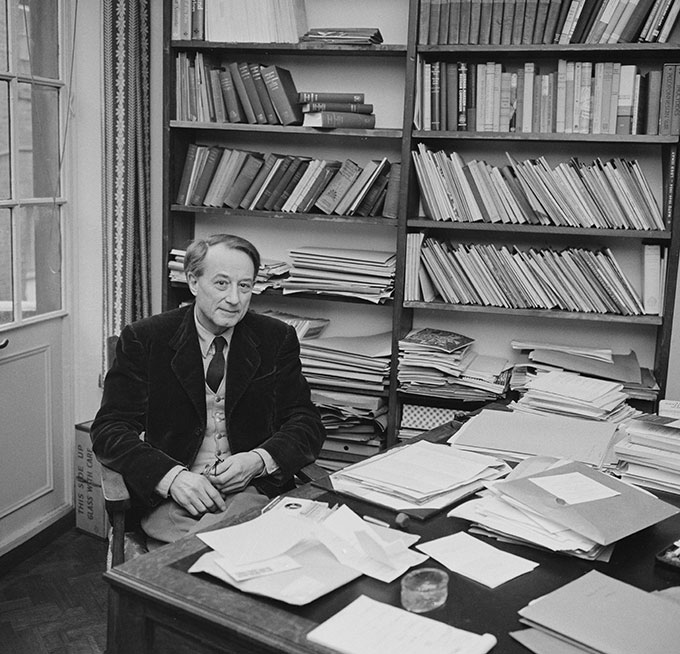
University life, in Oakeshott’s account, is an interval in which “a man might refuse to commit himself,” in which he may “taste the mystery” of life “without the necessity of at once seeking a solution.” It is an opportunity to practice what he calls “suspended judgment,” of which the vaunted “neutrality” of liberalism is only a pale shadow. What would it be like to be a Marxist—or a monarchist? A monk—or a murderer? And all of this, Oakeshott reminds us, occurs not in a vacuum but “surrounded by all the inherited learning and literature and experience of our civilization.”
Expression, however, is not the same as speech. It is a more romantic, and more opaque, term, as its etymology suggests, deriving from the Latin exprimere, “to press out.” Expression does not invite response in kind. It cannot be engaged, answered, or met with a counterpoint; it must either be indulged or ignored. In that sense, it is effectively rebuttal-proof.
This way of thinking has led us into dangerous territory, especially when embraced by those unwilling to admit the possibility of error. “Words are violence!” student protesters shouted at Middlebury College in 2017, borrowing a phrase from Toni Morrison to shout down their invited speaker, the sociologist Charles Murray, and to menace him and his host with physical harm, as if violence itself could be treated as a form of language. Such reasoning collapses essential distinctions and erodes the conditions of a university in which speech can serve its highest purpose: offering students the gift of an interval, a space in which the art of conversation can be learned and practiced. I need hardly add that the murder of Charlie Kirk makes the same point, far more chillingly.
Rightly understood, speech, logos, always entails the possibility of an answer, of interlocution, of dialogue, of engagement, of argument—in short, of talking back. Or, to put it more optimistically, of a genuine conversation, rather than a stale rehearsal of ideological desiderata, like a demonstrator’s mindless chant.
When we equate speech with other forms of expression, we deny or diminish its distinctive role: as the medium of deliberation between thought and action, and as the instrument that affords us an interim space in which to seek and test the truth. In doing so, we also weaken the university’s capacity to provide Oakeshott’s “gift of an interval”—a reflective middle ground between the formative experiences of childhood and the responsibilities of adult life.
It was Robert Maynard Hutchins, one of the University of Chicago’s most influential presidents, who popularized the idea that the Western intellectual tradition was best understood as a “great conversation.”
On this view, the thinkers of the past and their achievements do not die; they persist: as exemplars to be emulated, as foils to be contested, as ghosts in modernity’s machine, or simply as sources of ideas, metaphors, and models. Above all, they endure as thinkers who can still be responded to. In that sense, Plato’s work is as alive today as it has ever been, fully present in the activity of philosophy, and the same could be said of a dozen other figures besides.
In his great essay on the voice of poetry, Oakeshott called this ongoing exchange “the conversation of mankind,” emphasizing that it is not a merely transitional condition to be endured until a final consensus, presumably grounded in science, can be reached. It is not temporary. It is our human condition, at least the condition of civilized men and women living in the pluralism of modern life. Participation in this conversation is an end in itself, not a means to some further goal, and not an activity incidental to human nature. It should not be regarded as a grudging concession to imperfect knowledge in an imperfect world. Rather, it should be understood as Oakeshott did: as an activity that forswears the desire for final and unconditional victory, or any form of closure, and instead exists for its own sake, recognizing and respecting the full range of voices in play.
But whatever we call it, something like it is a necessary part of civilized life, precisely because it is the mark of civilized life to forbear, to restrain, to refrain from acting, to suspend the impulse to silence others, and instead pause to pay the other the respect of listening. Not that the matter can end there—we must act in the end, and the gift of an interval is a gift for only a limited time. But we should not skip that crucial step, or let a false sense of political urgency corrupt that gift.
In his luminous commencement address to the 1968 graduates of Columbia University, the historian Richard Hofstadter mounted a defense of the idea of the university against those who would disparage or destroy it, whether out of carelessness or malice or nihilism. The speech repays rereading in its entirety today, as the very idea of the university once again seems to be slipping from our grasp. One passage, in particular, speaks directly to the present debate over free speech:
The very possibility of civilized human discourse rests upon the willingness of people to consider that they may be mistaken. The possibility of modern democracy rests upon the willingness of governments to accept the existence of a loyal opposition, organized to reverse some of their policies and to replace them in office.
To those last words, he could have added one more admonition. Academic freedom, civilized discourse, a willingness to reconsider one’s views, to accept the concept of a loyal opposition, or to be an opposition that is also loyal: all these things point toward the moral requirement to listen to others. Freedom of speech won’t be meaningful if it does not also entail a willingness to listen.
This may be why Oakeshott’s outrageous-sounding contention, quoted earlier, deserves to be taken seriously: that “it is the ability to participate in conversation, and not the ability to reason cogently, to make discoveries about the world, or to contrive a better world, which distinguishes the human being from the animal and the civilized man from the barbarian.” Outrageous, counterintuitive, even radical: but he may well be right.
Certainly, the changes wrought by the digital revolution in the daily work of education have brought these questions to the fore. All of us who teach, especially in the humanities, are well aware of this. Many of the methods we long took for granted—lectures, laboratories, textbooks, term papers, take-home examinations, and the close reading of long and demanding texts—now seem increasingly obsolete, or at least ill-suited to the crucial task of student assessment. This is a genuine crisis. But it is also a genuine opportunity to reconsider what we are doing, what we want our schools and universities to achieve. Perhaps we have been aiming at the wrong goals, or need to find new means of reaching them.
Oakeshott concluded that the central task of education is to provide an “initiation into the skill and partnership” of conversation. If he is right, and if that is the goal we ought to set for ourselves, the implications would be profound: not only for how we educate the young, and ourselves, but also for how we understand free speech, and the responsibility to listen, as indispensable elements in the partnership of democratic life.
Top Photo: Christina House / Los Angeles Times via Getty Images
Source link