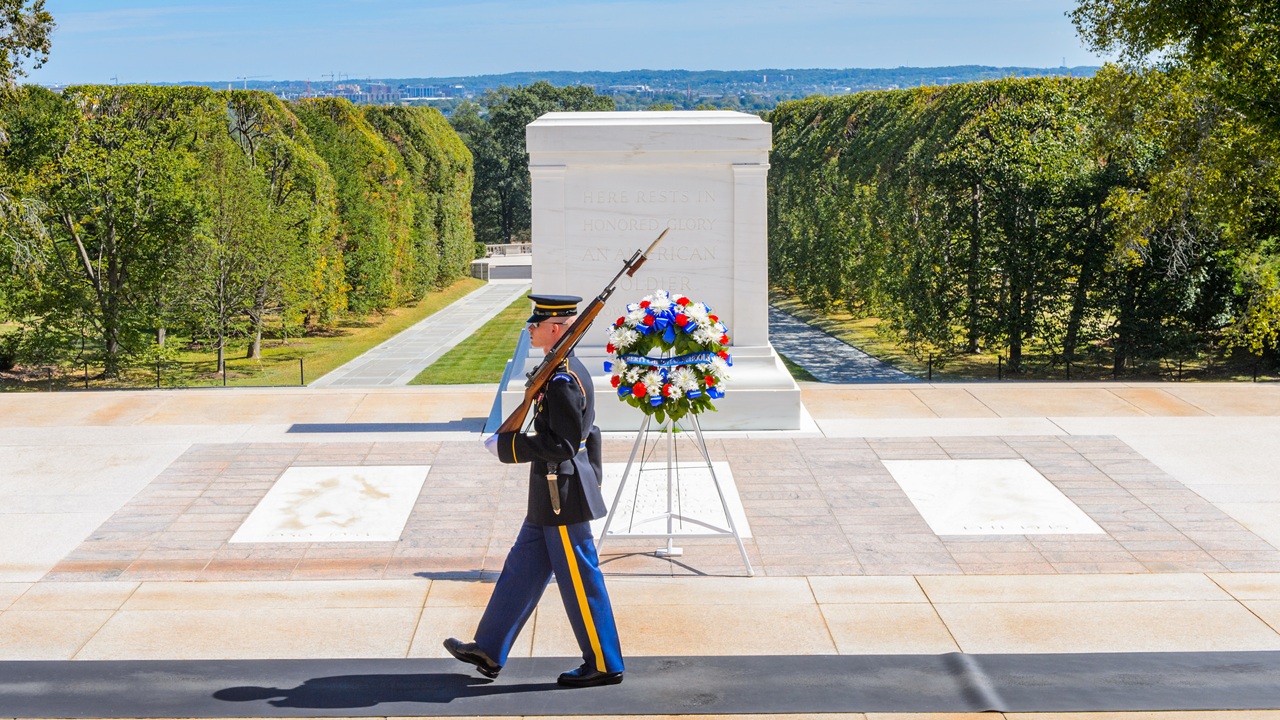
The sentinels at the Tomb of the Unknown Soldier keep a permanent watch on the tomb, although dangerous weather conditions have occasionally required them to relocate.
The United States military doesn’t have a changing of the guard ceremony like that of the British military at Buckingham Palace. The daily tradition began as pomp and circumstance, but the ceremony has become such a tourist attraction that it may have lost its meaning.
The US Army has something more solemn, one that even tourists who witness it can’t help but come away somewhat moved by the experience.
This, of course, is the display of the “Old Guard” sentinels who stand watch at the Tomb of the Unknown Soldier at Arlington National Cemetery. Through rain, snow, heat, and wind, the sentinels have stood guard for nearly 100 years. Tuesday, March 24 will mark a century of their unwavering service.
About the Tomb of the Unknown Soldier
The origins of the Tomb of the Unknown Soldier date back to the aftermath of World War I. On the second anniversary of Armistice Day in 1920, the United Kingdom and France each interred an unknown service member who had been killed.
The French laid their unknown soldier to rest under the Arc de Triomphe in Paris, while the British buried their unknown soldier at Westminster Abbey in London. Those unidentified remains were meant to represent all of the unknowns, allowing tombs to become shrines and places where citizens could mourn and pay their respects, and never forget the sacrifices made by the millions who died in the horrible conflict.
The United States, inspired by its wartime allies, created a similar tomb for the American Unknown Soldier. Multiple locations were considered, but Congress ultimately chose to locate the Tomb at Arlington National Cemetery, its national military cemetery since 1864.
In the fall of 1921, the US Army selected one of the unidentified servicemen killed in the war. That Unknown Soldier was returned to the United States on board the USS Olympia, the warship that had served as Admiral George Dewey’s flagship during the Spanish-American War in 1898. On its way back to the United States, the ship endured two storms crossing the Atlantic that almost capsized it.
Ceremonies to honor the Unknown Soldier began with the Olympia’s arrival at the Washington Navy Yard on November 9, 1921. A day later, the casket lay in state in the US Capitol Rotunda, and more than 90,000 mourners came to pay their respects.
On November 11, 1921, the funeral for the Unknown Soldier was held at Arlington. Telephone lines carried President Warren G. Harding’s eulogy to audiences in New York and San Francisco. During the ceremony, the president also presented the Medal of Honor to the Unknown Soldier, while dignitaries from France, Belgium, Great Britain, Italy, Romania, Czechoslovakia, and Poland attended. Each also presented their nation’s highest awards. Chief Plenty Coups of the Crow Nation represented Native Americans at the ceremony and placed his coup stick and war bonnet on the tomb.
In 1932, a tomb superstructure was placed atop the Unknown Soldier’s sarcophagus, giving the site its present appearance. Additional soldiers were later added to the gravesite from World War II, the Korean War, and the Vietnam War. In the 1990s, the identity of the Vietnam War unknown soldier was confirmed by DNA testing, and the body was disinterred; the grave was left empty and redesignated to commemorate missing servicemembers from the Vietnam era.
The Tomb Needed a Sentinel to Stand Guard
The site wasn’t initially guarded. Unfortunately, it wasn’t revered or respected, either. Tourists arrived quickly, showing little respect for the tomb or its significance. In 1925, Major General Fox Connor, the US Army’s deputy chief of staff, ordered that an armed military guard be posted at the Tomb of the Unknown Soldier.
“The first sentinel was posted the very next morning, with units from the 16th Brigade, 8th Infantry Division, 3rd Battalion, 12th Infantry Regiment, and the 2nd Squadron, 3rd Cavalry Regiment beginning what would become an unbroken vigil,” Military Times reported.
On April 6, 1948, the 3rd US Infantry Regiment, “The Old Guard,” from Fort Myer, Virginia, received the designation as the service’s official ceremonial unit.
Known for extreme precision, the sentinels execute a 21-step walk and 21-second pauses to honor the fallen, in reference to the military tradition of a 21-gun salute. Their uniforms are described as “immaculate, with medals and insignia polished and positioned precisely to meet strict standards.”
Candidates for the Old Guard are all volunteers and must pass intense physical and mental tests and have an unblemished record. Each is tasked with memorizing seven pages of Arlington National Cemetery history and must recite it verbatim to earn a “walk.” Would-be guards often train at the tomb at night, when the cemetery is closed to visitors. Even when alone, however, they maintain the same solemn reverence.
Only a very small percentage of applicants ever earn the coveted Tomb Guard Identification Badge. Today, the Sentinels “walking the mat” do not wear an army rank, so as to never outrank the Unknowns.
The Watch Has Been Broken—Sort Of—by Dangerous Weather
Sentinels stand watch 24 hours a day, 365 days a year, in nearly any weather.
The lives of the soldiers on guard are never put at risk, and the tomb guards are ready to be evacuated if the weather conditions place the soldiers at risk of injury or death.
“The Tomb Guards have contingencies that are ready to be executed if the weather conditions ever place the soldiers at risk of injury or death (i.e., lightning, high winds, etc),” reads the guards’ contingency plan for extreme weather conditions. “This ensures that sentinels can continue the mission while ensuring safety. It is the responsibility of the chain of command from the sergeant of the guard to the regimental commander to ensure mission accomplishment and soldier welfare at all times.”
During a hurricane, guards can be moved to a small enclosure, but will always remain within sight of the Tomb of the Unknown Soldier.
The sentinels braved record-breaking cold in February of this year, when the temperature in the cemetery dropped to around 15 degrees F (-9 C), with wind chill plunging it as low as -10 (-23 C).
About the Author: Peter Suciu
Peter Suciu has contributed to dozens of newspapers, magazines, and websites over a 30-year career in journalism. He regularly writes about military hardware, firearms history, cybersecurity, politics, and international affairs. Peter is also a contributing writer for Forbes and Clearance Jobs. He is based in Michigan. You can follow him on Twitter: @PeterSuciu. You can email the author: [email protected].