|
Forwarded this email? Sign up for free to have it sent directly to your inbox.
|
|
|
Good morning,
Today, we’re looking at the New York Times’s problematic D.C. crime coverage, a little-known group driving pro-Maduro protests, the case for a new response to mass shootings, good news about the economy, and left-wing complaints about the Supreme Court.
Don’t forget to write to us at editors@city-journal.org with questions or comments.
|
|
|
“The people whose deaths get downplayed or wiped away in his telling are typically people of color.”
That was the New York Times last month, referring to President Trump’s reaction to Washington, D.C.’s crime drop since the National Guard deployment. Trump had claimed that D.C. hadn’t seen a murder in six months, when in fact, there were about seven a month since the Guard arrived—though this represented a 31 percent drop from the same period in 2024.
Still, that was enough for the paper to run with the idea that the president’s crime policies are racist. It quoted residents upset that the deployment wasn’t focused on black neighborhoods (reminder: the Times wanted no Guard, period, back in August). It highlighted recent murder victims. And it noted Trump’s response to the killing of a “white” National Guard member in November.
“If Trump has failed to publicize the black homicide victims mentioned in the Times’s story,” Heather Mac Donald writes, “he was only following the paper’s lead. None of those killings got any coverage in the paper at the time.” In fact, she continues, the Times “has ignored even more egregious murders than the garden-variety gang violence that now so moves the paper to sorrow.”
Read her analysis.
|
|
|
Over the weekend, demonstrations broke out across New York City to protest the arrest and extraction of Venezuelan dictator Nicolas Maduro. Though the arrest occurred just hours before, many demonstrators had premade signs and polished talking points.
Stu Smith argues that their apparent organization should come as no surprise. For years, groups like The People’s Forum have effectively equipped left-wing organizations to stand up protests at a moment’s notice. Smith’s reporting reveals the inner workings of The People’s Forum and warns that the organization is “just one node in a massive militant network that opposes the American experiment.”
|
|
|
After a mass shooting, institutions follow a predictable script. Leaders emphasize people’s “anxiety and fear,” lament the resulting “trauma,” and offer emotional support and universal counseling. While this response may seem compassionate, Carolyn Gorman argues that a therapeutic approach to such tragedies often undermines resilience.
Gorman makes the case that focusing on emotions in the wake of a tragedy can often be counterproductive. In fact, she observes, studies have found that “unduly discussing or focusing on one’s mood, its causes, and its implications is associated with worse and longer symptoms,” while “a coping style reliant on distraction felt better” for many people.
Read why the common response to mass shootings often traps people in dependence—and masks the institutional failures that contributed to the tragedies.
|
|
|
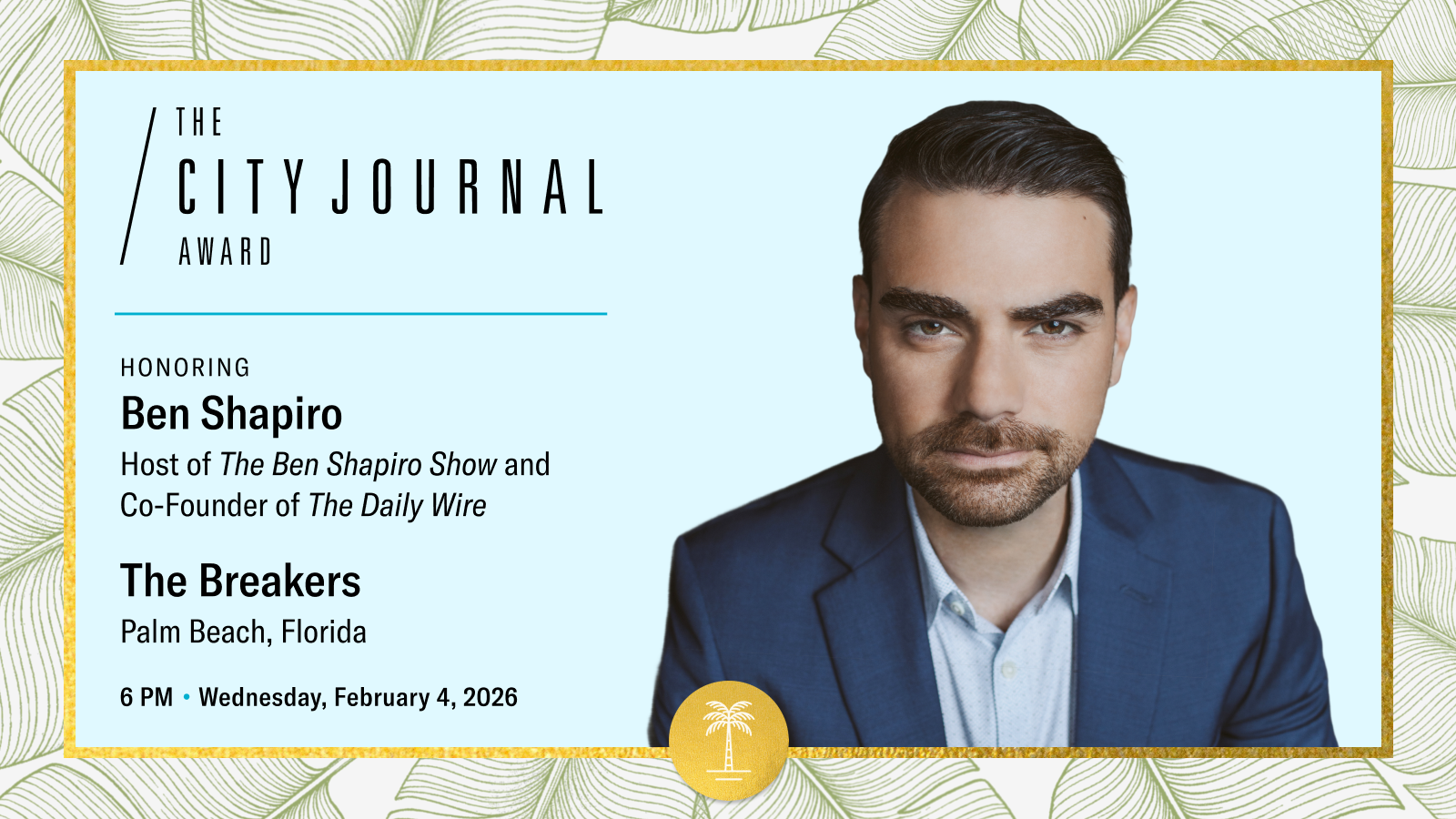
The Manhattan Institute is proud to serve as the Principal Institutional Partner for the Sun Valley Policy Forum’s 2026 Winter Summit in the iconic resort town of Sun Valley, Idaho on February 11, 2026.
We are thrilled to join Joe Lonsdale and MI senior fellow Christopher F. Rufo for an evening on principled leadership and the future of American institutions in an AI-driven era. Please click here to learn more about the Sun Valley Policy Forum and our partnership and to purchase tickets at a discounted rate for friends of the Manhattan Institute.
|
|
|
Ahead of this November’s midterm elections, all eyes are on the economy as the biggest potential swing factor. Though signs for President Trump and the GOP are mixed at present, Milton Ezrati notes two economic signals that could be encouraging for the administration: surging business formation and rising investments in technology and equipment.
“Both point to future hiring and income growth,” he writes. “If this news doesn’t banish all ambiguity, it does indicate something substantively positive about the economic outlook and points to surprising confidence within the business community, despite otherwise disruptive policies coming out of Washington.”
Read his assessment here.
|
|
|
The Supreme Court has lost all legitimacy, say law professors Ryan Doerfler and Samuel Moyn in a recent article. The Roberts Court, they argue, is enabling President Trump’s authoritarian tendencies and rolling back constitutional protections.
Nonsense, writes Jacob Eisler. “Doerfler and Moyn seem to be motivated by their perception of the Roberts Court’s politics. But disliking the outcomes of the Court’s decisions doesn’t justify their objections,” he maintains. “Ideally, judging is meant to be a neutral and principled exercise, not an expression of personal political ideology.”
In fact, the Roberts Court’s “primary posture toward the political branches has been permissiveness,” Eisler argues. Principled deference to democratic decision-making is hardly a threat to democracy.
|
|
|
“California is a failed state. The question for the future is whether or not the rest of us will bail it out when its lights go out.”
|
|
|
Photo credit: Andrew Leyden / Stringer / Getty Images News via Getty Images
|
|
|
A quarterly magazine of urban affairs, published by the Manhattan Institute, edited by Brian C. Anderson.
|
|
|
Copyright © 2025 Manhattan Institute, All rights reserved.
|
|
|
|