The United States Navy is not looking good these days. Literally.
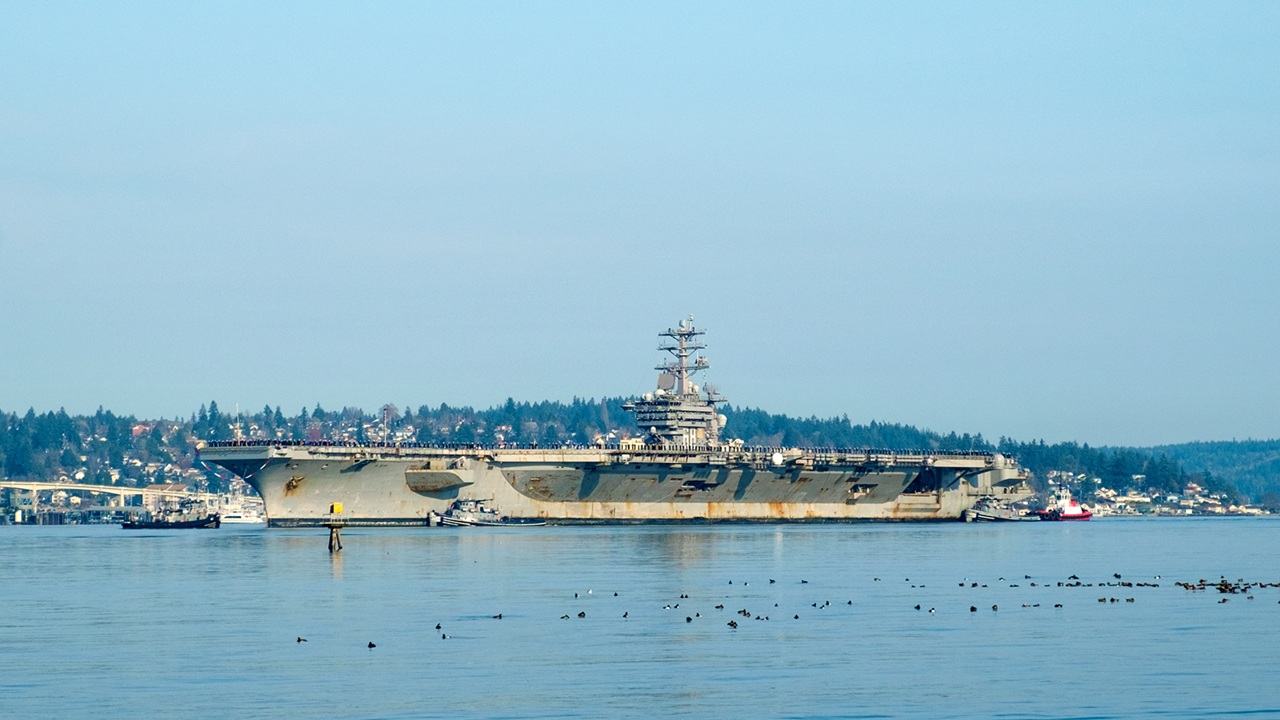
America’s warships may still be the deadliest in the world, but they are disproportionately rusty. The Navy insists that these are merely cosmetic in appearance. One can only hope. But it wasn’t that long ago that the USS Harry S. Truman crashed into a merchant vessel off the coast of Egypt. On its own, incidents like these are embarrassing—but they are made worse when combined with the outward appearance of a degraded fleet. The fact is that rust can often be a superficial manifestation of much deeper trouble.
President Donald Trump has taken a keen interest in naval affairs since returning to office. He has publicly ruminated about restoring the battleship to its former glory. Trump has referred to the need for building a “Golden Fleet.” Much like Teddy Roosevelt’s Great White Fleet, this “Golden Fleet” would be the most advanced and impressive US warships that would sail the world, showing the flag. Of course, there is not much chance of this happening—especially on top of the “Golden Dome” missile defense system and Trump’s various other military flights of fancy.
Trump Wants to Launch an Anti-Rust Campaign
But the rust is a real problem, not least because it is a symbol of decline. Just imagine what denizens in these port cities of the Global South must think when they see a rusted out American warship limping into port. It isn’t anything good that they’re thinking—particularly when compared to sleek, new Chinese warships sailing into their ports, handing out goodies.
Because Trump is so interested in naval affairs, though, his administration is doing something to address the rot in America’s warships. Writing over at Defence Blog, Colton Jones has detailed how on December 2, the Navy “has opened a new solicitation aimed at expanding corrosion-control work across the surface fleet, outlining assessments, training, and material support for combatant and amphibious ships.”
The Surface Ship Corrosion Mitigation Program “will identify specific ships and maintenance periods for each assessment event, using what the Navy describes as a ‘window of opportunity,” writes Jones.
Naval Surface Force, Atlantic, is to be the center of gravity for this new anti-rust campaign and it will be tailored for eight combatant ships and four amphibious ships.
An assessment per ship per month will be conducted on these warships every year to ensure that they are not rusting the way that these warships have been allowed to deteriorate. The Navy wants six months’ worth of corrosion-inhibiting product for each of the ships selected by the commander of the Naval Surface Force, Atlantic.
The Navy Has Better Anti-Rust Paint. Why Can’t It Use It?
As for the reason behind the rusting ships, it goes back to those systemic problems the Navy is enduring. For instance, the main culprit behind the rust is constant saltwater exposure. The truth, of course, is that saltwater exposure is going to happen no matter what the Navy does. High operational tempos, coupled with long deployments, has exposed these warships to the corrosive elements of the saltwater.
One would think that a little paint would do the trick. After all, just based on the images from the era, there were few—if any—visible signs of corrosion on the hulls of America’s warships during World War II.
Sadly, there are a variety of restrictions placed by the bureaucracy on effective paints. Tributyltin (TBT) compounds are very effective at biofouling—preventing marine life from growing on ship hulls, which increases drag and fuel costs. But environmental regulations now prevent the use of such paint by the Navy. Instead, when they are in port, US Navy warships are required to use environmentally friendly paints. In 2024, the US Congress passed a law requiring the Navy to remove existing copper-based coatings that help prevent corrosion of ship hulls by 2028 on the grounds that it is bad for the environment.
The list of banned chemicals and paints used to effectively prevent corrosion goes on. And because these paints are banned, US Navy warships are increasingly looking more like the Soviet Navy warships that were left to rot in port after the USSR collapsed in 1991 and less like American ships-of-the-line.
Then there’s the issue of maintenance time. US Navy warships are complex platforms that require much attention from maintenance crews. The problem is that these warships must utilize naval shipyards in the United States when they need repairs and maintenance. But there are grave personnel shortages at those shipyards, and limited space to dock the ships in need of service. To decrease congestion at America’s dwindling shipyards, the Navy tries to streamline maintenance procedures, invariably leading to less critical repairs—such as cosmetic anti-rust procedures—falling between the cracks.
So out with the stylish paint job, and in with the rusted-out warships of today.
Perception Is Power, Too
This is no way to run the world’s most powerful navy. The US Navy has real, systemic problems it is facing. Few have any firm grasp on the issues to be able to develop real solutions to these woes. Unless action is taken to address the fleetwide crisis of rust on America’s warships, however, the appearance of American decline will be unmistakable.
Perception is power, and the Navy must do whatever it takes to restore its image before it is too late. The Russians, Chinese, and their allies are trying to convince the world that they are on the ascent, and America’s best days are behind it. The United States must do all it can to break that narrative.
About the Author: Brandon J. Weichert
Brandon J. Weichert is a senior national security editor at The National Interest. Recently, Weichert became the host of The National Security Hour on America Outloud News and iHeartRadio, where he discusses national security policy every Wednesday at 8pm Eastern. Weichert hosts a companion book talk series on Rumble entitled “National Security Talk.” He is also a contributor at Popular Mechanics and has consulted regularly with various government institutions and private organizations on geopolitical issues. Weichert’s writings have appeared in multiple publications, including The Washington Times, National Review, The American Spectator, MSN, and the Asia Times. His books include Winning Space: How America Remains a Superpower, Biohacked: China’s Race to Control Life, and The Shadow War: Iran’s Quest for Supremacy. His newest book, A Disaster of Our Own Making: How the West Lost Ukraine is available for purchase wherever books are sold. He can be followed via Twitter @WeTheBrandon.
Image: Shutterstock / vewfinder.