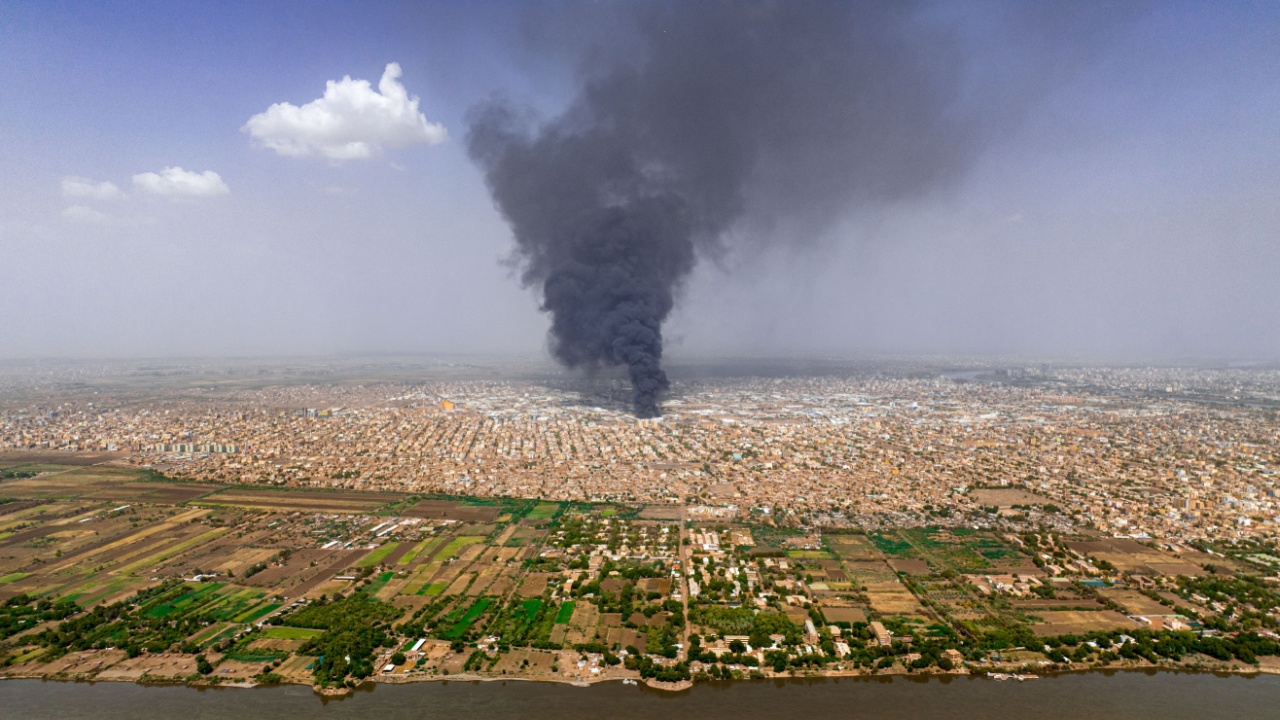
Sudan’s civil war won’t end, and civilian transition begin, until it faces its Muslim Brotherhood problem.
Western analysis of Sudan’s civil war continues to rely on a dangerous misconception. The notion that a confrontation between the Sudanese Armed Forces (SAF), led by General Abdel Fattah al-Burhan, and the Rapid Support Forces (RSF) continues to percolate in the West. This binary narrative may simplify headlines, but it obscures the real distribution of power inside the Sudanese state. The conflict is not merely a struggle between rival military formations; it is the latest operational phase in the Muslim Brotherhood’s nefarious attempt to control Sudanese institutions, whenever and wherever possible. Indeed, it has become, in many ways, a constituent element of the regime.
Politically, Brotherhood-aligned media and parties have framed the war as an existential struggle, rejecting ceasefires and negotiations while portraying civilian actors and international mediators as agents of foreign agendas. For al-Burhan, this arrangement provides loyal manpower, ideological cohesion, and internal security depth. For the Brotherhood, it offers protection, legitimacy, and a pathway back into the state. This is not a tactical alliance but a structural fusion.
This fusion follows a historical pattern with global consequences. When the Muslim Brotherhood previously exercised decisive influence over the Sudanese state in the 1990s, Sudan became one of the most permissive environments for transnational jihadist activity anywhere in the world. Under Brotherhood-dominated governance, Osama bin Laden was hosted in Sudan from 1991 to 1996, enjoying freedom of movement, access to capital, and protection that Sudan hosted Hamas personnel and affiliated businesses, while Brotherhood leaders acted as political sponsors and intermediaries.
Sudan also functioned as a logistical corridor for weapons destined for Gaza, including arms supplied by Iran and routed through Sudan and the Sinai Peninsula, a role that prompted repeated Israeli strikes on Sudanese territory. These relationships were not ideological anomalies; they were instruments of statecraft, revealing how the Brotherhood leveraged sovereignty to integrate militant movements, financial pipelines, and regional alliances into a single operational ecosystem.
The Brotherhood’s pragmatic relationship with Iran further exposes the strategic logic behind its resurgence. Despite Sunni-Shia differences, cooperation was driven by shared enemies and mutual benefit. Iran gained a geographic corridor extending its regional reach, while the Brotherhood gained access to weapons, resources, and geopolitical leverage.
That same logic now shapes the movement’s role under al-Burhan. Brotherhood leaders have reactivated regional networks, sought organizational and financial support abroad, and entrenched themselves within Sudan’s military and security institutions. This symbiosis explains why diplomatic initiatives repeatedly fail and why civilian rule remains perpetually deferred. Any genuine transition would require dismantling the Brotherhood’s reconstructed power inside the state—a step the current regime cannot survive politically or militarily. For US policymakers, this reality carries direct strategic consequences.
A government whose core is built around an organization with a documented history of hosting Al Qaeda, financing Hamas, cooperating with Iran, and systematically sabotaging democratic transitions cannot be treated as a conventional partner for stability. Compromise with this odious regime is not an option. It must be confronted, contained, and stymied.
Sudan’s war may appear to have two sides, but its central problem is unmistakable. With the Muslim Brotherhood embedded at the heart of al-Burhan’s regime, peace will remain a far-off prospect—not by miscalculation, but by design.
About the Author: Niger Innis
Niger Innis is the national chairman of the Congress of Racial Equality (CORE), the first Black-led organization recognized by the United Nations, and is currently serving on the UN’s Economic and Social Council. Niger is co-chairman of the Affordable Power Alliance, a coalition of minority ministerial organizations concerned about resource issues. He is the co-founder of the New America organization and has also worked with Senior Citizen Advocates, the EEN247 cable channel, the Membership Committee of the National Rifle Association, and various local chambers of commerce across America.
Image: Abd Almohimen Sayed / Shutterstock.com.