
A wave of pseudoscientific papers has tried to dismantle one of biology’s most fundamental truths: only two sexes exist, male and female. These papers often claim that sex is a broad “spectrum,” and that the notion of a male-female binary is “oppressive.”
A recent paper, published in the life sciences journal eLife, is the latest in this genre—and like all its predecessors, it fails to debunk the reality of the sex binary.
Finally, a reason to check your email.
Sign up for our free newsletter today.
Over the past decade, activists have published studies that claim to show that sex is a complex, multidimensional phenomenon that defies classification. Their goal is to create the illusion that most biologists no longer believe that “male” and “female” are two distinct biological categories.
But this supposed scientific revolution never happened. Biologists made no new discoveries that fundamentally changed our understanding of sex. Instead, activists and a handful of ideologically captured scientists talked into existence a supposed “consensus” against the male-female binary. Those objecting were labeled bigots or transphobes. I know because I was one of them.
For years, parents, lawmakers, and even fellow scientists have asked me for peer-reviewed papers that clearly explain why biological sex is binary. It was a reasonable request, but I struggled to provide what they were asking for.
While countless research papers are premised on the notion that an organism’s sex is defined by whether it produces sperm or eggs, I couldn’t find any solely devoted to articulating that assumption. Scientists apparently considered the sex binary self-evident, like the existence of gravity: a fact so obvious and basic that they never felt the need to spell it out.
That silence created an opening. Activists and ideologically captured scholars rushed to fill the void, flooding journals with papers advancing politically useful redefinitions of sex. With few rigorous alternatives to cite, even well-meaning policymakers felt compelled to reference activist frameworks as if they were authoritative.
Earlier this month, I published a commentary in the journal Archives of Sexual Behavior titled “Why There Are Exactly Two Sexes.” In it, I affirm that an organism’s sex is defined by whether its reproductive system has the function to produce sperm (male) or ova (female).
I also outlined five recurring tropes that activists use to deny this reality:
- Conflating “mating types” with sexes.
- Treating atypical sex chromosomal variations as new sexes.
- Using overlapping variation in any single trait between males and females to portray sex as a “spectrum.”
- Treating the two sexes as statistical clusters of multiple traits.
- Claiming that sex exists at multiple independent “levels” that can’t be unified across the body.
Every argument I’ve encountered against the sex binary fits into one or more of these categories. Activists tend to switch among them whenever convenient, even when the claims contradict each other. The goal isn’t to be scientifically accurate but to win a political fight.
Enter the new paper. Diethard Tautz, a prominent biologist and former director of the Department of Evolutionary Genetics at the Max Planck Institute for Evolutionary Biology, coauthored a report in eLife titled “Fast evolutionary turnover and overlapping variances of sex-biased gene expression patterns defy a simple binary sex classification of somatic tissues.” Since the paper’s publication in September, Tautz has promoted it in popular outlets as evidence that the sex binary is an “illusion.”
Tautz and his colleagues examined how genes are expressed in various organs in male and female mice and humans. They developed a “sex-biased gene expression index” (SBI) to quantify whether a gene’s expression in a tissue was more “male” or “female.” They found that while gonadal tissues (testes and ovaries) showed clear binary differences between males and females—as one might expect, given that they’re vastly different tissues—other tissues, like the liver, kidney, or heart, showed partial overlap between the sexes.
The authors presented this as a profound discovery. It isn’t. No one, to my knowledge, has ever claimed that the existence of two gamete types implies that every single trait in the body will come in discrete male and female forms.
In fact, evolutionary biology has long recognized that the fundamental reproductive asymmetry between the sexes—that males produce small, motile gametes, while females produce large, nutrient-rich ones—creates average, not absolute, differences between them. Overlap in gene expression between the sexes doesn’t challenge the binary nature of sex any more than overlapping height distributions does.
Ironically, Tautz and his coauthors’ argument assumes that sex is binary. “The different interests of males and females lead to sexual conflict,” they write, “characterized by opposing evolutionary constraints on the genes that mediate sex differences.”
This is correct, of course. And notice their use of the terms “male” and “female”—it suggests the authors are fully capable of distinguishing males and females as a distinct and separate entities, apart from their evolutionary “interests” and “genes that mediate sex differences.”
Their argument falls squarely within the third framework I outlined in my Archives of Sexual Behavior commentary: using overlapping variation in any single trait between the sexes to depict sex as a continuous “spectrum.” Tautz and colleagues take a familiar and uncontroversial fact—that many sex-linked traits vary in degree rather than kind—and present it as proof that the sexes themselves are fuzzy or fluid categories.
Their logic, boiled down, goes like this:
- People claim sex comes in two (binary) forms: male and female.
- Data show that patterns of gene expression in males and females overlap.
- Therefore, sex is not binary.
This is a textbook strawman. It redefines the sex binary—the distinction between sperm and ova that define males and females, respectively—as holding that males and females have no overlapping traits. Having constructed that convenient fiction, the authors then “disprove” it by pointing to overlapping variation in gene expression. This confuses downstream traits that differ by degree with the underlying reproductive function that defines the sexes themselves.
The paper’s own figures completely refute its framing. The authors include a series of charts plotting the “sex-bias indices”—a score summarizing the relative expression of all female-biased genes minus all male-biased genes—of various organs in mice and humans. Figure 7 from the paper contains a blue distribution (male) and a red distribution (female) showing each human organ’s apparent degree of “maleness” or “femaleness.”
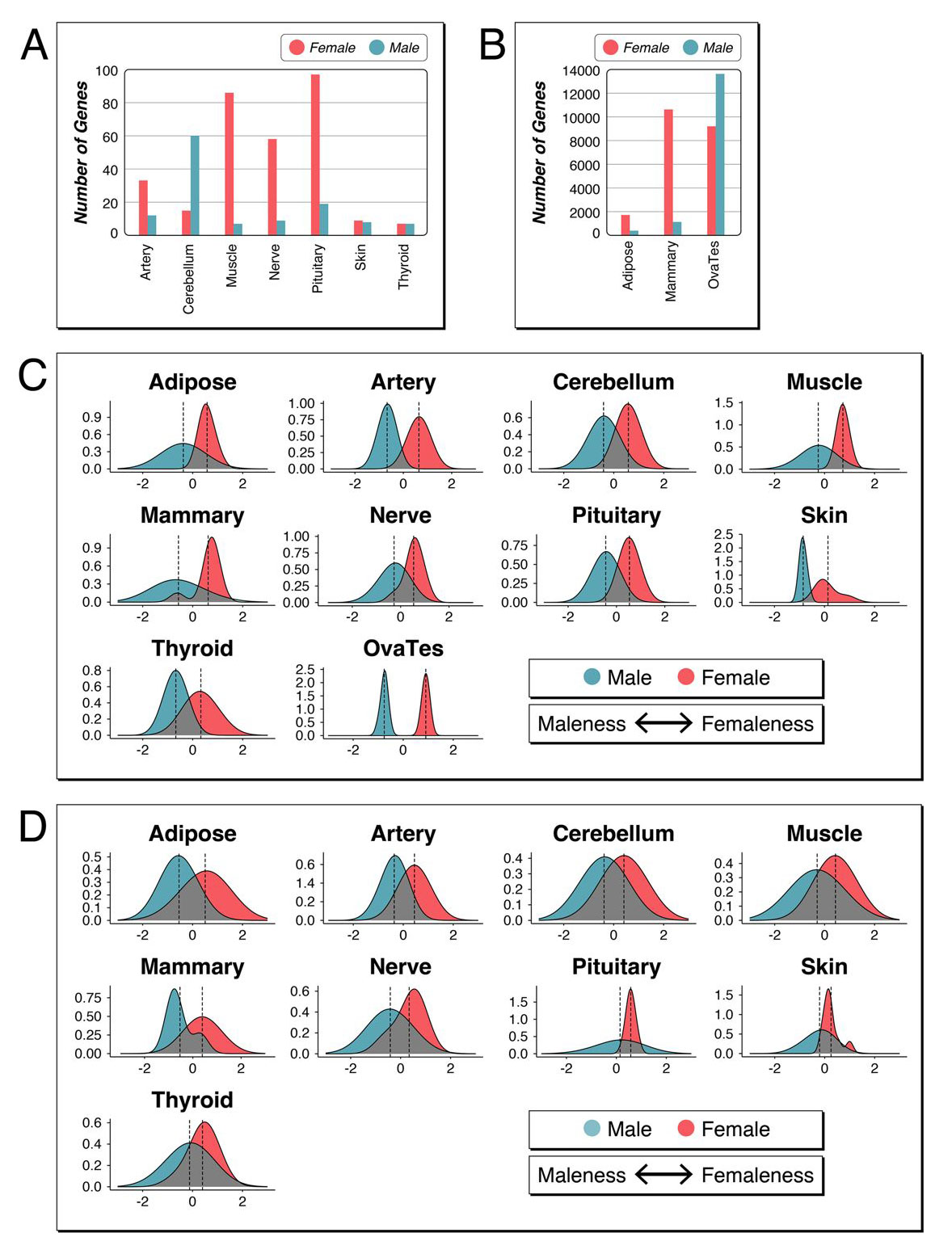
From this data, the paper’s authors conclude that “adult individuals are composed of a mosaic spectrum of sex characteristics in their somatic tissues that should not be cumulated into a simple binary classification.” In an interview with the German news outlet Kieler Nachrichten, Tautz maintains that his data demonstrate that “there are no clear categories, but overlapping characteristics” and that “Strictly separating male and female is therefore wrong.”
But on what basis were the individuals whose tissues were sampled assigned to the blue (male) and red (female) groups in the first place? And how would the authors know what patterns of gene expression represent greater “maleness” or “femaleness” unless they already knew which mice or humans were males and females according to the universal gamete-based definition? In other words, the very binary they claim to challenge is the same one they rely on to interpret their data.
As I wrote in my recent paper:
Traits are labeled “male-typical” or “female-typical” because they correlate with males and females already identified independently—ultimately by reference to gametes. In other words, the model presupposes the binary categories rooted in gametes it seeks to replace and then infers those categories back from their correlates.
That circular logic exposes the self-refuting nature of the argument. To claim that overlapping gene expression between males and females “defies” a binary model of sex is to rely on the very binary that makes such a comparison possible.
It’s hard not to see the political motive here. Tautz has said that his work “supports the idea that gender categories should fundamentally be abandoned,” and has spoken against sex-based legal protections. We live at a time where ideological conformity in science opens doors to grants, speaking invitations, and praise from peers.
Tautz and his colleagues’ paper is an otherwise solid study unnecessarily burdened by culture-war rhetoric. The data tell an uncontroversial story: sex differences in gene expression exist, they vary in degree, and they evolve quickly. The spin the authors try to give it tells another. But biology hasn’t changed: there are still two sexes.
Photo by Alishia Abodunde/Getty Images
Source link