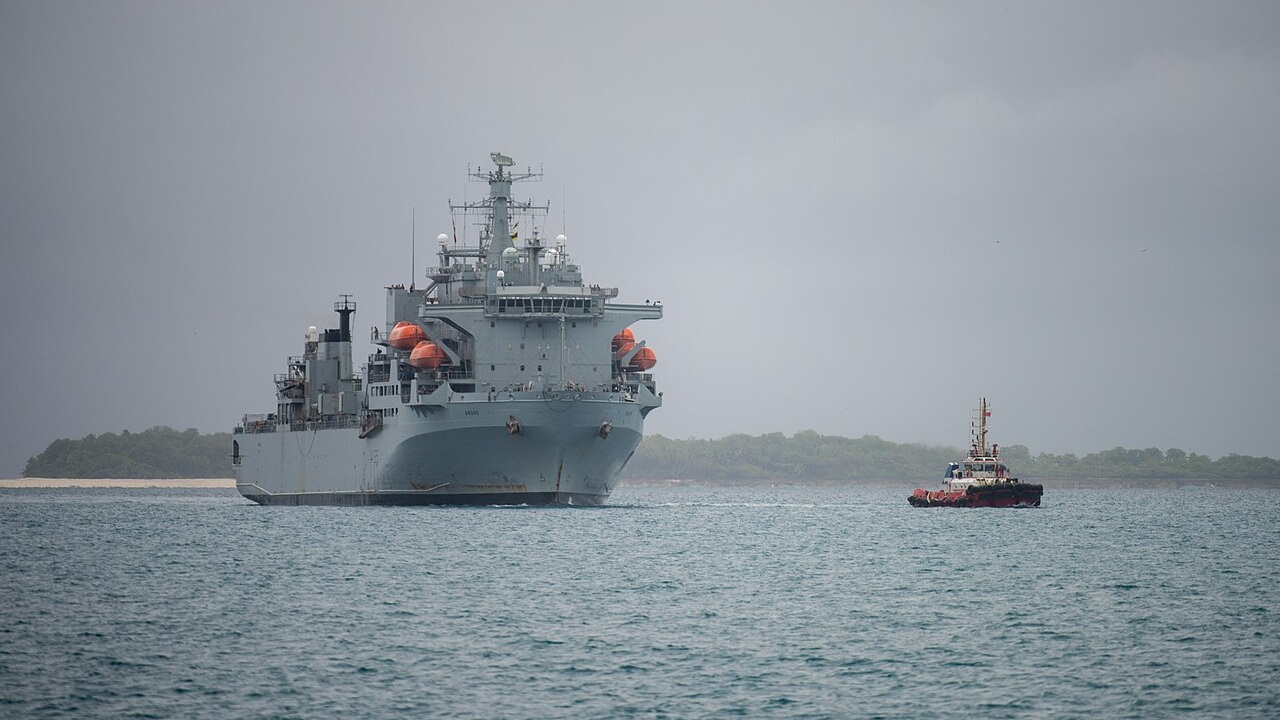
The RFA Argus, a British casualty receiving ship, is slated for retirement, then scrapping—but the Royal Navy has repeatedly dragged its heels on sending the ship to its grave.
This coming April will mark the 44th anniversary of the start of the Falklands War, widely regarded as the last major conventional naval conflict. The 74-day war between the United Kingdom and Argentina saw the UK’s Royal Navy deploy a massive task force to the South Atlantic, where it engaged in significant surface ship combat, aircraft carrier operations, and submarine warfare. It saw the first and only true major naval engagement carried out since the end of World War II.
Both the UK and Argentina lost warships during the conflict, notably the Royal Navy’s Type 42 guided-missile destroyer HMS Sheffield and the Argentine Navy’s light cruiser ARA General Belgrano. The latter vessel remains the largest warship sunk by an adversary since World War II, surpassing the size of any Russian vessels lost in the ongoing Ukraine War.
It is unclear how many veterans of that war are still serving in their respective militaries, but the number is likely very few, given the time that has passed since the conflict’s end. And although fighting ships serve longer than sailors, they, too, eventually retire; as of early 2026, no major Argentine vessels from the conflict are in service. This week, it was also reported that the Royal Navy will soon retire the last of its ships that took part in 1982’s Operation Corporate, the codename for the British plan to recapture the lost islands.
RFA Argus Given a Brief Reprieve
On Monday, the Royal Fleet Auxiliary (RFA) primary casualty receiving ship RFA Argus was scheduled to depart from His Majesty’s Naval Base (HMNB) Portsmouth for the final time, but her fate beyond that remains unclear. The ship has been a familiar sight at Falmouth Docks, where she has been laid up since early June of last year.
The condition of the receiving ship had deteriorated significantly, and the Maritime and Coastguard Agency and Lloyds Register withdrew the vessel’s safety certification.
The departure was canceled due to high winds and choppy seas, and it is now unclear when the 28,000-tonne RFA Argus will finally be towed to Falmouth for her scrapping.
What is noteworthy is that it was just over a year ago that RFA Argus completed a five-month overhaul at the Royal Navy’s A&P Falmouth, reportedly including upgrades and maintenance to several onboard systems.
The Royal Navy Can’t Decide What to Do About the Argus
RFA Argus was originally scheduled for decommissioning in 2024, with an RFA Bay-class dock landing ship to be converted to fill a role similar to Argus. However, the UK’s Ministry of Defence (MoD) changed course and, in a cost-saving move, opted to update and refurbish RFA Argus.
It was just the latest in an odd twist for the Italian-built vessel that began life as a container ship, before the Royal Navy requisitioned her for service in 1982’s Falklands War.
Two years later, the UK’s senior service purchased the former MV Contender Bezant outright and converted it into an aviation training ship.
RFA Argus later served as the Primary Casualty Receiving Ship during the 1991 Gulf War. That has been the vessel’s primary role since 2008. Yet, because she was previously armed with a Phalanx close-in weapons system (CIWS) and twin Oerlikon 20mm guns, along with other armament, she couldn’t be classified as a hospital ship.
Yet the vessel has been well-suited for a humanitarian aid role, and has undertaken several missions in that capacity. As RFA Argus is fitted with an aft flight deck, she could also serve in a support ship/helicopter carrier role in a pinch.
“She is also the last active ship to have served in the Falklands conflict. Her other services include delivering vital humanitarian aid, enabling aviation training, and providing lifesaving medical care to those in need. She will leave HMNB Portsmouth for the final time following four decades of loyal service to this country and our allies,” the Royal Navy announced earlier this month.
According to The Portsmouth News, in January, a white line was painted on her hull. It was “colloquially described as the ‘white mark of death.’”
A final decision has yet to be made, but numerous British outlets have reported that RFA Argus is likely to be scrapped rather than preserved as a museum ship.
RFA Argus is the first Royal Fleet Auxiliary vessel named for the hundred-eyed giant of Greek mythology. Nine ships of the Royal Navy were also named HMS Argus, including an ocean liner that was converted into the first aircraft carrier with a full-length flight deck.
About the Author: Peter Suciu
Peter Suciu has contributed over 3,200 published pieces to more than four dozen magazines and websites over a 30-year career in journalism. He regularly writes about military hardware, firearms history, cybersecurity, politics, and international affairs. Peter is also a contributing writer for Forbes and Clearance Jobs. He is based in Michigan. You can follow him on Twitter: @PeterSuciu. You can email the author: [email protected].