Two months ago, the National Transportation Safety Board released its verdict on why, last year, a military helicopter crashed into American Airlines Flight 5342 near Washington’s Ronald Reagan National Airport, killing all 67 people aboard the aircrafts. “Systemic failures,” the NTSB said—in “airspace design, safety oversight, and risk management.” But that’s exactly backward. It’s not the systems that are failing, but the people in charge. They have become so complacent and overconfident that well-built systems will work that they are abusing them beyond their limits.
The nation’s second fatal plane crash at a major airport in 13 months, Sunday night’s Air Canada Express Flight 8646 collision with a LaGuardia Airport fire truck killed both plane pilots, ejected a seated flight attendant, and injured dozens of others.
Finally, a reason to check your email.
Sign up for our free newsletter today.
It’s no coincidence that this crash happened against a backdrop of preexisting chaos at the nation’s major airports. On Friday morning, I arrived at JFK’s Terminal 5 at 5:45 a.m. for a 6:59 a.m. flight—normally plenty of time to spare, using the $25 priority security line. Instead, I stood in a line for more than two hours, missing my plane (but catching a later one). Transportation Security Administration workers haven’t received a paycheck since mid-February, due to the ongoing impasse between President Trump and Democrats in Congress on a funding package for the Department of Homeland Security, which oversees TSA. So workers are calling out sick at five times the normal rate, or quitting their jobs, leaving security posts unstaffed.
The weirdest thing about the airport mess last Friday was that nobody seemed in charge, and nobody seemed to care. The White House and Congress are responsible for keeping bombs and guns off planes, but even as the country is at war with a known terrorist state actor, neither party seems interested in whether an overstressed TSA will fail to intercept deadly contraband. The Port Authority of New York and New Jersey is responsible for safety and security at JFK, but it offered no visible presence to protect thousands of people in an unsecure area from the threat of a mass attack. JetBlue operates Terminal 5, but it didn’t deploy any staff to attempt to organize people in line by flight time. Even just a few uniformed people holding up signs at different points in line indicating wait times, or walking the line offering help with rescheduling flights, would have sent a message: we know that things have gone wrong, and we’re trying to fix it. The message instead from Washington, from New York, and from the airline alike was a fatalistic shrug.
Three days later, Trump ordered agents from another Department of Homeland Security body, Immigration and Customs Enforcement, to a dozen airports to keep watch over secure entries and exits so that more TSA agents can focus on passengers and their luggage. The ICE deployment points up the Democrats’ muddled strategy in refusing to fund TSA: they are withholding money because they’re angry at Trump’s aggressive approach to immigration enforcement, but ICE is already fully funded.
The TSA lines may appear trivial in comparison with the plane crash at LaGuardia two and a half days later. But it’s a classic illustration of Broken Windows policing principles: if nobody cares about a seemingly small thing—thousands of people waiting in confused tangles of lines with no direction and no security—chances are that nobody cares about a big thing. Indeed, both the lines and the crash stem from the same cause: complacency. The TSA has worked well enough since its creation nearly 25 years ago, two months after the 9/11 attacks. The thinking on the part of the political class is apparently that it will continue to work well enough, even if workers go unpaid. Nobody will bomb a tempting target of thousands of people stuck inside the landside of an airport terminal, because nobody has done it before—at least, not in the U.S. Attackers did do it in Belgium, ten years ago this month, killing 32 people.
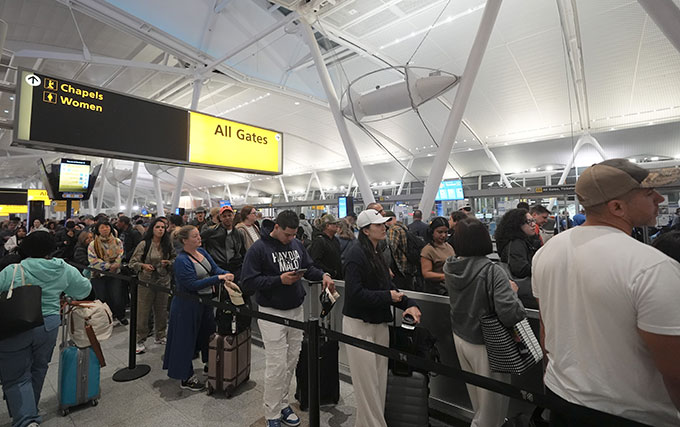
We show the same complacency when it comes to air-traffic control management and understaffing—not having heeded the lessons of last year’s crash, which happened partly due to poor air-traffic control communication. On Sunday night, just two controllers were working at LaGuardia, and, before the crash, they were already dealing with what one described as an “emergency”: a United Airlines jet needed a fire-department response after an aborted takeoff. According to air-traffic audio, one controller appears to have been directing ground and air traffic at the same time when he authorized a fire-truck driver to cross a live runway, just as the Air Canada jet was landing. Realizing this mistake too late, he told the fire-truck driver, “stop, stop, stop, truck one, stop, stop, stop. Stop, truck one, stop! Stop, truck one, stop.”
It was too late, and two people—the pilots—died. https://www.ctvnews.ca/world/article/i-messed-up-read-the-transcript-from-the-ny-plane-collision/One issue on which the NTSB will likely focus is lack of communication: the controller issued three “stop” commands before identifying to whom he was speaking; the last command he had issued was to the pilots of a different jet. The same confusion was a factor in last year’s Washington crash. As this controller said seconds after Sunday’s crash, “I messed up.”
He’s the only one who will admit it. Even a day after the deadly crash, Congress and the White House are showing no progress in resolving the TSA standoff, and across the country, hundreds of thousands of people continue to wait in vulnerably long lines to go up in the air.
After an unprecedented era of air safety between 2009 and 2024, with no major crashes, the government and passengers alike seem to think that they remain safe, with last year’s crash and Sunday’s just aberrations. But the crashes signal that we are abusing well-working systems beyond their capacities. What had protected us was a previous understanding by government, airports, and airlines—and the passengers who trust these systems—that safety is hard, daily work, and success is never assured.
Top Photo by Selcuk Acar/Anadolu via Getty Images
City Journal is a publication of the Manhattan Institute for Policy Research (MI), a leading free-market think tank. Are you interested in supporting the magazine? As a 501(c)(3) nonprofit, donations in support of MI and City Journal are fully tax-deductible as provided by law (EIN #13-2912529).
Source link