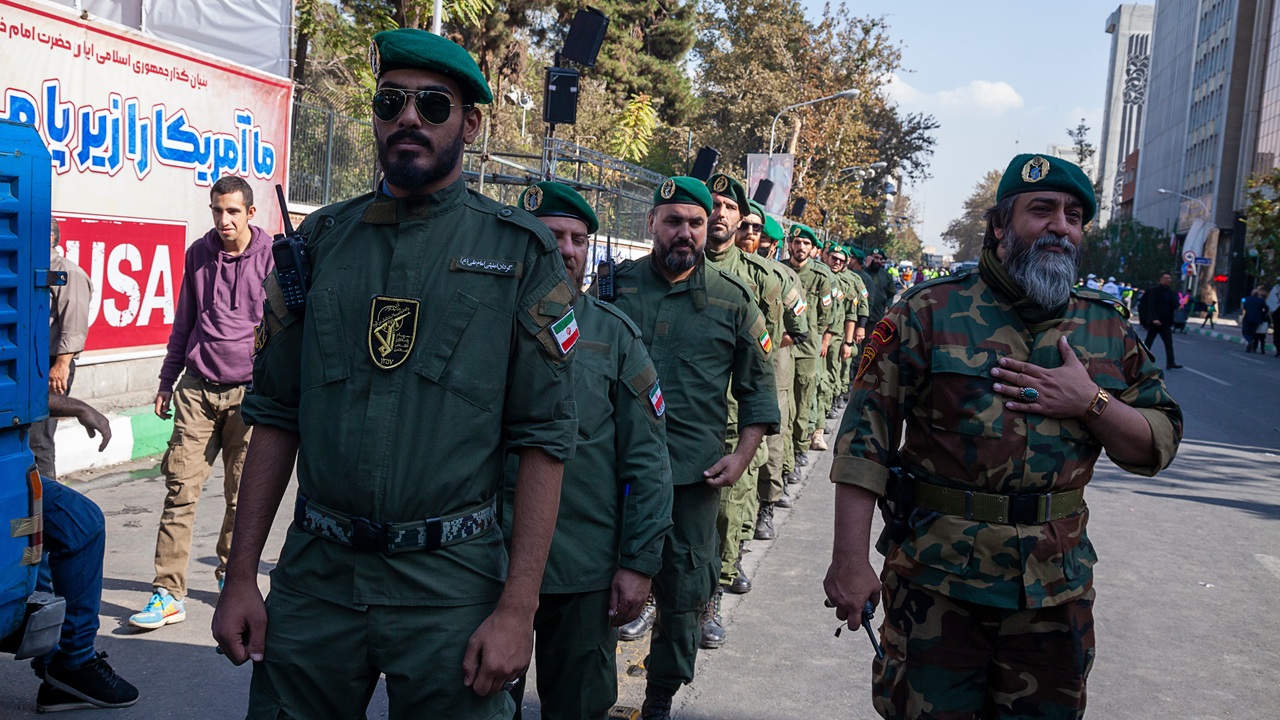
The IRGC has been dramatically weakened since the beginning of the Iran conflict last week—but it will be far harder to destroy.
In the opening hours of Operation Epic Fury, the United States successfully killed Ayatollah Ali Khamenei, Iran’s leader since 1989. In doing so, it opened a power vacuum inside Iran—one that other Iranians have rushed to fill. Hours after Khamenei’s death was made public, an interim Leadership Council was formed and assumed temporary leadership duties over the country. However, analysts have concluded that the real power within Iran likely now lies in the hands of the Islamic Revolutionary Guard Corps, or IRGC.
Even though the IRGC has been on the back foot since the war began—with many of its senior leaders targeted for assassination, some alongside Khamenei in the initial bombings on February 28—the organization is far from gone. Indeed, even in the temporary absence of centralized leadership, individual IRGC commanders quickly acted on their own initiative, retaliating against the US-Israeli attack with a missile and drone barrage. The distributed command model has worked to preserve operational continuity, reducing vulnerability to targeted leadership elimination—and suggesting that if the United States truly wishes to destroy the IRGC once and for all, it has its work cut out for it.
What Is the Islamic Revolutionary Guard Corps?
The Islamic Revolutionary Guard Corps (IRGC) was created by Ayatollah Ruhollah Khomeini in 1979 after the Iranian Revolution. It was formed in part to prevent a counter-coup by the dubiously loyal regular military (Artesh), which the clerical government had recently inherited from the Shah.
A parallel military force distinct from Iran’s regular army and navy, the IRGC’s mandate is to protect the clerical nature of the Iranian regime, not the nation itself. Indeed, the absence of the name “Iran” within the IRGC’s title was a conscious choice by its founders, who envisioned using the force to spread the 1979 Islamic Revolution beyond Iran’s borders.
The IRGC began its life as a paramilitary revolutionary guard. Over time, it has evolved into a hybrid military-political-economic power center. Today, it is the central actor in Iran’s domestic control and regional strategy—though the ongoing Operation Epic Fury has severely weakened the IRGC’s tactical abilities, raising questions about its long-term future.
What Can the IRGC Do?
The IRGC has absorbed Iran’s ballistic missile program, drone development, and foreign expeditionary operations. Organizationally, it now includes:
- Ground forces, in parallel to the Artesh;
- Aerospace forces (missiles, drones, and air defense elements);
- A navy, consisting mostly of fast-attack boats in the Persian Gulf;
- The notorious Quds Force, its external operations arm, named for the Arabic term for Jerusalem and responsible for aiding pro-Iranian Shi’a militias across the Middle East; and
- The Basij, an internal repression network responsible for crushing Iran’s periodic anti-government protests.
Despite its conventional elements, the IRGC remains distinct from Iran’s conventional armed forces.
The IRGC also controls major sectors of the Iranian economy, including construction, energy, and telecommunications. Since the late 2000s, amid growing international sanctions, it has developed sophisticated black-market and smuggling networks. The IRGC is deeply embedded within the state bureaucracy, with influence over the judiciary and intelligence communities, and has long been seen as the regime’s enforcement backbone.
How Hard Has the United States Hit the IRGC?
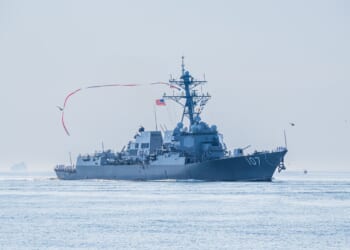
There is no doubt that the IRGC’s capabilities have been severely degraded since the Iran War began. The IRGC Navy has been described as combat-ineffective, with the Shahid Bagheri drone carrier, the IRIS Makran, and the Soleimani-class warships each sunk or put out of action. In all, over 20 major Iranian naval vessels have been struck since February 28. The IRGC Navy can still pose an asymmetric threat in the Gulf—chiefly through fast-attack boats that are easy to hide along Iran’s rocky coastline and difficult to target from the air—but that threat has been greatly diminished.
The IRGC missile and drone forces lost roughly 300 missile launchers in the opening waves of the attack, meaning that missile launch volume is down between 80 and 90 percent since February 28. Accordingly, the IRGC has shifted toward drone-heavy retaliation, using the Shahed-136 platform.
IRGC air defense and aerospace systems have been degraded, with over 200 air defense systems destroyed or damaged. Additionally, the C2 headquarters was destroyed and local air superiority was lost over Tehran. For the most part, Iran’s IADS air defense system has been dismantled, limiting the IRGC ability to contest the airspace over Iran.
Can the United States Defeat the IRGC?
It’s hard to say if the United States will be able to destroy the IRGC, given its amorphous structure and deep tendrils in Iranian society.
Fundamentally, the IRGC is more than just a parallel military. It is an ideological institution on its own, blending conventional forces with irregular warfare and gaining strategic depth through proxies. Certain organizational strengths will remain in spite of its present circumstances—including ideological cohesion, decentralized resilience, economic self-sufficiency, and the ability to repress domestic dissent. And while the IRGC has sustained heavy losses, expect the IRGC to consolidate power in the wake of the Supreme Leader’s death and the weakening of clerical power. The IRGC may well lead a transition to an overt military-dominant regime running a more nationalist security state.
Still, the IRGC’s long-term trajectory is not assured; it will depend on internal cohesion and the ability to regenerate tactical abilities quickly. Anything could happen in the weeks ahead.
About the Author: Harrison Kass
Harrison Kass is a senior defense and national security writer at The National Interest. Kass is an attorney and former political candidate who joined the US Air Force as a pilot trainee before being medically discharged. He focuses on military strategy, aerospace, and global security affairs. He holds a JD from the University of Oregon and a master’s in Global Journalism and International Relations from NYU.