The United States should make every effort to assure Iranians that it is not deliberately targeting their country’s national monuments.
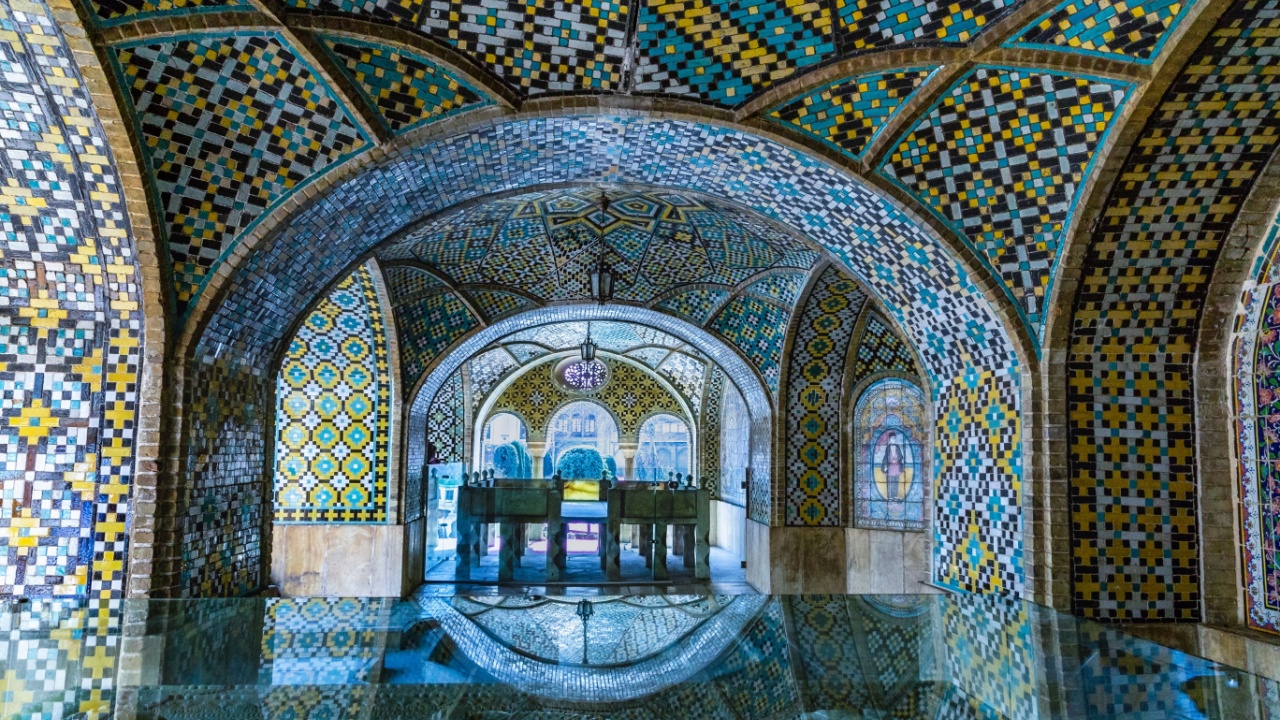
Tehran’s Golestan Palace has stood as a testament to Persian power and artistic brilliance for over four centuries, surviving dynasties, revolution, and decades of upheaval. Damaged by shockwaves from nearby airstrikes, it now stands as an early casualty of a widening Iran War.
As the war enters its second month, President Donald Trump and Defense Secretary Pete Hegseth promise to bomb Iran “back to the Stone Age” unless it capitulates. The conflict has already damaged Iran’s cultural landmarks, from Golestan Palace, Falak-ol-Aflak Castle, and Chechel Sotoun Palace, to other architectural treasures in Isfahan dating back to the 16th century. The devastation is as consequential as the indiscriminate bombing of homes and schools.
The scale of devastation has drawn condemnation from UNESCO and many experts, urging all parties to uphold international conventions on cultural property. Under international law, including the 1954 Hague Convention, such sites are explicitly protected during armed conflict. Yet the question remains: are these merely incidents of collateral damage or deliberate calculation?
According to Isfahan’s governor, Mehdi Jamalinejad, “This is a declaration of war on a civilization. An enemy that has no culture pays no heed to symbols of culture. A country that has no history has no respect for signs of history.”
There is no definitive evidence to suggest that the damage wrought on cultural landmarks by the US and Israeli campaign was intentional. Nonetheless, the Department of Defense’s new, watered-down rules of engagement, as well as historical precedent, make such a possibility difficult to dismiss outright.
From ancient empires to modern militaries, invaders have engaged in “culturecide,” the deliberate destruction of cultural landmarks. By erasing monuments, places of worship, palaces, and libraries, aggressors sought to sever the connection between people and their past, making it easier to impose a new order and rewrite the narrative of who belongs and who rules. As such, the destruction of cultural heritage forms part of the logic of conquest.
Invaders have long understood that culture is the backbone of collective identity and the anchor of historical memory. Monuments, language, and shared symbols sustain morale, and when they survive, they become rallying points for defiance. Erasing prior civilizations allows occupiers to rewrite the narrative of legitimacy, framing their dominance as inevitable. The destruction of heritage also sends a powerful message of humiliation and psychological control, signaling that not just the present, but the past and the future belong to the conqueror. Even when framed as religious or ideological, these acts help secure the political goal of asserting hegemony.
The burning of the Library of Alexandria, albeit much mythologized, and the actual destruction of the Sarajevo library during the Bosnian War, demonstrate how the erasure of knowledge is the destruction of intellectual sovereignty. Nullifying centuries of learning leaves societies vulnerable to domination. From ancient temples and royal archives to texts, monuments, and cultural centers, conquerors targeted the symbols and repositories of civilization to consolidate power.
In more recent history, the line between military necessity and cultural destruction has been tested on numerous occasions. During World War II, Allied forces bombed the historic Monte Cassino Abbey in Italy in 1944, believing German troops were using it as a strategic vantage point. The monastery, parts of which dated back to 529 AD, was reduced to rubble, only for the Allies to discover that German forces had not occupied the position prior to the strike.
In addition to the logic of “military necessity,” calculated ideological aims can fuel culturecide as well. The destruction of the Armenian cemetery in Julfa in 2005 in the Azerbaijani exclave of Nakhchivan is an example of how erasing heritage can mean erasing the historical presence of entire communities. Julfa’s mostly Armenian population was evicted in 1605 during a conflict between the Ottoman and Persian empires.
In Afghanistan, the Taliban blew up the twin statues of Buddha in the Bamiyan valley in 2001. Jamal Elias, an expert on heritage terrorism, argued that the Taliban deliberated over this decision and even considered the repercussions of international condemnation before deciding on the site’s destruction. The Taliban also sought to erase the culture of the Shia Muslim Hazara ethnic group, who, despite not practicing Buddhism, still held the statues in high esteem.
Other non-state actors inspired by similar religious interpretations have conducted heritage terrorism in Sub-Saharan Africa and the Middle East. In 2008, the Al Qaeda-affiliated al-Shabaab group in Somalia destroyed Sufi shrines in the city of Kismayo. In 2012, the Al Qaeda-affiliated Ansar Dine destroyed the Sidi Yahya mosque in Timbuktu, Mali, along with numerous other shrines in the city.
This iconoclasm, of course, does not necessarily follow from solely religious inspiration. In the cases of Bamiyan, Kismayo, and Timbuktu, insurgent groups that shared fundamentalist interpretations of Islam were also engaged in a long-term, secular goal of controlling territory, where the destruction of shrines had the secular objective of intimidating communities, compelling them to leave their territory, or instilling fear among those communities who chose to live within the new political order. Destruction of shrines in all of these cases ultimately served to enforce a group’s hegemony couched in an austere form of Islam.
Looking at Iran today, reports of damage to iconic sites, coupled with alarming accounts of looting, make it difficult to justify such destruction as a military necessity. The recurring logic of targeting cultural sites raises pertinent questions about intent. These buildings are repositories of Persian civilization, embodying centuries of historical continuity and even allowing such damage to occur strikes at the foundations of national identity, eroding the cultural memory that binds communities together.
Former US National Security Adviser Jake Sullivan has warned that the war risks becoming one aimed not simply at containment but at breaking Iran itself—“to cause chaos,” as he put it—on the premise that a fractured state poses less of a threat. In this case, it can be argued that the destruction of cultural heritage is not incidental but consistent with a pattern in which weakening a civilization requires the obliteration of its historical and cultural foundations.
At this stage, it is too early to tell whether such damage is the result of deliberate targeting or the byproduct of military operations, and such distinctions are rarely clarified in real time. What is clear, however, is the need for close monitoring and, ultimately, independent investigation.
Failing to prevent the erasure of cultural markers, or to demonstrate that the US military made every effort to protect them convincingly, will only fuel suspicions that this war is drifting toward a project of “civilizational replacement” with a new manufactured order in which Iran’s own rich civilization is diminished or forgotten.
About the Authors: Tanya Goudsouzian and Ibrahim al-Marashi
Tanya Goudsouzian is a Canadian journalist who has covered Afghanistan and the Middle East for over two decades. She has held senior editorial roles at major international media outlets, including as opinion editor at Al Jazeera English.
Ibrahim al-Marashi is an associate professor of Middle East history at California State University, on the board of the International Security and Conflict Resolution (ISCOR) program at San Diego State University, and a visiting faculty member at The American College of the Mediterranean and the Department of International Relations at Central European University. His publications include Iraq’s Armed Forces: An Analytical History (2008), The Modern History of Iraq (2017), and A Concise History of the Middle East (2024).