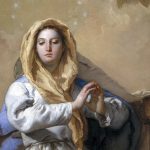
When Mary appeared to St. Bernadette Soubirous on March 25, 1858, she introduced herself as “The Immaculate Conception.” In fact, it was this title that helped to assuage any doubts about the veracity of Bernadette’s testimony, as she was a young, uneducated peasant girl who would have had no other way of knowing such a theologically profound title, one which had been defined as dogma just four years earlier by Pope Pius IX. By introducing herself with this title, Mary was confirming the pope’s declaration, thereby putting to rest any further doubts some might have held onto in what had previously been a highly debated belief.
But why did Mary choose as her title “Immaculate Conception” specifically? Were there not other highly debated beliefs? Other teachings of Mary that used unfamiliar language? Why not introduce herself to Bernadette as “The Assumption”? Or even as “Mother of God”? The fact that Mary chose “Immaculate Conception” as her title of introduction to Bernadette should tell us that it is this title which Mary wanted the world to ponder.
To complicate things further, that Mary appeared to Bernadette on March 25—the feast of the Annunciation, celebrated nine months prior to Our Lord’s birth—could naturally lead anyone to make the mistake of thinking that the words “immaculate conception” would have referred to the conception of Jesus, and not Mary. In fact, countless Catholics have made this very mistake. Would it not have made more sense if Mary had appeared to Bernadette on December 8th—nine months to the day before the celebration of her birth? Would this not have helped to clarify the pope’s newly declared dogma?
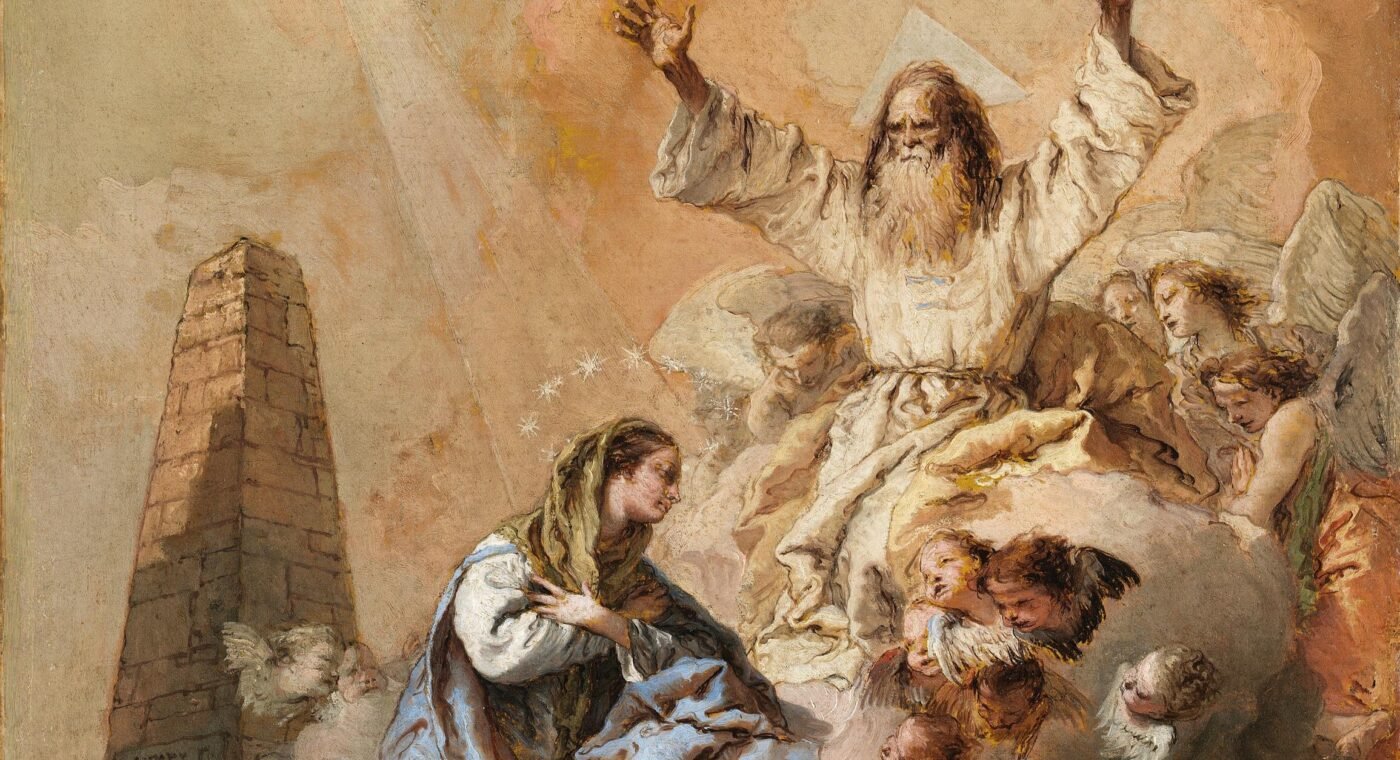
By choosing to appear to Bernadette specifically on the feast of the Annunciation of the Angel Gabriel, Our Lady would have been asking us to reflect not only on her birth or even only on her conception itself, but more importantly, on her words of consent to everything which the Lord had asked of her. Let’s try to understand why that is.
“Certain temporal consequences of [original] sin remain in the baptized, such as suffering, illness, death…as well as an inclination to sin that Tradition calls concupiscence.” (CCC 1264)
That Mary was born without original sin is one of the most significant teachings the Church offers us about her life. This teaching was not formulated based on an overly pious, pie-in-the-sky image of a cherub-faced young maiden whom we “imagine” did no wrong. Rather, the doctrine is based on sound evidence that has been analyzed, researched, and debated by theologians and Scripture scholars for centuries. And the evidence all begins with the words of God the Father through the message of the Angel Gabriel:
Hail, full of grace! The Lord is with you. (Lk. 1:28)
Mary was full of grace—not half-full, three quarters full, or even ninety-nine percent full. She was completely full—to overflowing. Most of us can perhaps think back to grace-filled moments in our lives, but these moments tend to stand out as a smattering of highlights among all the other far more common moments in which we did not correspond with grace. But not so for Mary. She would have corresponded with grace all the time. There would not have been a single moment in which Mary debated, hesitated, or failed to follow God’s will for her life. Can we even imagine this?
Because Mary was conceived without original sin, she was preserved from its “stain.” What does this mean? It means that Mary was free of concupiscence (the inclination to sin), death (thus explaining the Church’s teaching on Mary’s “Dormition”), illness (no colds or flu for Mary!), and suffering. But how could that be accurate? Mary’s suffering was unimaginable—worse that any suffering that any mother in the history of all mothers has ever endured—beginning with Simeon’s prophecy that her heart would be “pierced” by a “sword” (Lk. 2:35) and ending with the crucifixion of her Son. Could the Catechism be wrong?
The answer to that question should be obvious: the Catechism is not wrong. So if the Catechism tells us that the dogma of Mary’s Immaculate Conception means that she was preserved from the “stain” of original sin—which would include suffering—and yet Mary suffered like no other, how are we to understand this seeming contradiction? The only logical conclusion is that if Mary suffered with her Son, then it is because, like Jesus, Mary chose to do so—willingly and freely.
Mary said, “Behold, I am the handmaid of the Lord. May it be done to me according to your word.” (Lk. 1:38)
When Mary gave her consent to the Angel Gabriel, she didn’t only agree to carrying God’s baby in her womb. She consented to all that God asked of her, “according to [His] word.” And just as Jesus willingly suffered through the physical pain of crucifixion and the emotional pain of His agony in the Garden as a redemptive act of love, so too did Mary choose to suffer with Jesus in His Passion, in “com-passion,” for the sake of humanity, but also, as a mother who would not abandon her Son, for the sake of love.
A few years ago, my good friend’s adult son was diagnosed with a life-threatening illness. My friend dropped everything to be by her son’s side during those many weeks in the hospital. She helped feed him, dress him, watched football games with him to pass the time—and stood agonizingly helpless by his side in his moments of excruciating pain. What she didn’t do was leave him—not for a moment.
Anyone else would have taken a break—or left altogether, claiming it was “too much.” Anyone else would have just wanted their “old” lives back. That would be understandable! But not mom. A mother’s life is for her child the moment she holds her baby in her arms—and even when he is fully grown.
And in her maternity, such would have been Mary’s disposition with Jesus, even without the grace of having been immaculately conceived. Her motherhood is what would have given her the will to suffer with Jesus when she didn’t have to, but it was her Immaculate Conception that gave her the grace to suffer willingly for the sake of all the rest of us.
O Mary, conceived without sin, pray for us who have recourse to thee.
Editor’s Note: This article was adapted from an excerpt of 26 Steps With the Mother of God: A Treatise on the Life of Mary by M.C. Holbrook.
Image from Wikimedia Commons