
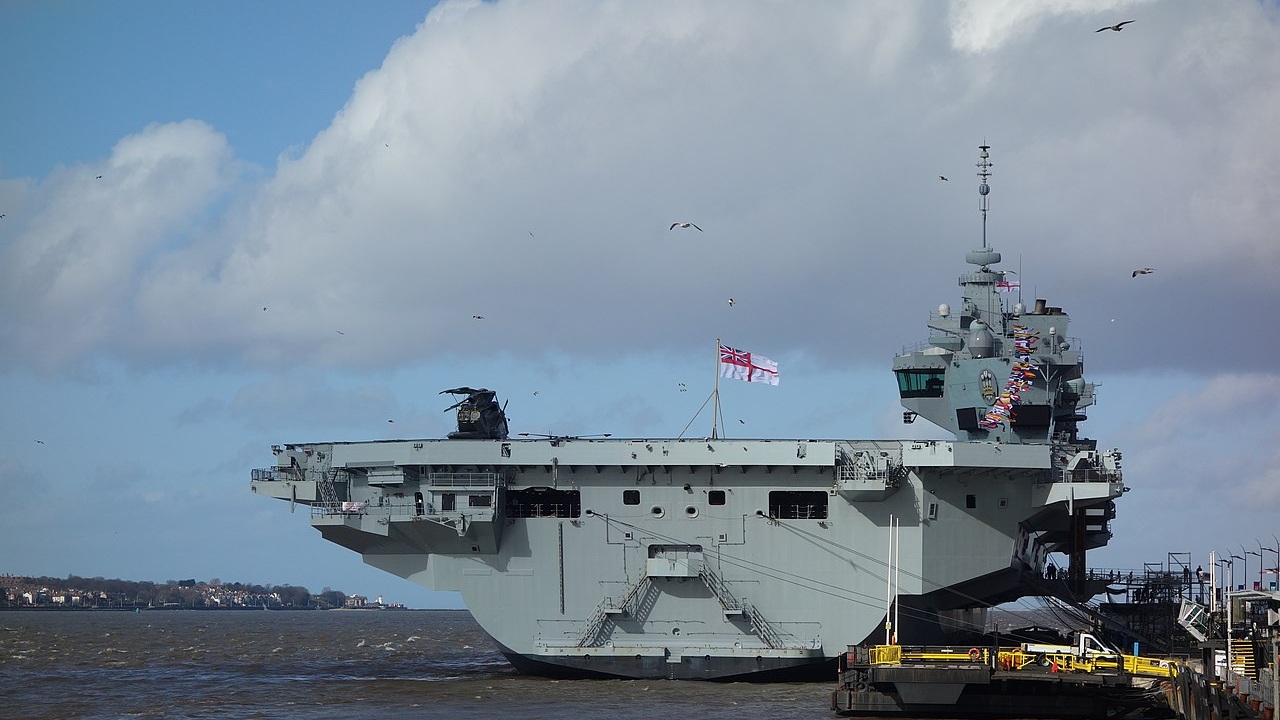
The British flagship returned to port at Portsmouth, England on Sunday—putting an end to “Operation Highmast,” its eight-month journey around the world.
Operation Highmast is now one of the history books, as the Royal Navy’s elements of the international Carrier Strike Group 25 (CSG25) returned home on Sunday, a day earlier than planned, following a nearly eight-month deployment to the Indo-Pacific. The Royal Navy’s flagship HMS Prince of Wales (R09) and Type-45 Daring-class air-defense destroyer HMS Dauntless (D33) each arrived at Portsmouth, England, joined by the Royal Norwegian Navy frigate HNoMS Roald Amundsen. The Royal Navy Type 23 frigate HMS Richmond (F239) also sailed into Plymouth, England.
At both port cities, massive crowds welcomed the warships home from the UK’s second major deployment to the Far East and back this century. The vessels each traveled more than 40,000 nautical miles since April, making port visits to Greece, Crete, Singapore, Australia, and Japan. CSG25 also took part in joint operations with NATO forces in the Mediterranean Sea, with the Indian Navy in the Indian Ocean, and with the US Navy, the Royal Australian Navy, and the Japan Maritime Self-Defense Force in the Pacific.
“It has been a privilege to lead the nearly 4,000 soldiers, sailors, aviators, and marines who have sailed over 40,000 nautical miles as part of the Strike Group, working with over 30 nations en route,” said Commodore James Blackmore, Commander UK Carrier Strike Group.
Commander Rich Kemp, Commanding Officer of HMS Richmond, also shared that sentiment.
“I hope my sailors walk off the ship with a bit of a swagger knowing they have made a difference for their country,” said Kemp.
The HMS Prince of Wales’ Specifications
- Year Commissioned: 2019
- Length: 280 meters (932 ft)
- Beam (Width): 73 meters (240 ft)
- Displacement: 65,000 tons
- Engines: Two Rolls-Royce MT30 gas turbine alternators, four Wärtsilä 38 marine diesel engines
- Top Speed: 32 knots (59 km/h; 37 mph); cruising speed 25 knots (46 km/h; 29 mph)
- Range: 10,000 nmi (11,500 mi, 19,000 km)
- Armaments: Three Phalanx CIWS (Close-In Weapon Systems), four 30mm DS30M Mk2 guns, six Browning .50 caliber heavy machine guns (formerly miniguns); also has air wing (up to 36 F-35B Lightning II jets, with a surge capacity for over 70 aircraft, including Merlin, Wildcat, Chinook, and Apache helicopters)
- Crew: 679 personnel, with a capacity to accommodate up to 1,600
R09 is the eighth vessel to be named for the title of the UK’s heir apparent, and the first since the King George V-class battleship that was launched in 1939 and sunk less than two years later during World War II. The commission date of the current HMS Prince of Wales coincided with the 78th anniversary of the sinking of her predecessor.
The Royal Navy Is Already Ready for Its Next Mission
Even as the crew of HMS Prince of Wales and the personnel from her escorts are almost certainly thinking about spending time with their loved ones during the holidays, Commodore Blackmore said the Royal Navy will be ready for future challenges.
The commodore noted that during Operation Highmast, a full two dozen British F-35B Lightning fighters were embarked on the carrier, the largest number of the stealth aircraft ever on one of the Royal Navy’s Queen Elizabeth-class flattops. The Lightning, the UK’s designation for the fifth-generation stealth fighters, has achieved Full Operating Capability (FOC) with the senior service.
“This carrier strike group doesn’t stop. We’ve now declared this capability,” Blackmore told BFBS Forces News. “We hold it at readiness permanently. It’s why we have two carriers. And you know the people, the equipment, the aircraft, at a time and place of choosing, are ready. Of course, there’s a programme next year. There’s another deployment scheduled for April. And yeah, we’ll be preparing and being ready for that, but always being ready.”
The conclusion of CSG25 should be seen as a triumph for the Royal Navy, particularly after both Queen Elizabeth-class conventionally powered carriers were sidelined for months at a time in recent years due to mechanical problems. That put into question their reliability and whether the warships would be ready to deploy in a time of crisis. Still, the Royal Navy did need to rely on foreign partners, with warships from Norway, Spain, and New Zealand supporting Operation Highmast—a reminder that Britain doesn’t quite rule the waves as it once did.
About the Author: Peter Suciu
Peter Suciu has contributed over 3,200 published pieces to more than four dozen magazines and websites over a 30-year career in journalism. He regularly writes about military hardware, firearms history, cybersecurity, politics, and international affairs. Peter is also a contributing writer for Forbes and Clearance Jobs. He is based in Michigan. You can follow him on Twitter: @PeterSuciu. You can email the author: [email protected].
Image: Wikimedia Commons.

















.jpg)