Editor’s note: This interview was posted originally on January 27, 2020.
Fr. Cajetan Cuddy, O.P., is a priest of the Dominican Province of St. Joseph. He has written for a number of Catholic and theological publications, and is currently working on a doctorate in sacred theology. He recently spoke with CWR about contemporary culture and its ills, about his own work, and about Thomism.
CWR: Could you please say a few words to introduce yourself to our readers?
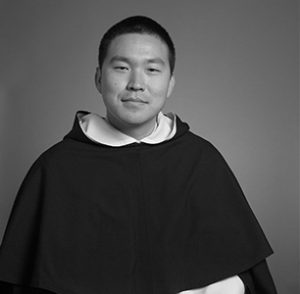
Father Cajetan Cuddy, O.P.: I am a Dominican priest of the Province of St. Joseph (Eastern Province, USA). Currently, I am finishing a doctorate in sacred theology at the University of Fribourg in Switzerland. My research and writing focus on the integration of philosophy, theology, and spirituality in the thought of Thomas Aquinas and the Thomist Tradition. These interests, however, are not wholly academic. A fundamental crisis of an intellectual sort, I believe, is prevalent in our society. We’re starving for wisdom. I am convinced that Thomas and the Thomists are the best guides for those who yearn for peaceful order in thought and in life.
CWR: Could you say more about the “fundamental crisis” that you observe in contemporary society?
Fr. Cajetan: I think that the divisions prevalent in societal conflicts are symptoms of individual paradoxes in human persons, which, themselves, manifest intellectual frustrations in human knowledge.
Commentators have pointed to a progressively acute disunity in modern society. There is great conflict about politics, economics, religion, race, and even gender. Social identities are often formed in terms of oppressor and victim: each party understanding itself as a victim of another group’s aggression.
Behind this societal discord is a prior division in individuals. Persons are not only divided from each other but also from their individual selves. Debates over gender and abortion, for example, reflect these inner self-tensions. The very prospects of changing our gender in an effort to realize personal authenticity or of terminating a pregnancy under the aspect of a pro-choice prerogative over our bodies reveal an underlying division in persons. Individuals are self-divided. We desperately seek to liberate ourselves from a hostility we find within ourselves. Personal identity is now thought of as a problem that can only be resolved by creating another, different self. This is the paradox of the modern individual person.
To the famous adage, “as a person thinks in his heart so is he,” we might add, “as persons think in their hearts so are they—socially.” Intellectual frustration is the green screen behind the divisions of society and the paradox of the individual. This is ironic because ours is a culture that esteems intelligence. The prominence of intellectuals like David Brooks, Jonathan Haidt, Alan Jacobs, Jordan B. Peterson, Steven Pinker, and Slavoj Žižek, for example, reflects the value that modern society ascribes to perceptive analysis. People want to understand the way things are and the way things ought to be. We are interested in questions that touch on topics of cornerstone importance: the dynamics of personal experience, human flourishing, cultural progress, and the meaning of life. It seems to me, however, that one would be hard-pressed to find any fundamental question not reducible, ultimately, to the Biblical questions posed by Zechariah (the father of John the Baptist), by the Serpent (in the Garden of Eden), or by the Blessed Virgin Mary. The interplay of these questions, when considered in light of intellectual history, helps us to see the contours of our contemporary crisis—and, perhaps, hints at the way out of it:
• Zechariah’s question: “How shall I know?” (Lk. 1:18)
• The Serpent’s question: “Did God really say?” (Gen. 3:1)
• Mary’s question: “How can this be?” (Lk. 1:34)
Zechariah’s question (How shall I know?) anticipates the preoccupations of modern thought (e.g., the “Age of Enlightenment”). Broadly speaking, modern philosophy is the attempt to find reality through or in the human mind. How can I be sure that I know what I know? Descartes, Spinoza, Hume, and Kant—to name only a few, emblematic figures—all grappled with the power and the limits of human knowledge. Sadly, none of these philosophical prodigies achieved their goal to liberate the human mind from the self-imposed confines of the human mind. The very instrument of their desired liberation became, itself, the shackle of human enslavement. Reality is not a product of human thought or imagination. To start with the human mind, even in an attempt to escape the human mind, runs the risk of becoming entrapped by the human mind. And a fabricated (even if elegant) world of ideas and concepts never successfully links up with real being and true reality. The Enlightenment experiment has proven to be a failure. Like Zechariah in the presence of the angel, modern philosophy has been “muted.”
And this brings us to the Serpent’s question (Did God really say?). Although “how shall I know?” predicaments may have dominated past discourse, another question is more prominent today: Is there any reality at all?—Is anything (or anyone) really real? The modern failure to escape the mind by means of the mind has resulted in a pervasive skepticism about the existence of objective reality. We no longer believe that there is anything real outside of the mind itself. Contemporary minds have largely despaired of arriving at the promised land of the really real. Subsequently, another project has arisen: absolute self-assertion. If no independent reality outside of the individual mind exists, the individual mind must formulate its own individual reality. Today’s world heralds radical authenticity and champions self-expression. Ours is an experiment of self-creation. Reminiscent of the exchange between the Serpent and the woman in the Garden of Eden, our skepticism with regard to the existence of objective, ordered reality (“did God really say?”) has resulted in the tyranny of disordered desire (“the forbidden tree was desirable”): an illusory scheme to create our very being according to our own conceptions (“you will be like gods, who know good and evil”).
We had initially hoped that diverse self-created realities could peacefully “co-exist.” But this promise of relativistic utopia has also not been fulfilled. A spirit of shame and fear dominates the modern psyche (“I was afraid, because I was naked, so I hid”). In an age where radical priority is given to unbridled desire, self-generated identity, and the equality of all “gods,” people actively shame others and are, themselves, radically ashamed (e.g., Twitter exchanges). It isn’t easy to live in an artificial construction—even one of our own making. We’re terrified by the very freedoms that we endorse and by the very identities that we aspire to create. Moreover, the self-asserted multitudes of individual mind-gods are compelled to wage war against each other, each demanding that the other recognize and pay tribute to their created realities. We’re angered by the “violence” of those who do not conform to our realities. Fear and anger are both the result, it seems to me, of frustrated minds attempting the impossible: to establish and to promulgate self-created realities. Only the really real can satisfy the real inclinations of real human persons.
The division between the mind and reality, and the project of self-creation, has sparked the disunity between us and all others. This mind-reality divide, in my judgment, is the fundamental intellectual crisis that has incited the confusion and conflict in society. There is no true unity because we are all radically alone—defined in opposition to reality, to others, and even to ourselves. (“The man replied, ‘The woman whom you put here with me—she gave me fruit from the tree, so I ate it.’”)
Contrary to that of the Serpent, Mary’s question (How can this be?) acknowledges that there is something to know. She asks a question about being. Her inquiry proceeds from no illusory, self-generated conceptions about her identity (or anything else). She is interested in the dynamics of real reality. And unlike Zechariah, Mary asks a question that gives these dynamics priority over the thought categories of her mind. She was not an Enlightenment woman. Her question reveals a mind that does not withdraw into itself. She reaches outside of herself—with tranquil confidence that her mind would encounter the really real, and be transformed by it (“May it be done to me according to your word”). Mary suffered no division of self. She was not trapped in her own intelligence. Hers was not a project of self-creation. She was a woman of reality (natural and supernatural). And because of this, she was able to be the mother of the Eternal Son of God: Wisdom Incarnate. Mary is the exemplar of those who think and live in conformity with the really real. She is the “Seat of Wisdom” (Sedes Sapientiae).
CWR: You recently wrote a book with Romanus Cessario, O.P.: Thomas and the Thomists: The Achievement of Thomas Aquinas and His Interpreters. What makes this book unique, and why did you decide to write it?
Fr. Cajetan: Over the past 25 years or so, there has been a renewed appreciation for Thomas Aquinas’s thought. Additionally, there is growing interest in the Thomists who followed Thomas—thinkers like Cardinal Cajetan, John of St. Thomas, Jacques and Raïssa Maritain, Charles de Koninck, and Reginald Garrigou-Lagrange (St. John Paul II’s doctoral professor). Father Romanus Cessario and I wrote Thomas and the Thomists (Fortress Press, 2017) to provide an accessible and short introduction to the unique genius of Thomas and the tradition he engendered. What makes our book unique is that it highlights the intellectual and evangelical continuity between Thomas and the Thomists. Their unity resides in a shared consecration to the truth of reality. Like Thomas, the Thomists believed 1. that reality exists, 2. that it is objectively knowable, and 3. that the dynamics of love unfold in the context of this knowable reality. Thought, life, and salvation are inseparable in their writings. Our book attempts to realign the study of Thomas and the Thomists around this shared thought-and-life project.
Because of their emphasis on reality, knowledge, and love, Thomas and the Thomists emphasize the dual importance of reason and faith. This is a key theme that runs throughout the book. The light of reason and the light of faith both illumine the nature of reality – and both of these lights lead, ultimately, to God (who is the principle of all reality). Reason and faith bring the human person into personal, virtuous contact with the way things actually are and with the One who—in wisdom and love—created all that actually is. Thus, while Thomism is certainly a way of thinking, it is also a way of life—a life lived according to reason and faith.
Finally, Thomas and the Thomists shows how the Thomas and his interpreters were thinkers of ecclesial service. In moments of cultural confusion or controversy, they devoted themselves to the exposition and defense of the sacred deposit of faith confided to the Church. I would summarize our book in this way: the legacy of Thomas and his interpreters is one of intellectual evangelization. Thomas and the Thomists proclaim with penetrating insight how God creates in wisdom and redeems in mercy.
CWR: How would you define “Thomism”?
Fr. Cajetan: I recently had the honor of answering a form of this question in a video interview (“Thomism and Intellectual Monasticism”) conducted by iAquinas. Several additional points, however, come to mind.
The person of Thomas Aquinas: Thomism is more than the repetition of Thomas’s words and phrases or the imitation of his literary style. Thomas did not posit himself as the goal of Christian thought. Although he gave intellectual shape to the tradition that bears his name, the object of his teaching resides outside of Thomas’s person. In his writings, Thomas largely ignored himself because he found reality to be far more interesting. Were he to speak to us today, he would undoubtedly discourage students from embarking on something like a “Quest for the Historical Thomas” if this were to distract them from taking up Thomas’s own project: the quest for truth. A Thomistic gaze is not so much oriented to Thomas himself as it is to what Thomas knew (and whom he loved). Therefore, Thomism is a way of thinking that searches with Thomas for the truth about reality (and, ultimately, the truth about God).
Wisdom: Consequently, Thomas Aquinas hands on (“traditions”) to his students something much more precious than a collection of erudite books. Thomas’s true gift—and the essence of Thomism—is a way of wise thinking governed by first principles. And it is here that we distinguish wisdom from the memorization of facts. Wisdom and native intelligence are not the same thing. Smart people can formulate stimulating ideas in their minds. Wise people allow their minds to be formed by the most fundamental truths. Wisdom enables us to recognize—and to promote—order. The contemporary world is dominated by an overwhelming amount of information. Not all information is created equal, however.
And, as a wise teacher, Thomas identifies the most important truths—the “first truths” (or “first principles”) that configure all knowledge in all contexts. Chief among the first truths is this: being and nothingness are really distinct. Thomas recognized that all other truths proceed from this foundational principle. His graced genius enabled him to see profound depths in—and to recognize the universal implications of – the nature of being. Therefore, Thomism approaches all of reality in light of the “first truths” that underlie everything that exists—everything from a blade of grass, to the squirrel, to the newborn baby, to marriage, to the Church, to God. “Thomism” receives its name from Thomas because he is the one who identified which principles are absolutely primordial. And “Thomists” see how these first truths permeate all aspects of thought and life.
“Intellectual Monasticism”: Interestingly, amidst the noise and chaos of contemporary life, there has been a renewed interest in monasticism and contemplation. (See, for example, Rod Dreher’s The Benedict Option and Cardinal Robert Sarah’s The Power of Silence.) Everyone pines for “peace of mind.” This is unsurprising. Tranquility and thought are essential parts of human experience. All of the most important elements of our lives involve rational reflection—the kind of career we pursue, whom we choose to marry, how we raise our children, what our political affiliations will be, etc. Thomas Aquinas offers an ordered way of thinking that shapes the intellect just as a monastic rule shapes the rhythms of human living. I like to describe Thomism as an intellectual monasticism. Monasticism orders all aspects of human life around God—time, work, recreation, and even the very architecture of the monastery are God-directed. Thomism orders all aspects of human thought around the highest truths. Each of Thomas’s “first truths” serve as the “building blocks” upon which the “intellectual monastery” is constructed in the soul of the Thomist.
To summarize: Thomism is a wise–and ordered–way of thought that reflects Thomas’s consecration to the truth. The truth alone enables one to find abiding peace, authentic freedom, and real happiness. And only the truth has grace.
CWR: You serve as General Editor of the Thomist Tradition Series of books published by Cluny Media. Could you say a few words about this book series and its purpose?
Fr. Cajetan: Thomist Tradition Series assists readers of today who wish to benefit from wise writers of the past. As I say in my introduction to the series: “The Thomist Tradition book series from Cluny Media arises from a dual conviction: 1. the thought of St. Thomas Aquinas contains an incomparable fullness of wisdom, and 2. the writings of the Thomists who followed him play a necessary role in mediating his wisdom to subsequent generations.”
Proceeding from this conviction, the series does two things. First, it makes available (in a new edition) classic texts of Thomistic philosophy and theology. Examples of these include the brilliant philosophical essay by Thomas C. O’Brien titled: Metaphysics and the Existence of God. We are particularly happy to have republished Joseph Clifford Fenton’s What Is Sacred Theology?, which addresses theology’s nature and practice.
Second, the series also includes titles that have never before been published in English translation. This past year, we released Édouard Hugon’s profound yet accessible book on the Blessed Mother: Mary, Full of Grace (translated by John G. Brungardt). The newest volume in the series is a marvelous collection of Garrigou-Lagrange’s essays (translated by Matthew K. Minerd) that covers an array of philosophical and theological topics: Philosophizing in Faith (Dec. 2019).
I would like to clarify, however, that the Thomist Tradition Series is not simply an assortment of reprints and translations. Each volume comes with a new (and often lengthy) introduction that contextualizes the importance of the work and its author. Explanatory footnotes have also been added throughout the body of the text. These additions are designed to help readers understand the book’s argument and to place the work in contact with later authors and discussions. I should also note that the series does not bespeak a nostalgia for the “good old days.” It’s simply that past thinkers often thought more clearly and more profoundly than we do today. We in the present can glean much from the wisdom of past Thomists.
CWR: What advice would you offer to aspiring Thomists and those who want to embark on the search for wisdom?
Fr. Cajetan: Ask for wisdom. Wisdom, ultimately, is a gift. It does not originate from ourselves. We must search for it—in others—with receptive humility. Although enticing, the prospect of “self-generation” is an illusion. We cannot create ourselves. This means, first, that we must pray and ask God for the gift of wisdom. Because God is the first cause and the final end of all reality, the order of wisdom has its paradigmatic origin in God himself. Second, we do well to search out wise teachers who exemplify wise thinking and model wise living. Admittedly, it is not always easy to find a living mentor. But God always provides for our wisdom-needs—when we ask.
Study wisely. Thankfully, some of the wisest people in history have written books that expose readers to wisdom in practice, regardless of whether or not we are able to encounter wisdom’s recipients in person. Wise study habits give priority to an intensive reading of select books and articles rather than to a cursory reading of many books and articles. “Skimming” is not a practice characteristic of wise persons. If a text is unworthy of concentration and focus, it will probably not do much to advance our reception of wisdom. Although technology has made it easy to publish many words and ideas, the Internet does not cultivate penetrating thought or truth-directed discourse. A profound appreciation of the most important things is superior to a vague familiarity with all things. A. G. Sertillanges’ The Intellectual Life and Mortimer J. Adler’s How to Read a Book are valuable starting places for those who wish to study wisely.
Live wisely. Wisdom and virtue are inextricably linked. Contrary to the tendencies of idealism and materialism, the human person is a real union of soul and body. Consequently, the chaos of disordered desire always frustrates even the intellectual pursuit of wise order. Because of the essential unity of the human person, those who deprive their lives of the truth will find it difficult to inform their minds with the truth. How we live influences how we think, and vice versa. (The biographical profiles sketched in Paul Johnson’s Intellectuals vividly illustrate this point). Anyone can find personal peace and happiness in the absence of physical health, material possessions, or fame. But no one can elude personal frustration and nonfulfillment if wisdom and friendship are absent. My favorite line from Thomas Aquinas is: “Christ is our wisest and greatest friend” (Summa Theologiae I-II, q. 108, a. 4, On the Contrary). No sin disqualifies us from meeting Incarnate Wisdom. We who are prone to foolishness and to betrayal have a place in the communion of divine friendship. How do we live in friendship with Christ? Through his seven sacraments. Because the sacraments unite us to Jesus, the sacraments are instruments of wisdom. Therefore, a wise life is a sacramental life.
If you value the news and views Catholic World Report provides, please consider donating to support our efforts. Your contribution will help us continue to make CWR available to all readers worldwide for free, without a subscription. Thank you for your generosity!
Click here for more information on donating to CWR. Click here to sign up for our newsletter.