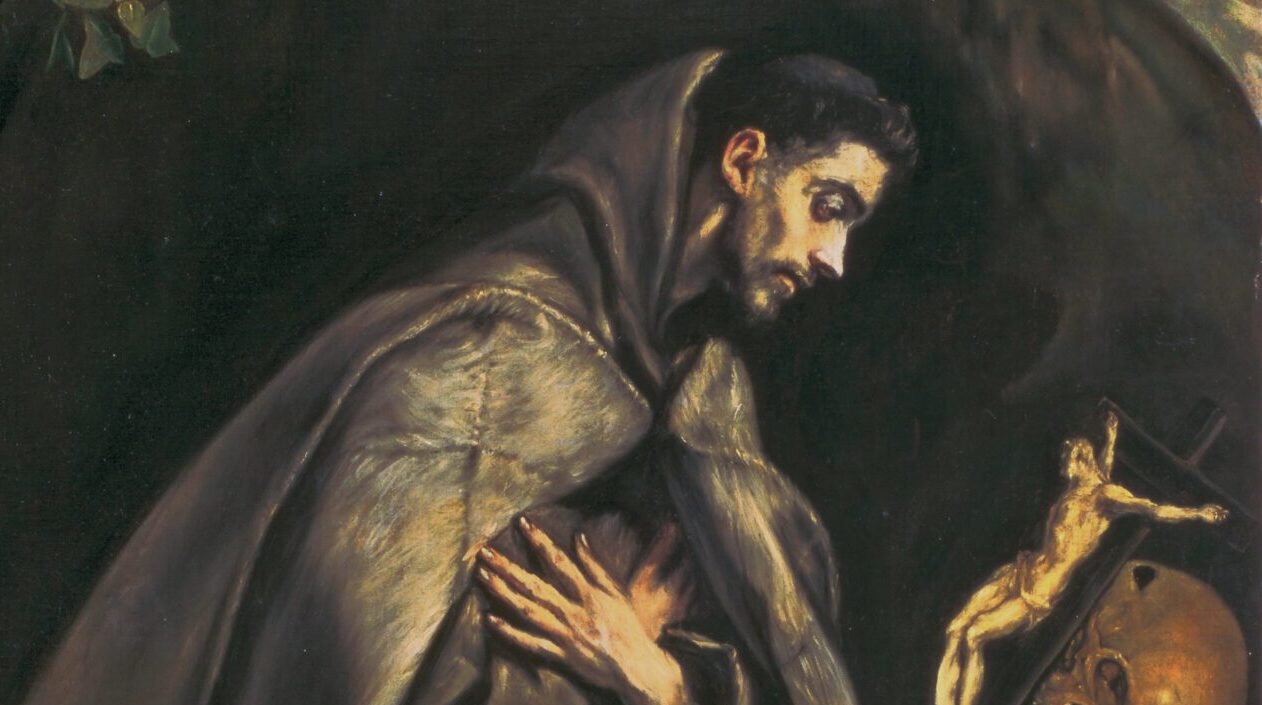
Among the Church’s multitudes of saints, perhaps none is as well-recognized as St. Francis of Assisi. The little man with the brown habit, scruffy beard, and forest creatures perched upon his shoulders is one of the most universal images in Catholic iconography, recognizable to Catholics and non-Catholics alike. The passage of eight centuries since the saint’s death have not diminished his popularity. He is as beloved today as he ever was.
Yet Francis has, in some respects, become a victim of his own renown—a saint better recognized than understood, easier to stereotype that to exegete. Perceptions of St. Francis tend to be based not on the actual life and writings of the saint so much as on a constellation of ideals considered “Franciscan”: poverty, care for creation, love of animals, humility, and so on. It can, consequently, be easy to miss the real St. Francis for the caricature.
In the spirit of rediscovering the real St. Francis, I’d like to highlight one aspect of Francis that is easy to miss—the deeply Eucharistic spirituality of the Poverello. We may not think of Francis as a Eucharistic saint, but the Eucharist features prominently in Francis’s extant writings, exemplifying the profound reverence he had for the Body and Blood of Christ. In this article, we will briefly survey some of Francis’s statements about the Eucharist in his writings.
The Admonitions
All the biographers of St. Francis relate that he was in the habit of giving “admonitions” to his brethren—teachings, reprimands, or directives as he saw fit to deliver. These represented the core of Francis’s ideals, which the saint thought so important he directed them to be written down for posterity.
The first entry in the Admonitions is titled “The Body of Christ” and concerns the importance of recognizing the Body of Christ in the Blessed Sacrament. After quoting some relevant Scripture passages, Francis says:
All those who saw the Lord Jesus according to his humanity and did not see and believe according to the Spirit and the Godhead that he is the true Son of God were condemned. And now, in the same way, all those who see the sacrament, which is sanctified by the words of the Lord upon the altar at the hands of the priest in the form of bread and wine, and who do not see and believe according to the Spirit and the Godhead that it is truly the most holy Body and Blood of our Lord Jesus Christ, are condemned…
Daily he comes to us in humble form; daily he comes down from the bosom of the Father upon the altar in the hands of the priest. And as he appeared to the holy apostles in the true flesh, so now he reveals himself to us in the sacred bread. And as they saw only his flesh by means of their bodily sight, yet believed him to be God as they contemplated him with the eyes of faith, so, as we see bread and wine with our bodily eyes, we too are to see and firmly believe them to be his most holy Body and Blood, living and true. (Admonitions, 1)
Later, in the twenty-sixth Admonition, Francis speaks of the obligation of the friars to reverence the clergy. Francis grounds the dignity of the clergy specifically in their ministry of the Blessed Sacrament:
Blessed is the servant who has faith in the clergy who live uprightly according to the norms of the Roman Church. And woe to those who look down upon them; for even though they may be sinners, nonetheless no one is to judge them since the Lord alone reserves judgement on them to himself. For inasmuch as their ministry is greater in that it concerns the most holy Body and Blood of our Lord Jesus Christ, which they receive and which they alone administer to others, so those who sin against them commit a greater sin than [if they sinned] against all other people of this world. (Admonitions, 26)
A Letter to the Clergy
Sometime in the early 1220s St. Francis wrote a circular letter to the clergy on the subject of the Eucharist. Pope Honorius III had published a decree called Sane cum olim in 1219, urging reverence for the Blessed Sacrament. Francis’s letter appears to have been written in support of the pope’s efforts. Though space does not permit us to reproduce the letter in its entirety, we can see the deep love Francis had for the Eucharist in his concern that abuses in the keeping of the Blessed Sacrament be rectified:
Let all who administer such holy mysteries—especially those who administer them carelessly—consider the sad state of the chalices, the corporals, and the altar linens upon which the Body and Blood of our Lord are sacrificed. And it is left by many in dirty places, carried about in a miserable manner, received unworthily, and administered to others without discretion…Well then, let us quickly and firmly amend our ways in these and other matters, and wherever the most holy Body of our Lord Jesus Christ has been unlawfully housed and neglected, let it be removed from that place and deposited and locked in a precious location. (A Letter to the Clergy, 1-5)
The First Letter to the Custodians
The “custodians” (custos or custodes) were those who held positions of authority within the Friars Minor. Francis’s First Letter to the Custodians was prompted by similar concerns as his Letter to the Clergy—concerns about respect for the Blessed Sacrament. Here we see some of Francis’s most lavish praise for all that pertains to the Eucharist, not merely the Body of our Lord, but also all of the ritual instruments that pertain to the sacrifice of the Mass:
I beg you, with all that is in me and more, that, when it is becoming and you will deem it convenient, you humbly beseech the clerics to venerate above all the most holy Body and Blood of our Lord Jesus Christ and His Holy Name and written words which sanctify the body. They ought to hold the chalices, corporals, ornaments of the altar, and all that pertain to the Sacrifice as precious. And if the most holy Body of the Lord is left very poorly in any place, let it be moved by them to a precious place, according to the command of the Church and let it be carried with great veneration and administered to others with discretion…And in every time you preach, admonish the people about penance and that no one can be saved except he that receives the most holy Body and Blood of the Lord. And when it is being sacrificed by the priest on the altar and is being carried to any place, let all the people give praise, honor, and glory to the Lord God living and true on their bended knees. (First Letter to the Custodians, 2-6)
A Letter to the Entire Order
St. Francis’s letter written to the entire order is considered the most liturgical of all his writings, urging his brethren to manifest devotion and respect for the celebration of the Eucharist and Divine Office. The occasion of this letter is believed to be Honorius III’s 1224 bull Quia populares tumultus, which granted the Friars Minor permission to celebrate the Eucharist in their churches and oratories.
I implore all of you brothers to show all possible reverence and honor to the most holy Body and Blood of our Lord Jesus Christ…I also beg all my brothers who are priests, or who will be or who wish to be priests of the Most High, that, whenever they wish to celebrate Mass, being pure, they offer the true sacrifice of the most holy Body and Blood of our Lord Jesus Christ purely. (A Letter to the Entire Order, 12-14)
A Letter to the Rulers of the Peoples
Just as Francis had dictated a letter to all the clergy, so he penned a circular letter to secular authorities, “to all mayors and consuls, magistrates and rulers throughout the world,” reminding them of their mortality and obligations to God and urging them to put aside petty strife and squabbling, using their authority to remind men of God. Francis viewed the Eucharist as a sign of concord among rulers:
Therefore, I firmly advise you my lords, to put aside all care and preoccupation and receive with joy the most holy Body and the most holy Blood of our Lord Jesus Christ in holy remembrance of him. (A Letter to the Rulers, 6).
In the Eucharist, rulers could put aside their worldly concerns and come together as brethren in the Lord Jesus Christ. For Francis, devoted reception of the Eucharist was not merely about sanctifying the soul, but of healing civil society as well.
A Eucharistic Saint
These are but a few examples of the Eucharistic piety of the Holy Man of Assisi. In the midst of his radical embrace of poverty, St. Francis of Assisi nurtured a spirituality profoundly centered on the Eucharist, viewing the humble appearances of bread and wine as the living presence of the eternal God who daily descends upon the altar.
His insistent calls for reverence—toward the sacrament itself, the priests who consecrate it, and the vessels that contain it—remind us that humility and liturgical excellence are not mutually exclusive; true humility finds its deepest expression in awe before the divine mystery made tangible in the Blessed Sacrament.
Far from the sentimental eco-mystic of popular imagination, the real St. Francis was a man on his knees before the Blessed Sacrament, teaching that authentic love of the poor, the leper, and the sparrow flows from adoration of the Poor One who hides Himself in the Host.
Image from Wikimedia Commons