Much about E. T. A. Hoffmann (1776–1822) can be discerned from his name. Born Ernst Theodor Wilhelm Hoffmann, he later replaced “Wilhelm” with “Amadeus” as both a tribute to Mozart and a declaration of his identity as an artist. In that act of self-baptism, Hoffmann signaled a lifelong allegiance to creativity, a belief that a life might be fashioned as a work of art. The tragedy and interest of his short existence, as Ritchie Robertson makes plain in his galloping new biography, lies in the discovery that the Romantic harmony between art and life is more easily imagined than sustained. More precisely, Hoffmann was a man of three vocations—a composer, a writer, and a jurist—who pursued each with varying bursts of passion, often at the cost of his financial security and personal stability.
Robertson paints Hoffmann’s childhood in Königsberg, Prussia, as one both melancholy and absurd: he grew up with a depressive mother, an absent father, and an eccentric attic lodger who believed she would one day bear the savior of the world (her actual son, Zacharias Werner, did become a Romantic playwright of some fame). As a young adult, Hoffmann drank deeply from the well of Rousseau—he claimed to have read Confessions at least thirty times by 1804—and fed his imagination with the gothic novels then in vogue, notably Matthew Lewis’s The Monk. From this reading he picked up the late-eighteenth-century sensibility for the supernatural, the morbid, and the sublime.
Music was in the air young Hoffmann breathed. His father played the viola da gamba, his uncle the piano, and his aunt the lute, while he himself excelled on the piano, violin, and harp. He studied under the organist of Königsberg Cathedral, attended performances of Don Giovanni, and pored over piano transcriptions of Mozart with quasi-religious devotion. Prudence, however, demanded that he pursue law. He studied at the University of Königsberg but a scandalous affair with a married piano pupil ten years his senior, Dorothea Hatt, forced his family to send him to Silesia in 1796.
Hoffmann transferred to Warsaw in 1804, married Marianna Thekla Michalina (nicknamed Mischa), and endured the brutal loss of a young daughter. By day he served in the Prussian bureaucracy; by night he composed and wrote with unremitting zeal. His Warsaw years drew him into the orbit of German Romanticism’s intellectual elite. It was there that he met the writer and fellow civil servant Julius Eduard Hitzig, a friend to the Mendelssohns and Friedrich Schleiermacher, and developed a taste for the poetry of Novalis. Hoffmann also served as vice president of the Ressource Musical Society in Warsaw, conducting his own Symphony in E-flat major at its inaugural concert.
Robertson devotes considerable space to Hoffmann’s musical career, and understandably so, since he saw music as his ultimate calling. His output was indeed impressive—including a symphony, a Miserere, eight operas and singspiels, some two dozen pieces of stage music, three dozen songs and choruses, and fifteen works for piano or chamber ensemble—but much of it does not survive and that which does suggests more ambition than mastery. With his opera Undine (1816), he finally achieved some critical success. Admired by Weber and Wagner, it anticipates the leitmotif technique that came later to define Wagner’s art. But Hoffmann’s more enduring musical legacy lies in his criticism. His rhapsodic essays on Beethoven stand as monuments of Romantic aesthetic theory, and to read them today is to glimpse the dawn of the notion of “absolute music.”
Hoffmann’s exalted aesthetic visions couldn’t keep the bailiff from the door. His compositions brought him little income, and his fiction, though ultimately more lucrative, could not support him alone. Again and again he returned to the law, finding in its rigidity the solid ground that his imagination nonetheless sought to escape. “I cannot simply give up the arts,” he confessed to a friend in 1815, “and if I did not have to provide for a beloved wife I would sooner go back to being a musical schoolmaster than be confined in the legal treadmill.” For two decades, he swung between the creative urge and the legal bureaucracy that ensured he could scrape together a livelihood for Mischa. During this period, he moved frequently. When Napoleon invaded Warsaw in 1806, Hoffmann, along with the rest of the Prussian bureaucracy, lost his post. In the ensuing years he drifted between cities—Berlin, Bamberg, Leipzig, Dresden—and cycled through precarious musical and legal positions.
Robertson sketches a vivid picture of Hoffmann’s literary achievements, beginning with his first published collection, Fantasy Pieces in Callot’s Manner (1814–15), and his Lewis-inspired gothic novel The Devil’s Elixirs (1815), which reportedly terrified readers—Heinrich Heine even claimed a Göttingen student went mad after reading it. He guides us through later collections like The Serapion Brethren (1819–21) and finally to the unfinished masterpiece The Life and Opinions of the Tomcat Murr (1819–21), a savage parody of the German bildungsroman delivered in the self-reflexive comic mode of Laurence Sterne. Robertson situates Hoffmann’s literary imagination—his obsession with mirrors, doubles, and automata in particular—against the backdrop of the Kantian revolution, which had split the world into the phenomenal and noumenal and galvanized a generation of Romantics.
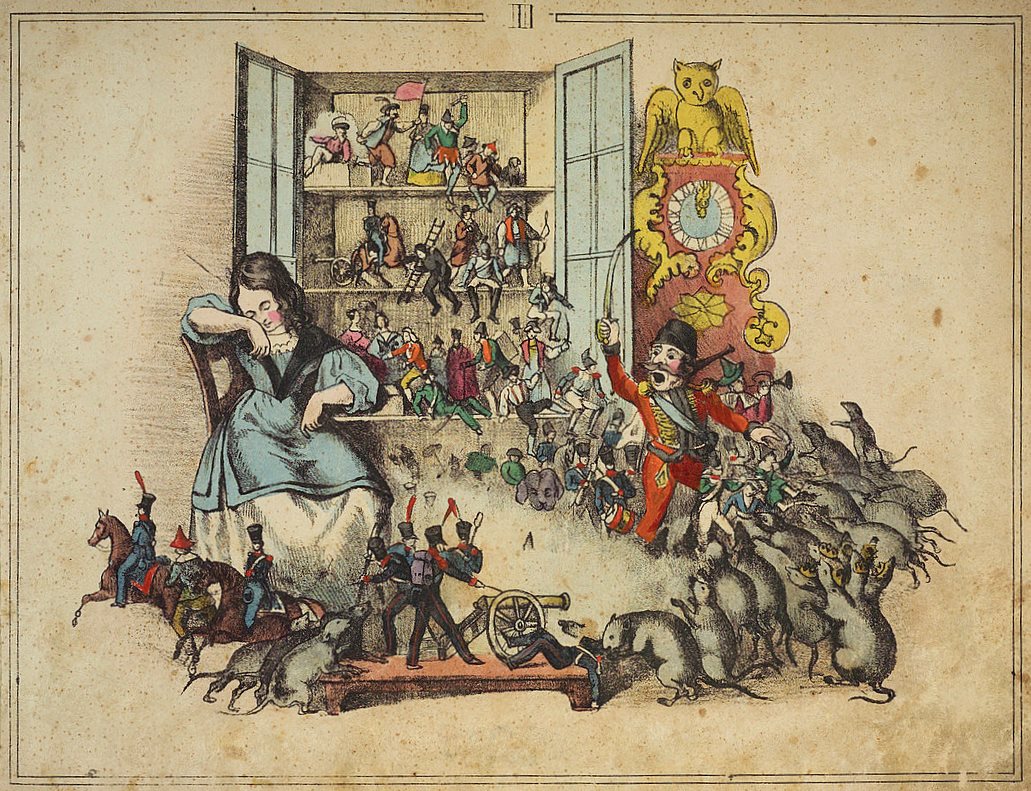
Posterity’s verdict on Hoffmann was initially mixed. Goethe dismissed his tales as unserious, and Sir Walter Scott, in his 1827 essay on the supernatural, derided them as the “feverish dreams of a light-headed patient.” Yet time has recognized Hoffmann as one of the progenitors of modern psychological fiction. His influence on Dostoevsky, Gogol, Baudelaire, and Poe is unmistakable, while his short story “The Sandman” entered the mainstream of modern thought through Freud’s 1919 essay on the uncanny. Two of Hoffmann’s stories achieved second lives in ballet, though scrubbed of some of their original menace: Delibes’ Coppélia (1870) transforms “The Sandman” into a comic ballet, and Tchaikovsky’s The Nutcracker (1892) reimagines “The Nutcracker and the Mouse-King” as a festive dream-vision.
Robertson’s E.T.A. Hoffmann restores coherence to a life that has often been treated as a series of disparate fragments. Hoffmann appears not as the caricature of a drunken reveler, as in Jacques Offenbach’s opera Les contes d’Hoffmann (1881), nor as a minor jurist and thwarted composer who happened to write some uncanny tales. He emerges instead as the prototype of the modern Romantic artist: buoyed by creative freedom but hobbled by precariousness, answerable to no patron yet dependent on every buyer, wagering that his works would redeem a life of ceaseless striving.