The Clean Air Act’s outdated framework is hindering progress. New bills aim to modernize it with reforms aligned to today’s economic, environmental, and scientific realities.
The Clean Air Act (CAA) is now 55 years old—and shows its age. That’s not a critique of its legacy. The law, in conjunction with innovation and private investment in environmental improvement, has contributed to significant improvements in air quality, public health, and environmental protection. But its regulatory framework still operates like it’s 1970, often resulting in costly, inefficient regulations that stifle economic growth for little environmental gain. It’s time to modernize the Clean Air Act—not to abandon its ambitions but to upgrade its approach.
A Track Record Worth Celebrating
Americans today breathe far cleaner air than in the 1970s. National parks have clearer vistas. Acid-rain damage has declined. These environmental triumphs helped improve, save, and support economic growth.
When it comes to environmental quality, the data speak for themselves. The Yale Environmental Performance Index ranksthe United States among the top global leaders in air quality. According to the US Environmental Protection Agency (EPA), between 1970 and 2020, US emissions of the six major “criteria” pollutants—carbon monoxide, sulfur dioxide, nitrogen oxides, coarse and fine particulate matter, lead, and ozone precursors—dropped by 78 percent even as the economy, population, and energy use all grew.
Ambient air concentrations also fell dramatically. From 1980 to recent years, EPA data show carbon monoxide concentrations down ~73 percent, nitrogen dioxide (annual standard) down ~61 percent, ozone down ~25 percent, and sulfur dioxide one-hour standard down ~91 percent. For lead, concentrations fell by ~86 percent between 1980 and 2005.
The World Changed, But the Clean Air Act Hasn’t Much
Despite these successes, the regulatory machinery behind the Clean Air Act has often failed to evolve. The federal agency charged with implementing it—the EPA—continues to treat air pollution as though we still lived in an era dominated by coal-smoke chimneys, massive sulfur stacks, and heavy-duty industrial smokestacks.
That 1970s-style toolbox is now mismatched to a cleaner, modernized, and more innovative 21st-century economy. Compliance costs under CAA regulations have ballooned—sometimes with only marginal environmental or public-health gains to show.
Meanwhile, the EPA’s regulatory reach has expanded far beyond what most Americans traditionally think of as “air quality.” Through sweeping rules on greenhouse gas emissions and fuel economy standards, the agency imposes regulations that reshape entire sectors of the economy—with little regard for costs, economic trade-offs, or whether they make air cleaner in meaningful, localized ways.
Adding insult to injury is the fact that different administrations ratchet up or down these regulations every four or eight years, not to mention the time and money spent in the courts. The regulatory whipsawing stymies investment, creates uncertainty, and fails to deliver meaningful improvements to the environment.
What Modernization of the Clean Air Act Should Look Like
Serious proposals are on the table for updating how America regulates air quality. In March, the Competitive Enterprise Institute released a report detailing how to modernize air quality regulations. The report offers guardrails to prevent and reign in regulatory overreach, including: explicitly limiting the agency’s power to regulate greenhouse-gas emissions under the CAA; abolishing technological “one-size-fits-all” mandates; clarifying that EPA cannot impose highly aggressive emissions standards without robust and transparent cost-benefit analysis; and giving more flexibility to states, communities, and local authorities to craft air-quality solutions tailored to their particular circumstances.
House Republicans are also thinking seriously about reform. On December 5, the Members of the Energy and Commerce Committee introduced four bills to update the Clean Air Act. The bills include:
- The Reducing and Eliminating Duplicative Environmental Regulations (RED Tape) Act, which ends unnecessary “second-review” obligations by the EPA under the National Environmental Policy Act (NEPA) when another agency has already completed an environmental impact statement, thereby cutting redundant reviews and speeding up project approvals.
- The Foreign Emissions and Nonattainment Clarification for Economic Stability (FENCES) Act, which states that emissions originating outside the United States (e.g., from wildfires, international pollution) do not count against a state’s attainment status—preventing states and industries from being penalized for pollution they did not cause.
- The Fire Improvement and Reforming Exceptional Events (FIRE) Act, which updates how “exceptional events” (such as wildfires or prescribed burns) are treated under the Clean Air Act, gives states a more predictable, transparent way to exclude such events when evaluating air-quality compliance and issuing new permits.
- The Air Permitting Improvements to Protect National Security Act, which advanced manufacturing and critical-mineral facilities (critical to US supply chains and defense) for exemption from certain Clean Air Act (CAA) emissions-offset requirements when offsets are unavailable, while still requiring compliance with all other environmental standards.
Modernization isn’t about loosening rules or providing giveaways to industry. Environmental policy will still hold polluters accountable. Instead, policy reforms will align regulations with current environmental conditions, scientific evidence, and economic realities. A modernized Clean Air Act can—and should—continue to protect the air we breathe while avoiding needless regulatory burdens that bring little additional benefit while stunting economic growth.
It’s Time for Congress to Act
Fifty-plus years after its landmark 1970 founding, the Clean Air Act has earned its place in American history. Its broad goals—cleaner air, healthier communities, environmental stewardship—remain as vital now as ever. But the methods by which we pursue those goals must evolve. EPA should embrace cost-benefit analysis, permit flexibility, realistic standards, and modern pollution-control technology. Sensible reforms can help guide air policy for the next half-century.
About the Author: Nick Loris
Nick Loris is the executive vice president of Policy at C3 Solutions. Loris studies and writes on topics related to energy and climate policies, including natural resource extraction, energy subsidies, nuclear energy, renewable power, energy efficiency, as well as the ways in which markets will improve the environment, reduce emissions, and better adapt to a changing climate.
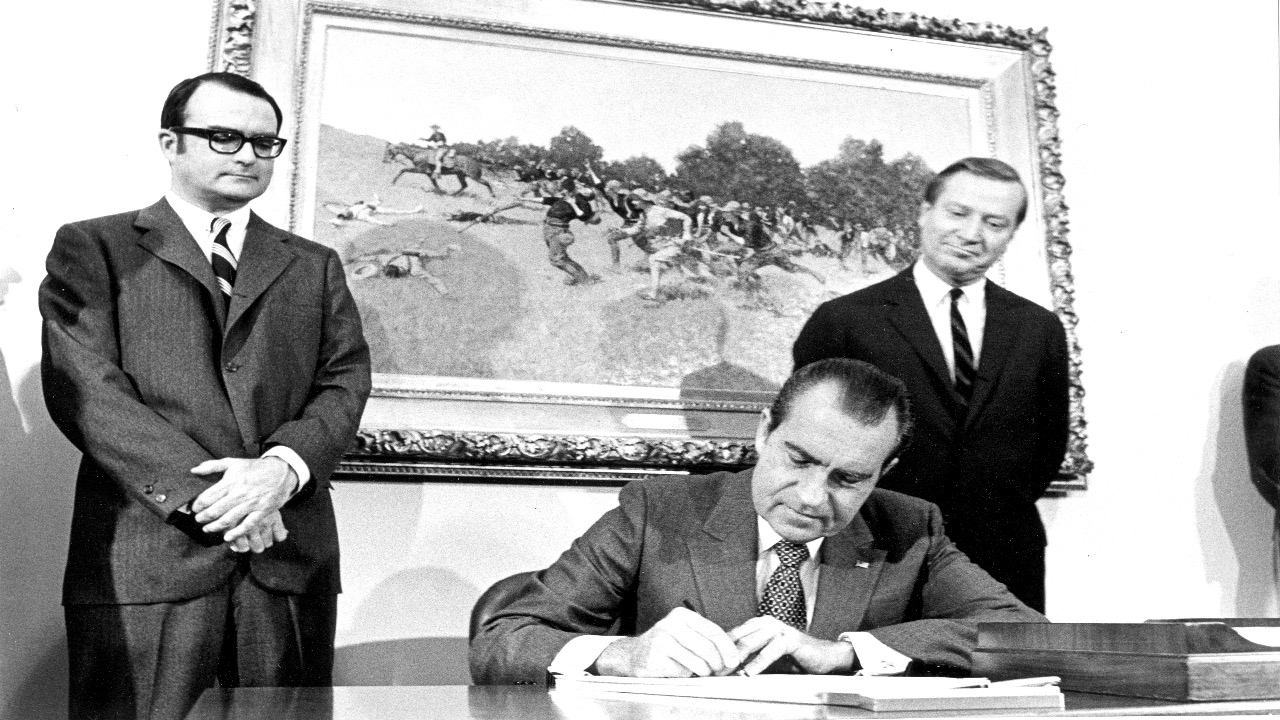
Image: White House Photo Office/Wikimedia Commons