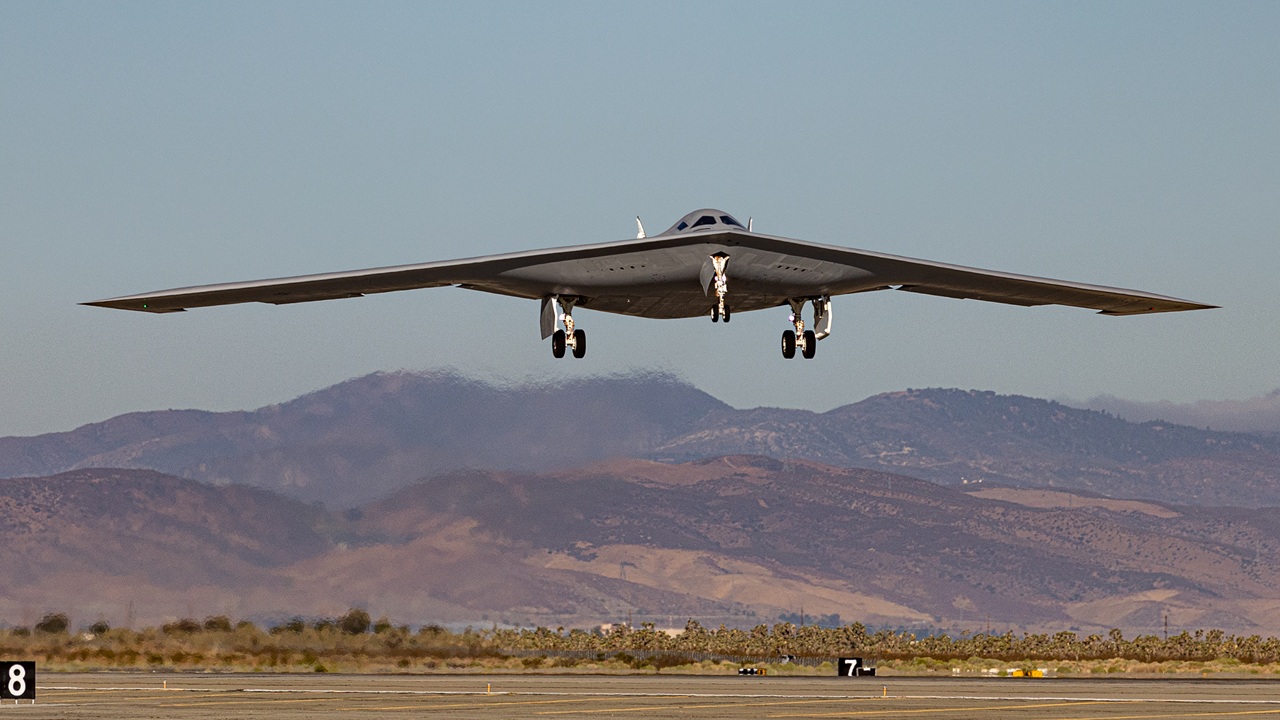
During a recent test, the B-21 was photographed in refueling position behind a KC-135 Stratotanker aerial refueling aircraft—but it appears that no fuel was actually transferred.
The B-21 Raider, America’s upcoming sixth-generation stealth bomber, continues to undergo flight tests at Edwards Air Force Base (AFB) in southern California. That recently included the first confirmed aerial refueling test of the flying wing long-range strategic bomber. Aviation observers spotted one of the B-21 prototypes over Edwards Air Force Base (AFB) on Tuesday, March 10, 2026, while flying along with a KC-135 aerial tanker from the 370th Flight Test Squadron.
Photos shared on social media captured the moment the Raider connected with the KC-135’s fuel line, while being followed by a US Air Force F-16 Fighting Falcon. The B-21 didn’t appear to actually take on any fuel during the recent test, and that milestone hasn’t been reached yet.
“We can confirm that a B-21 Raider flight test aircraft completed a test event involving a close-proximity flight with a KC-135 Stratotanker,” an Air Force spokesperson told Defense One. “This flight is part of the ongoing, rigorous test campaign to validate the B-21’s capabilities and operational readiness.”
Being able to refuel in the air is critical for the long-range bomber, as it may need to strike distant targets. The US Air Force has deployed the Northrop B-2 Spirit on CONUS-to-CONUS missions from Whiteman Air Force Base (AFB), Missouri, with the aircraft spending up to 37 hours in the air.
The B-21 will need to do the same, and more.
At issue are the vastly different aerodynamics of the B-2 and the aircraft that will serve as the in-flight refueling stations; hence, the need to conduct these tests in stages.
“To maintain enhanced security measures, we will not provide further details on specific test points. The B-21 program remains on track to deliver a survivable, long-range, penetrating strike capability to the U.S. Air Force,” the Air Force added.
B-21 and KC-135: The Old And the New, Joined Together
The display of the B-21 and the KC-135 showed the newest, and at this point most advanced, US military aircraft juxtaposed with the far older Stratotanker, which first entered service in 1957.
It also gave a sense of the B-21’s scale, which is reported to have a wingspan of 132 to 150 feet. That is still smaller than the B-2 Spirit’s 172-foot wingspan, which was intended to enhance the stealth, improve maintainability, and allow it to operate from more US Air Force base hangars.
However, it is far from the “small” aircraft that some aviation buffs had previously suggested—and the aircraft appeared a respectable size against the KC-135, which has a wingspan of only 130 feet.
Once it is introduced, the Raider will carry only 110,000 to 120,000 pounds of fuel, or about two-thirds of the Spirit’s 167,000-pound load. That means that in spite of its smaller size, it likely cannot fly as far—meaning it will require multiple refuelings during the long-haul missions that the stealth aircraft have become known for.
The B-21 Raider’s Specifications
Testing on the future backbone of the service’s strategic long-range bombers has been ongoing since late 2023, when the first prototype made its unannounced maiden flight in Palmdale, California. It came just a year after the flying-wing bomber was officially unveiled to the public during a ceremony at Northrop Grumman’s facility in December 2022.
- Year Introduced: Not yet introduced (anticipated 2027)
- Number Built: 3 (prototypes)
- Length: 54 ft (16.46 m)
- Wingspan: 132 ft (40.2 m)
- Weight (MTOW): 180,000 lb (81,646 kg)
- Engines: Two Pratt & Whitney PW9000 turbofan engines (27,000 lbf each)
- Top Speed: ~600 mph (965 km/h) / Mach 0.8
- Range: ~ 6,000 mi (9,650 km)
- Service Ceiling: ~50,000 ft (15,240 m)
- Loadout: Internal weapons bay, 20,000 lb (9,070 kg) payload capacity; expected to field a dual-capable loadout of both nuclear and conventional weapons, including precision-guided munitions like the AGM-181 LRSO cruise missile, B61-12 nuclear glide bomb, and B61-13 nuclear bunker buster bombs
- Aircrew: Likely 2
The Air Force has described the Raider as a “sixth-generation stealth bomber,” which will replace the aging B-1B Lancer and B-2 Spirit, while serving alongside the early Cold War-era Boeing B-52 Stratofortress until that bomber is retired in the early 2050s. Current plans call for the US Air Force to acquire at least 100 B-21 Raiders, though some officials have said the number should be increased, possibly doubled.
In addition to developing a state-of-the-art bomber, Air Force officials have underscored their focus on containing costs while allowing for maximum flexibility. The Raider, named for the 80 men who participated in the 1942 “Doolittle Raid” on Tokyo, was developed using Northrop Grumman’s pioneering digital engineering practices and advanced manufacturing techniques.
About the Author: Peter Suciu
Peter Suciu has contributed to dozens of newspapers, magazines and websites over a 30-year career in journalism. He regularly writes about military hardware, firearms history, cybersecurity, politics, and international affairs. Peter is also a contributing writer for Forbes and Clearance Jobs. He is based in Michigan. You can follow him on Twitter: @PeterSuciu. You can email the author: [email protected].