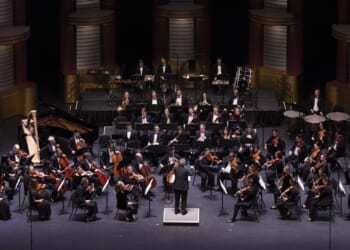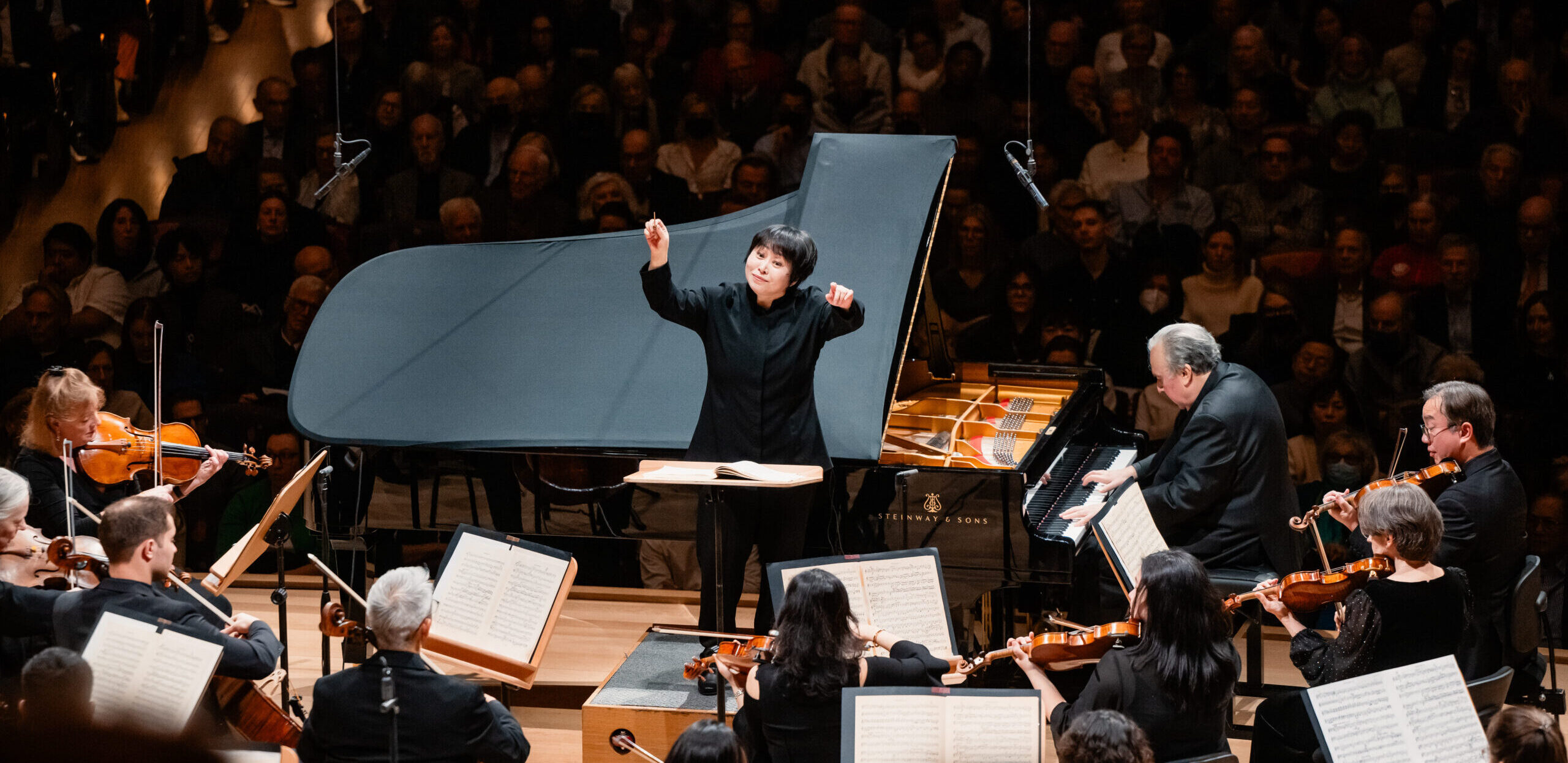
When the conductor took the stage at David Geffen Hall on Friday afternoon, the man in front of me said to his wife, “She’s short.” I thought, “But is she shorter than Ormandy?”
I met Eugene Ormandy when I was about twelve. As I recall, I towered over him. (But he was gigantic in musical stature.)
Friday afternoon’s conductor was Xian Zhang, who was “guesting” with the New York Philharmonic. She is the music director of the New Jersey Symphony Orchestra. Farther away, she is the music director of the Seattle Symphony. In the early 2000s, she worked with the Philharmonic, assisting Maestro Lorin Maazel.
The concert on Friday began with a new work, or relatively new work: Landscape Impression, by Chen Yi, which premiered in 2023. I will discuss it in a forthcoming chronicle for the print magazine.
On, then, to the second work of the afternoon—which was the Schumann Piano Concerto.
Our soloist was Yefim Bronfman, a Soviet-born American (who did a stint in Israel). Is he the most frequent soloist with the New York Philharmonic? A statistician could give us a precise answer, but I can tell you that he is certainly one of them. He is practically part of the furniture.
The first note of the concerto—an E, played by various musicians—was almost together. This work is a piano concerto, yes, but it has a prominent clarinet part. And the Philharmonic’s Anthony McGill did some nice singing in it.
Bronfman did some nice singing too—very nice. He’s a Russian bear, but he can play like an angel. Simply and purely. The first movement has an A-flat section, which was like a reverie. Throughout this movement, nothing was overstated, but nothing was dull, either.
The pianist’s arpeggios and other passagework were super-smooth. He moves his arms, rather than reaching with his hands. Therefore, the notes are always in front of him. (Think of an outfielder being under a fly ball, not having to lurch or dive for it.)
When Bronfman thunders, he never pounds or bangs. He plays from the shoulders. His two-handed trill coming out of the cadenza was shiver-making. The final chords of the first movement were, blessedly, in strict tempo.
I’m so sick of cutesy pauses—especially before a concluding chord—I could spit.
The middle movement, the Intermezzo? Bronfman really didn’t do anything to it. He just played it, rightly. How about Maestro, or Maestra, Zhang? It seemed to me she was guilty of a little overmanaging. But then, Maazel—for whom I have the utmost respect—could be the same.
Very effective, from both pianist and conductor, was the transition to the third movement. In an initial figure, Bronfman was a little muddy, uncharacteristically. But clarity followed. He played the music with panache but without showiness.
What to do for an encore? I was thinking more Schumann, and I was thinking Horowitz’s encore: “Träumerei” (from Scenes from Childhood). Bronfman indeed played Schumann—but it was the Arabesque in C, Op. 18. He played it dearly, and affectionately, but without perfume. Perfume kills Schumann.
Bronfman is an interesting fellow. Even when he is at his most refined and most subtle, he is masculine—unusually masculine. How is this so? It just is.
By the way, I regard the Arabesque as a little long for an encore. But I doubt anyone objected.
After intermission, there was a symphony: the Symphony No. 2 in C minor, by Tchaikovsky. He wrote six of them—six symphonies. Most people’s favorite, I suppose, is either No. 6 or No. 5. Their third favorite, I suppose, would be No. 4.
You know? I’m not sure there’s another of the six I like more—love more—than No. 2.
Right out of the gate, there is an extended French-horn solo. On Friday afternoon, it was really good. Truly, first-rate. Who was that player? After the concert, I learned that he was a guest from Iceland: Stefán Jón Bernharðsson. Can he stay?
Later in the symphony, as I was listening to him, I thought, “He’s not merely getting through the part” (which would be commendable enough—the horn is a hard instrument). “He’s singing. He’s being musical.”
Doing her part, too, was Judith LeClair, the Philharmonic’s veteran principal bassoon.
The second movement is a little march—and no one has ever been better at little marches than Tchaikovsky. The timpanist on this occasion, Markus Rhoten, was deft. And he did something I had never heard before. In his opening measures—his introduction to the movement—he effected a diminuendo.
I’m not sure Tchaikovsky wrote it, but I liked it.
How did the movement overall go? Well. I would have liked a little more sparkle and snap. In the next movement, the Scherzo, I would have liked more electricity, more drama. In the Finale, I would have liked more . . . more of a thrill? Even a touch of delirium?
But I’m greedy, especially when it comes to this symphony. Xian Zhang and the Philharmonic were capable at every turn.
In this review, I have not used the symphony’s nickname. Let me quote from the Philharmonic’s program notes:
Tchaikovsky’s Second Symphony has long been known by the nickname “Little Russian,” which the composer appears never to have used or sanctioned.
Tchaikovsky incorporates folk songs into the work. A writer came up with the nickname in 1896. “At that time,” the program notes say,
“Little Russia” referred approximately to the portion of the Russian Empire that is today within the borders of Ukraine. The term, which reflects the imperialistic perspective of 19th-century Russia, has long since become anachronistic, and now perhaps even offensive in light of current events.
Some of us think so, yes