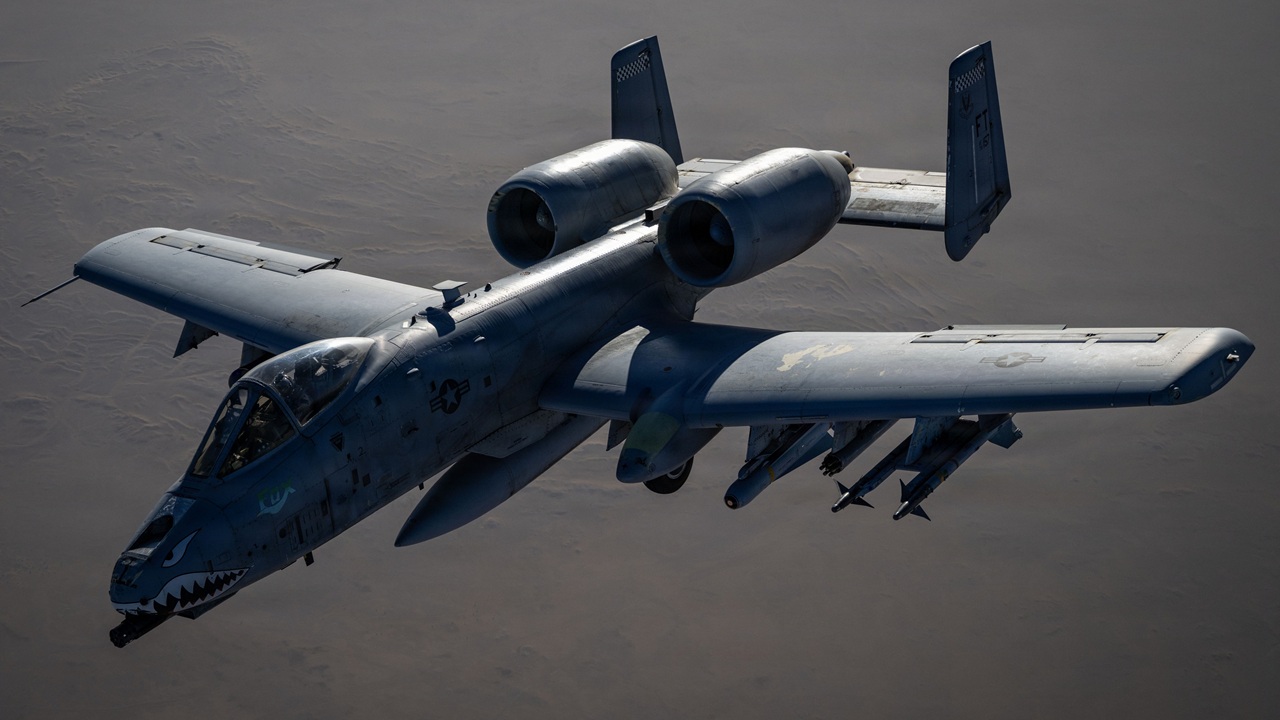
The A-10 is well-suited to take on the Iranian “fast boats” menacing shipping in the Strait of Hormuz.
Iran’s closure of the Strait of Hormuz has caused significant concerns about the state of the global economy. It is also directly affecting the course of Operation Epic Fury.
The US military is attempting to hold one of the most important maritime trade lanes open for oil and liquified natural gas, while the Iranian military and the Islamic Revolutionary Guard Corps (IRGC) are trying to keep it shut through a range of methods. One of those involves the use of fast-attack craft, which can quickly attack passing merchant vessels before retreating along the Iranian coastline.
The US Air Force is now experimenting with a new method to tackle this threat, involving one of the most popular aircraft in its inventory: the A-10 Thunderbolt II, or “Warthog.”
About the A-10 Warthog
- Year Introduced: 1977
- Number Built: ~716 (all variants)
- Length: 53 ft 4 in (16.16 m)
- Wingspan: 57 ft 6 in (17.42 m)
- Weight (MTOW): ~51,000 lbs (23,132 kg)
- Engines: Two General Electric TF34-GE-100 turbofans (~9,000–9,275 lbs thrust each)
- Top Speed: ~420 mph (675 km/h)
- Range: Combat radius: 290 nautical miles (334 miles, 537 km); ferry range with tanks ~2,200 nautical miles (2,532 miles, 4,074 km)
- Service Ceiling: ~45,000 ft (13,700 m) — tactical employment almost always near ground level
- Loadout: GAU-8/A 30 mm rotary cannon (centerline); up to ~16,000 lbs (7,260 kg) of external stores; loadout can include AGM-65 Mavericks, AIM-9M Sidewinder, LAU-131 seven-round rocket pods, Hydra 70 2.75″ rockets/APKWS, JDAM/GBU kits, gun pods, flares/chaff, LITENING targeting pod, and external tanks
- Aircrew: 1 (pilot)
Why A-10 Warthogs Are Perfect Against Iranian Fast-Attack Craft
“The A-10 Warthog is now in the fight across the southern flank and is hunting and killing fast attack watercraft in the Straits of Hormuz,” Chairman of the Joint Chiefs of Staff, Air Force Gen. Dan Caine, said during a joint news conference with Secretary of Defense Pete Hegseth on Thursday.
The A-10 Warthog is ideal for such missions, in part because of its relatively slow speed. Supersonic fighter jets like the F-15 Eagle, F-16 Fighting Falcon, and F-35 Lightning II are primarily built to fight enemy aircraft. Because their engines are optimized for supersonic speeds, they have a very high stall speed—meaning they cannot confront slow-moving targets without quickly overshooting them. The Warthog, a subsonic aircraft, has no such limitations; it was designed specifically to tackle targets on the ground and provide assistance to friendly troops. It is rare for an aircraft that has been designed and built for a specific mission set. But that is the case with the Warthog, which was designed around its enormous GAU-8/A 30mm rotary cannon.
The close air support aircraft can still outpace an Iranian speedboat, but it has a good loiter time and can stay on target for reasonably long periods. Although it is vulnerable to ground-to-air missiles, it can hold its own and deliver serious destruction to targets on the ground or sea.
The A-10’s close air support mission over the Strait of Hormuz also enables other aircraft to go after other targets in Iran that also threaten maritime shipping and other assets in the region.
“We’re flying further to the east now and penetrating deeper into Iranian airspace to hunt and kill one way attack garrisons, destroying Iran’s ability to project power outside of its borders,” Caine said.
About the Author: Stavros Atlamazoglou
Stavros Atlamazoglou is a seasoned defense journalist specializing in special operations and a Hellenic Army veteran (national service with the 575th Marine Battalion and Army HQ). He holds a BA from the Johns Hopkins University and an MA from the Johns Hopkins’ School of Advanced International Studies (SAIS). His work has been featured in Business Insider, Sandboxx, and SOFREP.