Author E.P. Cowley is a retired homeschooling mother living in southern British Columbia, Canada, who holds a master’s degree in English literature from Portland State University.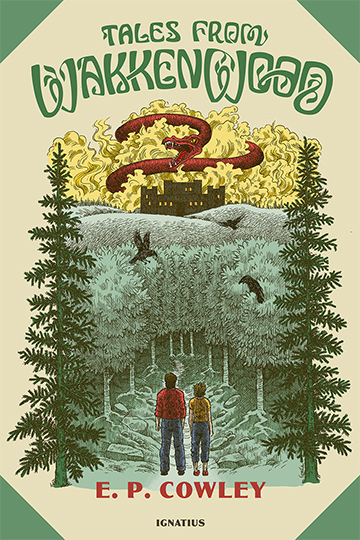
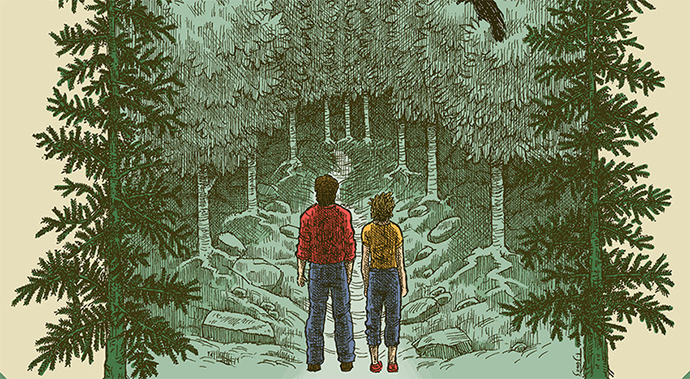
Her novel, Tales from Wakken Wood, recently published by Ignatius Press, is inspired by the folklore and language of the Isle of Man, in the midst of the British Isles. It tells the story of a young boy with a mysterious family and strange abilities, and the odd creatures that inhabit the seemingly normal islands where he lives. He and his friend must join forces to unravel the mysteries and overcome evil. Joseph Pearce describes it as “somewhere as weird and wonderful as Middle-earth or Narnia,” and Cheri Blomquist says it is part “Middle-earth, part Narnia, and part contemporary whimsy rooted in Manx fairy lore…”
Cowley recently spoke with Catholic World Report about her debut novel, the inspiration she took from earlier authors, and the place of fantasy literature in evangelization.
Catholic World Report: How did the book come about?
E.P. Cowley: Fifteen years ago, I set out to write a fairy tale for the fun of it, and to entertain my family. That first iteration of Wakken Wood (WW) ended up in the rubbish bin because it seemed trite to me and lacked inner meaning and cohesion. Also, I had not yet stumbled upon Manx folklore and its eccentricities.
After trashing that first version of WW, I wrote an entirely different story in which the mysterious Bread Lady emerged. Eventually, she led me not only into the Catholic Church but back to Wakken Wood. And that’s when I met the Manx creatures.
During the decade it took to complete the first draft, I knew the endpoint of the story; but the pathway to get there—the unfolding plot—turned out to be surprising, which was why I kept at it. Every time I wrote myself into a corner, I asked our master storyteller for help, and he always nudged me into some unexpected scene or incident I would never have thought of myself. This is why I see WW as an unlooked-for gift from God. Looking back over the years of writing and rewriting, I can only remember holding the pen and learning to say yes.
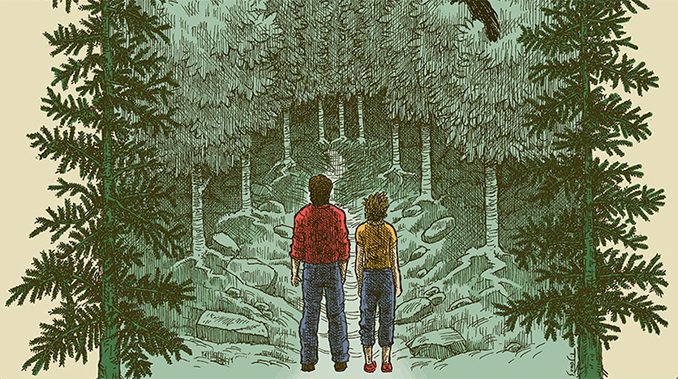
I’d like to thank Ignatius Press for taking a risk with this story and for including Jackie Richard’s illustrations. The cover art by Tim Jones came as a complete surprise and is quite perfect, complemented by John Herreid’s thoughtful and beautiful cover design.
CWR: The book seems to have influences from earlier fantasy works. What were some of your inspirations in that genre?
Cowley: Tolkien, of course, is a major influence. Lord of the Rings, certainly. But most especially Smith of Wootton Major. Smith is “a learner and explorer” of fairyland, and “some of his briefer visits he spent looking only at one tree or one flower.” This was the Tolkien I returned to whenever I was discouraged or stumped by my own explorations in Wakken Wood. And my thanks to him for setting a high bar in his essay, “On Fairy-Stories.”
From Ursula K. Le Guin’s A Wizard of Earthsea, I learned that a character’s seemingly rambling journey can have a hidden purpose. And in The Dark is Rising series, Susan Cooper blends the modern world with the ancient world of Arthurian magic; her main characters live in both times at once. There are other influential fantasy stories, but it’s a bit like trying to sort out and name all the tightly packed threads of a woven fabric.
Within the sub-genre of fairy tale—WW is most closely aligned here―the obvious inspiration comes from the Brothers Grimm, Hans Christian Andersen, the Arabian Nights, and the collections of Andrew Lang. I’ve also taken in a steady diet of George MacDonald over the years.
I owe a debt to so many great writers who contribute one thing or another to the craft of storytelling: Chesterton’s fearless, tumbling, yet perfectly sane characters, such as Innocent Smith of Manalive; the strange and wonderful settings of Lewis’s space trilogy. To Kenneth Grahame, Beatrix Potter, the essays of E.B. White, and the poetry of Coleridge and Wordsworth, I owe a hankering for descriptions of Nature in all her various moods. For characterization, Dickens is my favorite master.
CWR: Fantasy is one genre of fiction with a long-established Christian pedigree. Even just in more recent years, with the Narnia and Lord of the Rings books, people are ready to see Christian symbolism. But is it difficult not to be too heavy-handed with that symbolism?
Cowley: A number of years ago, I would have thought so. Then, in various secular and church settings, working with children aged five to eighteen, I began to encounter young people who did not know the biblical stories or symbols, and their parents didn’t either. There was the moment I mentioned Noah and the Ark to illustrate the definition of ‘deluge’, and was met with the blank faces of high schoolers—they had no knowledge of the story. Four years ago, on a December afternoon, a sixth-grade girl asked me, “Who is this Jesus guy and what does he have to do with Christmas?” Repeated experiences like these made me realize that I don’t have to be overly concerned about folding sacred imagery and ideas into fiction.
My theory is that if we Christians don’t say too much about it, our works of fantasy could still “sneak past watchful dragons,” and convey evangelium (the joy of the Gospel) as Lewis hoped his stories would. I realize, these days, that the watchful dragons are joined by howling wolves and squealing zombies of the apocalyptic cancel cult. Yet these creatures are no longer entirely sure what “the everlasting hills” might mean; the identity of the white rider with “eyes like a flame of fire” is unknown to them.
So our fantasy works have a chance of quietly passing through the gauntlet, into that inner realm where a Reader sits with a book, and where the Word is already quietly speaking.
CWR: The role of Manx and the Isle of Man in the story is very interesting, as that’s really not something one encounters every day. Tell us about how that came to be.
Cowley: There’s a fair bit of folklore in WW, but Manx mythology is the most obvious foothold. It happened this way.
While my husband, a fifth-generation Manxman, was investigating his family tree, I went ferreting around in an old Manx dictionary, curious about the language. Certain entries, like this one from 1924, caught my attention:
ARKAN SONNEY [a(r)kan sona] (Mx. lit. ‘ lucky urchin ‘, ‘ plentiful little pig ‘), hedgehog. The name of a fabulous animal. The old people said that if you caught it you would always find a silver piece in your pocket. You mus’ a met the arkan-sonney, bhoy.
Naturally, this led to an investigation of the mythology. Because of its early isolation in the middle of the Irish Sea, the Isle of Man’s folklore, like its tailless Manx cat, has a unique DNA that diverges from the rest of the British Isles. I was hooked, and read every collection of Manx fairy tales I could get hold of, as well as A.W. Moore’s History of the Isle of Man, among other accounts.
Incidentally, my husband assumed I made up that bit about the Arkan Sonney of Wakken Wood plunking out silver coins until I showed him the old dictionary entry. This goes to show that truth is always stranger than fiction.
CWR: Do you consider yourself a Catholic author, or an author who happens to be Catholic?
Cowley: Answering this question seems a bit like trying to split a hair, which is fiddly work, but here’s a roundabout reply.
I began writing WW while in the Protestant church. As I’ve already mentioned, my conversion happened somewhere in the middle of the tale’s first draft. As my son once said, life as a Protestant was like trying to view an enormous, elaborate painting through a toilet paper tube held to one eye. After Confirmation, the tube was plucked from my hand and, gradually, I began to see the big picture.
Sheldon Vanauken put it another way (and I believe he was quoting Chesterton): a convert goes from a tent pitched outside the cathedral, right into the cathedral. And, with both eyes wide open, it was easier to explore Wakken Wood, which is, for me, one of the rooms in God’s cathedral treasure house.
CWR: Many authors (especially Christian ones) of fantasy feel strongly, one way or the other, about the use of allegory in their works. Would you say there are elements of Christian allegory in Tales from Wakken Wood?
Cowley: No allegory in this story; there are no characters, objects, or places that stand in for a meaning that lies outside the narrative (that’s the definition of allegory). And, since it’s sometimes difficult to distinguish between allegory and symbolism, I’ll risk trying to split that literary hair.
Within the confines of literary definitions, symbolism is the use of one object to represent or suggest another—the way a flag stands for a country. That’s a brief and simplistic definition. What I’m saying is that Wakken Wood is neither a Christian allegory nor are the characters and places strictly symbolic. Then what am I claiming?
Tales from Wakken Wood is a fairy tale.
Though I don’t swallow everything Bruno Bettelheim says about the purpose of fairy tale, he states how they work in a way that suits my intentions here: “ . . . although the events which occur in fairy tales are often unusual and most improbable, they are always presented as ordinary, something that could happen to you or me or the person next door when out on a walk in the woods” (The Uses of Enchantment). The unusual and improbable things that can happen in the woods are often meant as a test of character; the hero’s response is meant to give us hope that, as Chesterton says, the dragons and evil wizards can indeed be conquered with the right kind of help.
The fairy tale seems, to me, ideal for conveying the nature of the “double world” we live in. For example, in Tales from Wakken Wood, Peter and Pixel can go by car from the shopping center in a regular town, straight into the surprising region called Wakken Wood, and a big house that is populated by odd creatures. In my view, this is not unlike my own trip to Mass on any given Sunday: I get in my car and drive to a place where strange and wonderful things are afoot. If the Mass is a boundary place where we meet God, then truly our “real” world has become enchanted; so the sanctuary is not unlike Wakken Wood, or the perilous region in any fairy tale, and shouldn’t be treated lightly.
The first time I read about the events surrounding Our Lady of Guadalupe, I remember thinking, “This is like the wildest fairy tale come true. Can it be?” But nothing has ever been the same since the Incarnation: the wildest and most beautiful realities have been let loose all over the planet. As Tolkien said of the Gospel, “this story is supreme; and it is true. Art has been verified. God is the Lord of angels and of men—and of elves. Legend and History have met and fused.”
And so, as the real-life fairy tale of Guadalupe goes, the humble hero, Juan Diego, meets the queen and is given a treasure in his cloak.
One last literary clarification. Magical Realism is often a tag applied to stories such as WW, but this is a misunderstanding. Usually, the magic, or mystical event, in a story of Magical Realism is powered by human action, especially strong human emotion or desire—Like Water for Chocolate is a good example. Again, the “magic” at work in WW is really of a sacred origin. Even the WW villains operate with borrowed powers.
By the way, I’m a big fan of Pilgrim’s Progress, as well as medieval allegories, such as Pearl. The medieval bestiaries are also full of interest. I sometimes wish allegory would come into fashion again, but I suppose our views are too scientific now; it’s difficult to see the essence of things like hawthorn trees and hornets.
CWR: Is Tales from Wakken Wood only for Catholics, or can anyone get something out of it?
Cowley: The “willing suspension of disbelief” is the only real requirement for approaching fiction, so any curious reader should be able to visit Wakken Wood and get something out of it. If a reader comes with their own agenda, or a template for what a fantasy novel should or should not be, they may be disappointed, possibly unnerved, or maybe bored senseless.
I count myself as one of the rank-and-file readers who are sometimes derided by the frustrated literati; but we are actually full of common sense and intelligence. So, I wrote the kind of book that I like to read, layered with plots and subplots, unfolding secrets, big houses with nooks and crannies, and the occasional meal of sausages and donuts that mothers tend to frown on.
CWR: What do you hope people will take away from the book?
Cowley: I hope readers will experience Escape and Consolation, Tolkien’s mark of a good fairy tale: Escape for a little while from cell phones, homework, and traffic jams; and after that, the Consolation of a happy ending. If the tale becomes one of the many small lights we turn to when we find ourselves suffocating in the windowless rooms constructed by materialists, that is good.
And if Wakken Wood also achieves an echo of evangelium in some readers, that sudden stab of joy beyond hope, this is good too. Like most people, I’m always on the lookout for that split second of piercing joy and sudden knowledge that, in spite of all that’s gone bad in our world, everything will pan out all right. Because that’s how it’s meant to be, and someone of infinite kindness is writing the ending.
If you value the news and views Catholic World Report provides, please consider donating to support our efforts. Your contribution will help us continue to make CWR available to all readers worldwide for free, without a subscription. Thank you for your generosity!
Click here for more information on donating to CWR. Click here to sign up for our newsletter.