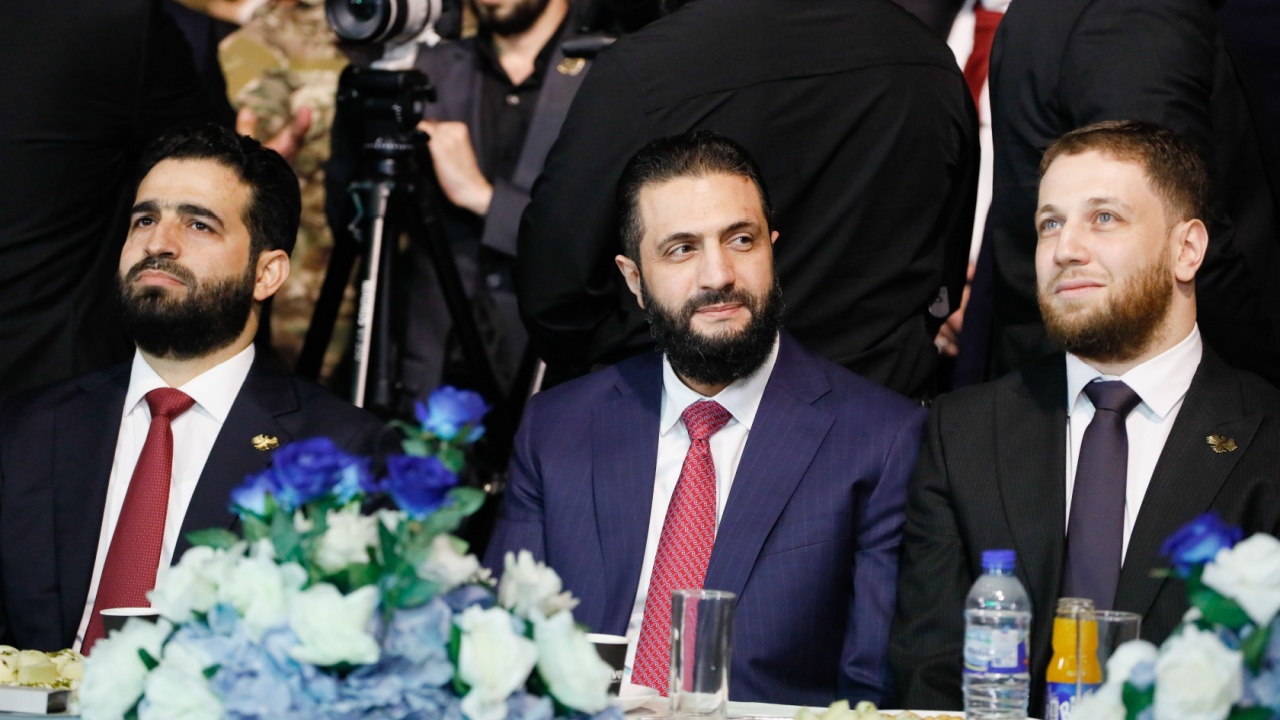
The West’s unconditional rehabilitation of Ahmed al-Shara has come too swiftly for Syria’s minority communities.
A year ago this week, Abou Mohammad Al Jolani, now Ahmed al-Shara, arrived in Damascus, leading a lightning offensive that took the nation by surprise, defeating the remnants of the poorly paid Syrian Arab Army from Aleppo to Hama to Homs, and finally entering the capital with little fighting.
While those who knew the record of his group ruling over Idlib Governorate for the last 5 years were worried, many in the streets of Syria celebrated. After all, the Syrian people seemed stuck. Economic sanctions had eviscerated their economy and massively devalued their currency. Many in Syria wanted change, and from where it came mattered little.
While some in Syria, especially the Kurdish, Christian, Alawite, and Druze communities, were proceeding with cautious optimism in the first months that followed, many in the West took a different approach. Western capitals from Paris to Washington welcomed al-Shara and his foreign minister with open arms. This unconditional openness now looks like a recipe for disaster.
The West’s Unconditional Welcome for Al-Shara
“Are you getting enough sleep at night?” Gen. David Petraeus asked Ahmed al-Shara. On stage at the 2025 Concordia Annual Summit on the sides of the UN General Assembly, the exchange was casual, even warm, between the former CIA Director and the man who once led al-Qaeda’s Syrian branch.
The diplomatic charm offensive did not start there. In May, al-Shara met President Donald Trump and Secretary of State Marco Rubio in Riyadh. Months earlier, France’s President Emmanuel Macron hosted al-Shara at the Élysée, the former Hay’at Tahrir al-Sham (HTS) leader’s first official visit to a Western capital. All these meetings have appeared to underscore a Western, seemingly unconditional, openness to the new regime in Damascus. This welcoming attitude persisted throughout the first year without considering developments on the ground.
Herein lies the problem. Those green welcoming lights abroad are being interpreted as yellow lights at home. While Western dignitaries normalize photo-ops, Syrians on the ground, especially the minorities, bear the costs. Over the last nine months of al-Shara’s rule, 10,000 Syrians have been killed, according to the Syrian Observatory for Human Rights. These numbers exceed annual casualty figures from the final years of the civil war.
In September alone, the confirmed number of sectarian deaths has reached 70. In early October, three Christian men in the Christian Valley in eastern Homs were gunned down by armed men affiliated with HTS. A day before that incident, four Alawite workers were murdered on their way home at an HTS roadblock in Hama.
While al-Shara was in New York, videos circulated on the internet proving that HTS security forces, or at least HTS-associated Sunni militiamen, were responsible for igniting the wildfires that have been ravaging the bucolic Christian valley for the last six months. The video shows a military fatigued individual shooting incendiary fireworks into a forest that is starting to burn.
These sporadic cases, and many others like last week’s rape of an Alawite woman in Salhab, can be written off as one-off regrettable incidents. Incidents that can be ignored by Western capitals eager for a stable post-Assad Syria. Yet, two mass-scale harrowing incidents this year are hard to ignore. Two cases of systematic violence enacted by HTS against two of Syria’s largest minority communities: the Alawites and the Druze.
Syrian Horrors at the Coast and on the Mountain
In March, the Syrian Coast, home to the majority of Syria’s Alawite community, which makes up about 12 percent of Syria’s population, saw three consecutive days of sectarian pogroms. Over 1,500 perished. Local Alawite organizations dispute this figure, claiming it’s much higher. Video footage captured by the security forces themselves shows a continuous barrage of summary executions, torture, ritualistic beheadings, and indiscriminate helicopter bombing of Alawite villages.
In July, after diplomatic overtures failed to convince the southern Druze community of Suwayda to submit to Damascus, al-Shara ordered a full mobilization. Hordes of HTS armed forces, flanked by Sunni tribal militiamen, descended on the southern province to take it by force. The 48 hours of fighting saw another litany of horrific and documented crimes that ended with the murder of over 1,000 members of the Druze community.
Again, videos filmed by the fighters themselves show a bevy of war crimes. One clip shows three druze men being forced to jump to their deaths off a balcony as they were shot at. Many others, like this now viral clip that made it onto CNN, show summary executions of defenseless, unarmed Druze citizens based on their sect. A CCTV clip from the Suwayda National Hospital shows the precursor to a massacre committed against the medical staff of the hospital by the fighters.
On July 16, after nightmarish clips had already surfaced online and the Israeli Druze community demanded action from their government to protect their co-religionist in Syria, the Israeli Air Force struck the Ministry of Defense in the heart of Damascus in a clear message. Only then did the incursion end with a full withdrawal of fighters. The aftermath showed even further proof of rapes, torture, and killings that didn’t spare children, American citizens like Hussam Saraya, and octogenarian men.
Today, Syria is on a knife-edge. Christian, Alawite, and Kurdish communities are bracing for the next mass atrocity incident that will afflict their communities. The signs are there. Christian cemeteries are being desecrated, and churches vandalized; Alawite women are being kidnapped, and Alawite shrines incinerated on a weekly basis, and Kurdish schools are being forced to abandon the Kurdish language while Druze students are being attacked at their colleges. This is a long list of incidents that can’t be read other than as precursors of further violence.
Ending Impunity for Ahmed Al-Shara
As Syria struggles to be reborn, the West must condition every handshake and photo-op. No financial injections, investment, or diplomatic engagement without verifiable benchmarks: minority-protection guarantees, and independent investigations into crimes with prosecutions, not just self-inquiries that never deliver justice.
Western capitals must demand and guarantee the protection of the vulnerable minority communities where they live. International monitors must keep focus on the Druze of Suwayda, the Alawites of the coast, the Christians of the Valley, and the Kurds on the Eastern Bank of the Euphrates.
Laundering the image of Al Jolani’s HTS government won’t erase its five-year historical precedent ruling over the Idlib governorate, nor the ideology behind that rule. There, in North West Syria, Christian, Druze, and Shia heritage was erased and populations cleansed under al-Shara’s direct rule.
The more al-Shara and his foreign minister, Asaad al-Shaibani, are welcomed on stages with the Von der Leyens, Tony Blairs, and Fareed Zakarias of the West, the more comfortable Damascus will feel as mass atrocities fester unpunished under its rule.
Therefore, one year on, the West must help the Syrian people achieve true stability and peace, and until then, should probably keep the red carpets in the closet.
About the Author: Hekmat Matthew Aboukhater
Hekmat Matthew Aboukhater is a Syrian American policy analyst and founder of ProjectOnwards.org, a Syrian American NGO focused on helping Syrian youth. Hekmat worked as a researcher with the Quincy Institute’s Democratizing Foreign Policy program and with the United Nations Department of Peacebuilding and Political Affairs. Currently, Hekmat is pursuing a graduate degree in Public Policy at Yale’s Jackson School of Global Affairs.
Image: Mohammad Bash / Shutterstock.com.