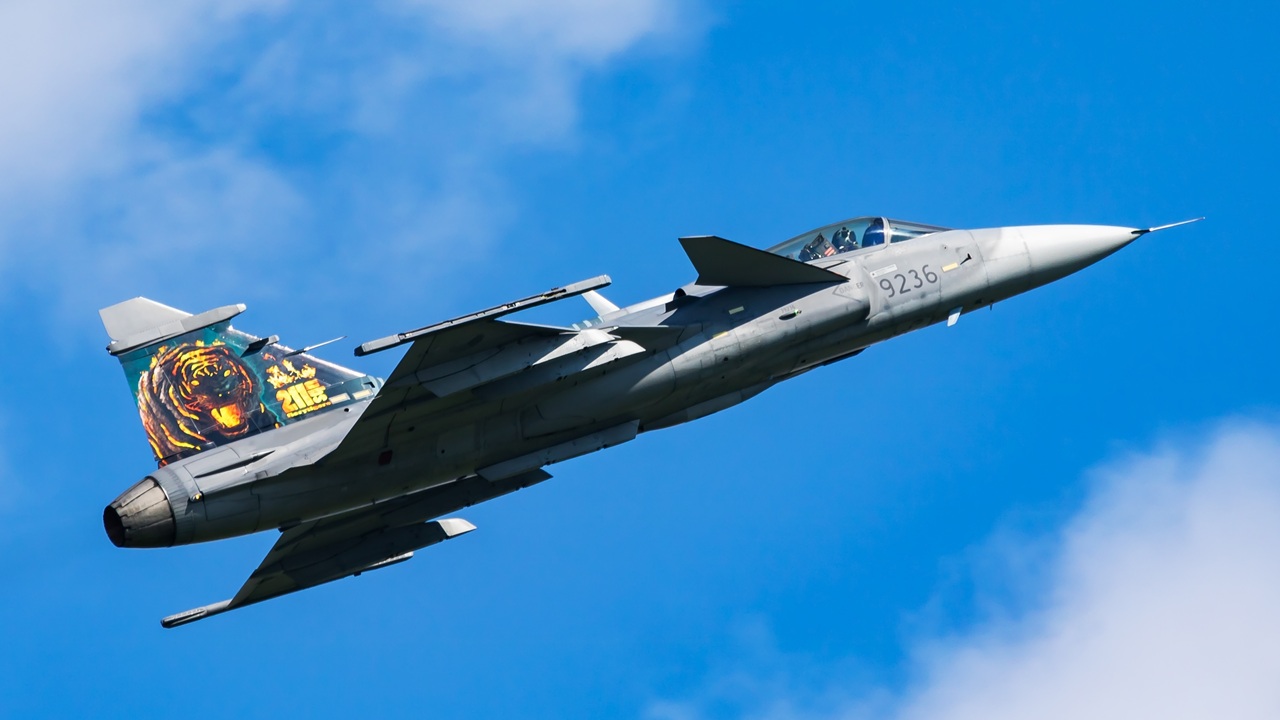
The JAS 39 Gripen was designed for simplicity and ease of use—giving it a niche among air forces without intensive maintenance support.
The Saab JAS 39 Gripen is often overshadowed by newer, stealthier fighters. Yet the Gripen remains one of the most pragmatic combat aircraft in service. Designed around cost controls, survivability, and the need for national independence, the Gripen is less about dominance and more about sustainable air power.
The JAS 39 Gripen’s Specifications
- Year Introduced: 1996 (A); 2019 (E)
- Number Built: ~300
- Length: 14.9 m (48 ft 11 in) JAS 39C/E / 15.6 m (51 ft) JAS 39D/F
- Wingspan: ~8.4 m (27 ft 6 in)
- Weight (MTOW): 14,000 kg (30,865 lb)
- Engines: One GE F414G afterburning turbofan (E/F variants)
- Top Speed: 2,100 km/h (1,300 mph) / Mach 2
- Range: 800 km (500 mi, 430 nmi)
- Service Ceiling: 15,240 m (50,000 ft)
- Loadout: 27 mm Mauser BK-27 cannon (omitted on the two-seat variants), including air-to-air missiles such as the AIM-9 Sidewinder, air-to-ground missiles such as the AGM-65 Maverick, and anti-ship missiles such as the RBS-15
- Aircrew: 1–2, depending on variant
The History of the Gripen
The Gripen was developed during the Cold War for Sweden’s unique defense needs. As a neutral country, independent of both NATO and the Soviet Union, Sweden needed the firepower to defend itself without breaking its own budget. It therefore required a platform offering high readiness, dispersed operating capability, and minimal maintenance costs and reliance on foreign basing.
First flown in the late 1980s, the Gripen replaced older Viggen and Draken fleets, which had laid the groundwork for the Gripen’s development, but had since fallen out of date against the rise of late Cold War-era Soviet fighters.
In Swedish, the JAS acronym stands for Jake (fighter), Attack, Spaning (reconnaissance). As the acronym suggests, the Gripen is a true multirole fighter, built with an emphasis on short takeoff and landing, rapid turnaround, and simple maintenance regimes.
Lightweight, with one engine, the Gripen is a relatively simple machine, featuring a distinct canard-delta configuration. Optimized for high agility and efficient cruise, the modern Gripen E-variant relies on a GE414-derived engine for power, offering a reasonable balance of performance and fuel economy.
The new Gripens feature advanced AESA radar and a capable electronic warfare suites. The platform is capable of sensor fusion, despite not being a fifth-generation platform. The cockpit layout is pilot-centric, reducing workload, allowing the pilot to be “outside” the aircraft. The Gripen is compatible with a wide range of Western munitions and is able to integrate new weapons without major redesigns. The Gripen was built to emphasize beyond-visual-range (BVR) combat, precision strike, and defensive counter-air.
Uniquely, the Gripen was designed for dispersed operations and survivability. Accordingly, it can operate from roads and short, austere runways—both of which were to be expected in an air battle in northern Scandinavia. The ground crew requirements are intentionally minimal, which enables survivability against preemptive strikes. This is a rare capability among modern fighters, most of which require extensive ground crew preparations and long, luxurious runways to operate from.
Can the Gripen Stand Up to American and Russian Jets?
The Gripen relies on networked sensors, cooperative targeting, and hit-and-run engagements. The platform avoids prolonged exposure in contested air space—that’s not what it was built for. It gets in and out and pairs well with ground-based air defenses to improve survivability despite being a non-stealth platform.
Strategically, the Gripen is ideal for small and mid-sized air forces who need assistance with territorial defense and/or coalition interoperability without total dependency. The Gripen is less well suited for deep penetration against A2/AD; the non-stealth characteristics of the platform would leave it highly vulnerable against modern air defense systems. But although the Gripen is non-stealth, it compensates to an extent with capable EW and cost-effectiveness. The Gripen doesn’t try to be something it is not; it acknowledges its limitations and fights accordingly—which is why, despite being non-stealth, the Gripen E/F-variants will be relevant into the 2040s, likely to evolve with improved sensors, unmanned teaming, and software upgrades.
The Gripen will always be a niche fighter, never a mainstream platform on the cutting-edge of great power competition. But it remains respected for its sustainable and low-maintenance performance, and will continue to carve out an enduring market niche in the world’s air forces for those reasons.
About the Author: Harrison Kass
Harrison Kass is a senior defense and national security writer at The National Interest. Kass is an attorney and former political candidate who joined the US Air Force as a pilot trainee before being medically discharged. He focuses on military strategy, aerospace, and global security affairs. He holds a JD from the University of Oregon and a master’s in Global Journalism and International Relations from NYU.
Image: Shutterstock / Soos Jozsef.