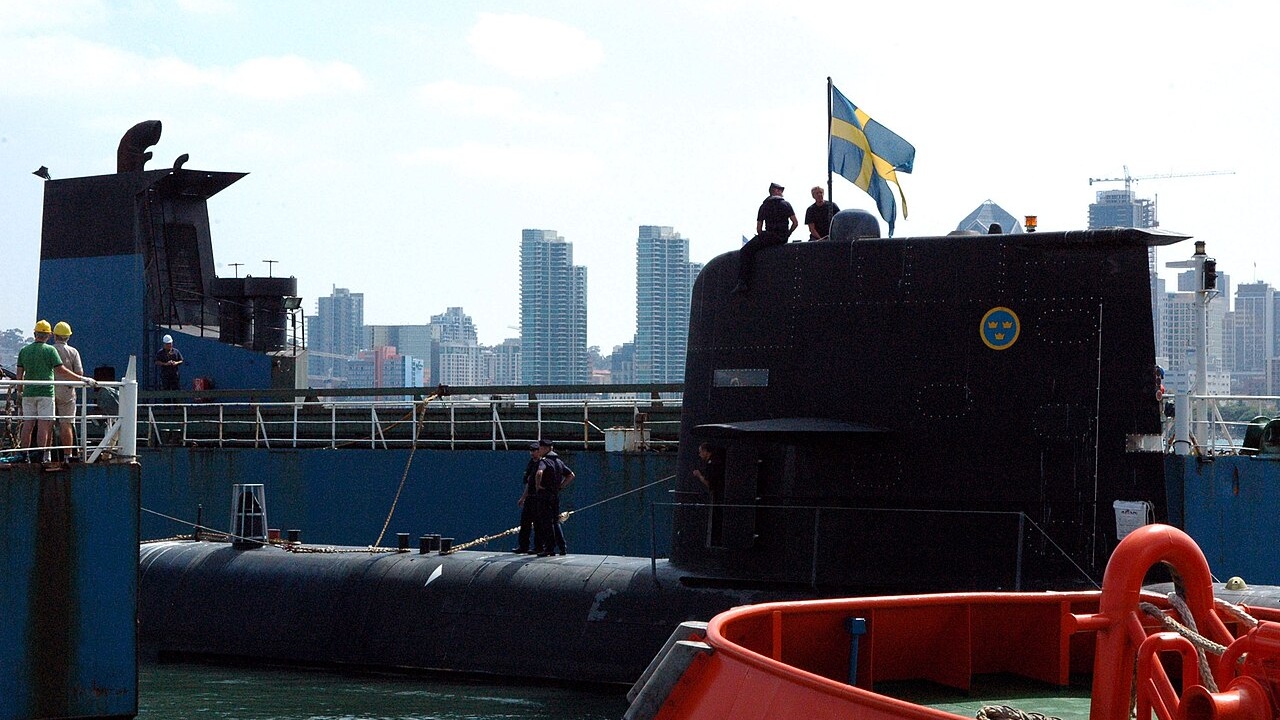
In a sense, Sweden’s A26 submarine is a microcosm of Europe’s defense woes: it can build amazing platforms, but cannot build enough of them on time.
Saab has achieved what it calls the world’s first-ever fifth-generation diesel-electric submarine: the Blekinge-class (or just “A26”). It is, by every technical measure, a breakthrough submarine. Designed to replace Sweden’s aging underwater fleet, the A26 represents one of the most ambitious undersea programs underway in Europe. Even Poland—desperate to shed its decrepit Soviet-era Kilo-class submersible, the ORP Orzel—has announced interest in acquiring export variants.
On a continent where “rearmament” has largely been a buzzword with little real meaning, the A26 is a rare and tangible achievement. But the story isn’t as simple as Europe finally waking up. The A26 is cutting-edge, yes—but it is also a symptom of a continent racing the clock, moving far too slowly as the world grows darker (and more dangerous).
The Blekinge-Class (A26) Submarine’s Specifications
- Year Introduced: Not yet introduced (anticipated 2031)
- Number Built: 0 (2 planned)
- Length: 66.1 m (216 ft 10 in)
- Beam (Width): 6.75 m (22 ft 2 in)
- Displacement: 1,925 tonnes (surfaced); 2,100 tonnes (submerged)
- Engines: One shaft, with one propeller, driven by four Kockums Mk V V4-275R Stirling air independent propulsion (AIP) engines
- Top Speed: 20 km/h (12 mph) surfaced; 11 km/h (7 mph) submerged
- Range: 45 days’ endurance
- Armaments: Six torpedo tubes (four 533mm/21-inch, two 400mm/16-inch); naval mines
- Crew: 17–26
A Submarine Built for the Wars Europe Is Actually Likely to Fight
The Blekinge-class A26 prioritizes stealth in every dimension—acoustic, magnetic, electric, hydrodynamic, even radar signature—for a reason. Sweden lives in the shadow of a Russian military that, while focused on Ukraine, still dominates the Baltic and Arctic regions. Stockholm’s defense strategists believe their submarines must be undetectable to survive, let alone influence events around them.
Saab’s A26 has an advanced hull form replete with radar-absorbing coatings, an electronic degaussing system, and shock-resistant structures which all reflect a simple truth: modern naval warfare is trending toward the unseen. Russia’s sophisticated “Harmony” underwater sensor system has turned large sections of the Arctic seabed into a surveillance web. To operate there, Sweden needs a boat that is less of a machine and more of a ghost.
Sweden’s designers responded with a potent combination of technology and mission flexibility. The submarine’s Stirling-engine air-independent propulsion (AIP) allows it to remain submerged for weeks at a time—critical for covert operations in contested littoral zones, like the Baltic Sea. A modular “multi-mission portal” turns the A26 into a jack-of-all-trades of undersea warfare. It can deploy unmanned underwater vehicles, special operations teams, seabed infrastructure tools, swimmer delivery systems, and mine-laying or mine-sweeping modalities.
Critically, the A26 can “bottom”—rest quietly on the seabed for extended periods—evading detection and waiting for the right moment to strike or gather intelligence. This is not a blue-water cruiser meant to chase Chinese aircraft carriers. It is a scalpel built for chokepoints, gray-zone conflict, and covert warfare—exactly the environments Europe is likely to face first.
A Triumph of Design—and A Disaster of Execution
So far, so good. But here is where Europe’s chronic strategic malaise reasserts itself. The A26 program was launched in 2015, with two submarines expected to be delivered in the early 2020s. As of late 2025, those delivery dates have slipped—again—to somewhere between 2031 and 2033. In other words, it is taking Sweden nearly two decades to build just two submersibles.
Costs have ballooned. Schedules have collapsed. Program managers have offered optimistic statements that strain the limits of credibility. And with only two boats planned, Sweden risks fielding a “class” so small that its upkeep, training, upgrade cycles, and operational flexibility will be far more expensive per hull than Swedish military planners can justify.
Europe’s defense-planning pathology is all over this program: brilliant engineering suffocated by bureaucratic inertia. The A26 is the future of undersea warfare. But the future never seems to arrive.
What the A26 Really Reveals About Europe
The Blekinge-class submarine is, in many respects, a microcosm of Europe’s entire defense situation. Here is what it says—loudly—about Europe today:
1. Europe can still innovate—but only in isolated pockets. Saab produced something extraordinary, but no continent-wide naval revival exists—no matter what the Europeans proclaim. Poland’s interest underscores the desperation of smaller states, not the coordination of a strategic bloc.
2. Europe is preparing for the wrong fights—or at least preparing too slowly for the right ones. The A26 is perfect for Baltic and Arctic missions. But if only two exist by the mid-2030s, Sweden will not possess a real deterrence at sea.
3. Europe continues to mistake boutique capabilities for actual military power. To be clear, the A26 is dazzling. Yet, a handful of dazzling submarines does not counter a resurgent Russia—or a fracturing global order in which collective Europe is most certainly an entrée in the coming smorgasbord of violence that follows such a violently collapsing world order.
4. Europe’s leaders still believe announcements equates to readiness. They do not. Hardware does. And this is the central tragedy: the A26 shows what Europe could build if it treated defense with the intensity and seriousness the times demand. Instead, the A26 stands (floats?) almost alone—a gleaming undersea prototype floating atop a sea of European strategic wishful thinking.
A Breakthrough Worth Celebrating—but Not Enough to Matter
If Saab delivers what it promises, the A26 could become the gold standard for non-nuclear submarines. Its stealth characteristics, modular mission systems, seabed-warfare capabilities, and extended submerged endurance make it a truly formidable weapon for the kinds of conflicts Europe is most likely to encounter.
But Europe needs more than breakthroughs. It needs mass. It needs timelines that reflect urgency. Crucially, it needs governments willing to spend money on weapons, not consultants.
The A26 is a technological triumph. It may even be a glimpse of the future. But unless Europe learns to build more of them on time and under-budget, this fifth-generation submarine will remain what so many European defense programs have sadly become: a masterpiece without an orchestra.
About the Author: Brandon J. Weichert
Brandon J. Weichert is a senior national security editor at The National Interest. Recently, Weichert became the host of The National Security Hour on America Outloud News and iHeartRadio, where he discusses national security policy every Wednesday at 8pm Eastern. Weichert hosts a companion book talk series on Rumble entitled “National Security Talk.” He is also a contributor at Popular Mechanics and has consulted regularly with various government institutions and private organizations on geopolitical issues. Weichert’s writings have appeared in multiple publications, including The Washington Times, National Review, The American Spectator, MSN, and the Asia Times. His books include Winning Space: How America Remains a Superpower, Biohacked: China’s Race to Control Life, and The Shadow War: Iran’s Quest for Supremacy. His newest book, A Disaster of Our Own Making: How the West Lost Ukraine is available for purchase wherever books are sold. He can be followed via Twitter @WeTheBrandon.
Image: Wikimedia Commons.