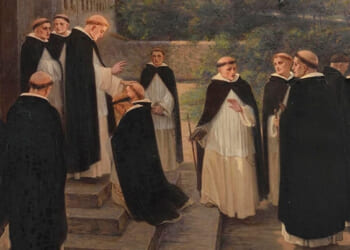
At a recent Lay Dominican meeting, we discussed the importance of studying the life of St. Dominic, our founder. There is little written record of his life, prayer, and theology. We learn about him by studying what his contemporaries wrote and what his life demonstrated. There is a document of that time attributed to a Sister Cecelia which outlines St. Dominic’s “Nine Ways of Prayer.” These nine ways are postures Dominic used during his nighttime vigils. Using his body, mind, and heart, Dominic gave himself in every way he could and was in turn open to receive our Lord through prayer.
Our group discussion turned to theology, as it often does. Our fraternity president used an apt analogy of our study of this “Queen of the Sciences,” comparing it to “strength training” by which we condition our body. Immediately my mind returned to another major area of Dominican study: prayer. If the study (and practice) of theology is our soul’s strength training, then our practice (and study) of prayer could be called our soul’s cardio-pulmonary training. Cardio referring to the heart and pulmonary to the lungs, prayer opens our hearts to God by the very breath, the Ruah, of the Holy Spirit in us.
A balanced physical regime would include both strength and cardio-pulmonary training to keep all the systems of our body strong, healthy, and energized. Practicing only one type of exercise is better than nothing but leaves certain vulnerabilities and avoidable weaknesses. When we have a lot of head knowledge about the Faith but fail to spend time building our relationship with the Lord, we can be weak in our “heart,” and unable to “breathe” fully the life where grace and truth flow throughout.
Often it is said that the 18” between the head and the heart are the longest inches to traverse. Only by prayer can theological knowledge make that 18” journey from mind to heart. We cannot infuse our own hearts with knowledge and wisdom, only God can do that. When we study theology and spend time with God in prayer, the Holy Spirit breathes in us, moving head knowledge into our hearts. Strength and cardio-pulmonary training work together, in the Holy Spirit, to form us in this Christian life.
In the Spiritual Exercises of St. Ignatius, the Jesuits teach that true prayer has three important characteristics: it is generous, open, and courageous. It surrenders self and selfish intentions to God, trusting that He wills the best for us and will lead us to that best through our surrender. Theology must humbly yield to mystery, and we must trust God with the consequences. “Conditioning” ourselves in this manner through prayer will also lead us to be generous, open, and courageous in other areas of our life, including study.
In nurturing a life of prayer, the theology we study becomes the rock of strength upon which we can safely dwell. From that foundation God will build, with our cooperation, a house where we can dwell together, where strength and breath will support a heart growing ever deeper in love with Him.
A physical regime that focuses only on cardio-pulmonary training and ignores strength training likewise leaves vulnerabilities. The well-known phrase, “he is so heavenly minded that he is no earthly good” refers to people who are so gifted in prayer, but take the gift out of balance, ignoring the practical aspects of life and responsibilities. Beyond this being “no earthly good” is the vulnerability of a prayer life that moves off the firm foundation of truth handed down to us through Scripture, Tradition, and the Magisterial teachings of the Church. When our knowledge of theology is not what it should be, we become susceptible to false teachings and our own fallible mysticism.
In his autobiography, St. Ignatius of Loyola relayed an experience that turned out to be demonic in nature. At first, he was convinced of its heavenly origin, but through careful discernment the truth was revealed. The devil often comes, “cloaked as an angel of light,” who offers consolation and holy thoughts at first but then, “little by little draws the soul to covert deceits and perverse intentions.” A soul with the firm foundation of theological strength-training will be less likely to be deceived by ideas that contradict the truths of the Faith. Prayer elevates the mind and heart, but the study of theology grounds us in truth.
Prayer helps us to run with the Lord to places we cannot imagine, places He wishes us to go. We will run with endurance the race He has set out for us if we have the cardio-pulmonary, “heart-breath,” strength derived from a consistent prayer life. Theology will help us to discern the directions to go as we come to the turns in the road, choosing those that coincide with what our Faith teaches and rejecting those that don’t.
A well-rounded Christian is like a well-rounded athlete. The combination of discipline and love draws us closer to God every day. As Paul exhorts us, “Every athlete exercises discipline in every way. They do it to win a perishable crown, but we an imperishable one” (1 Cor. 9:25). When we discipline our Christian lives with both study and prayer on a consistent basis over time, we will draw closer to Him, just as an athlete who cross-trains consistently will become strong, healthy, and full of energy for life.
As we approach a new calendar year, the time for making resolutions is at hand. Perhaps this year, during the precious time between Christmas and New Year’s, when we bask in the glow of the newborn Child, we might ponder with Christ this question: is either important area of my Christian life, study or prayer, in need of more attention than I give it?
We each have our natural gifts and tendencies. We may feel more capable studying than praying, or vice versa. Either case offers us the opportunity to show God our love for Him by applying discipline and practice to the area we are less comfortable with. God will reward our efforts with deeper life in Him, the goal of this Christian life.
Earlier in that letter to the Corinthians, St. Paul tells us, “Do you not know that the runners in the stadium all run in the race, but only one wins the prize? Run so as to win” (1 Cor. 9:24). We have but one life to give to the Lord. By applying ourselves to both what is more comfortable to us as well as to that which is less, we generously, openly, and courageously run so as to win. As the ads for gym memberships and exercise equipment crowd your news feed, take it as a signal grace to spend time with Jesus pondering your study and prayer efforts, and see where He leads you.
Jesus, you have made us body, mind, and spirit. Thank you for these gifts! Please help us to nurture them by living a life strengthened by study and enlivened by prayer, growing closer to you every day, enabling us to go out and be your salt and light in the world.
Image from WikiArt