On Holy Thursday, we are called to remember the Institution of the Holy Eucharist and Holy Orders. We walk with Christ to the Last Supper and end the Mass of the Lord’s Supper by accompanying Him to Gethsemane and ultimately to the Cross. At the Last Supper, on top of the glorious gifts of the Holy Eucharist and the priesthood, we are invited to deeper conversion through Christ’s love and healing in the washing of the Apostles’ feet. We are invited into deeper humility and weakness, because without these dispositions, we will abandon Our Lord in His darkest hour.
Before the feast of Passover, Jesus knew that his hour had come
to pass from this world to the Father.
He loved his own in the world and he loved them to the end.
The devil had already induced Judas, son of Simon the Iscariot, to hand him over.
So, during supper,
fully aware that the Father had put everything into his power
and that he had come from God and was returning to God,
he rose from supper and took off his outer garments.
He took a towel and tied it around his waist.
Then he poured water into a basin
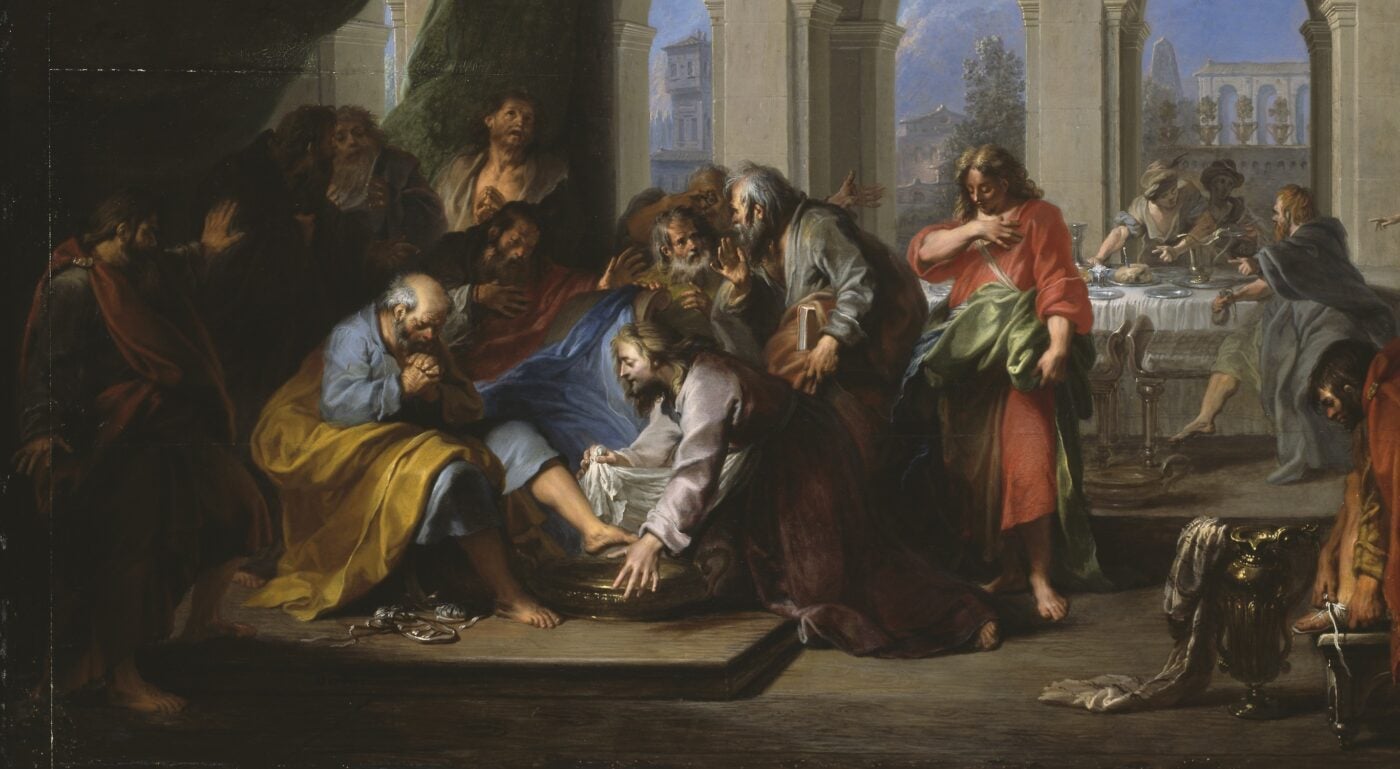
and began to wash the disciples’ feet
and dry them with the towel around his waist.
He came to Simon Peter, who said to him,
“Master, are you going to wash my feet?”
Jesus answered and said to him,
“What I am doing, you do not understand now,
but you will understand later.”
Peter said to him, “You will never wash my feet.”
Jesus answered him,
“Unless I wash you, you will have no inheritance with me.”
Simon Peter said to him,
“Master, then not only my feet, but my hands and head as well.”
Jesus said to him,
“Whoever has bathed has no need except to have his feet washed,
for he is clean all over;
so you are clean, but not all.”
For he knew who would betray him;
for this reason, he said, “Not all of you are clean.”
So when he had washed their feet
and put his garments back on and reclined at table again,
he said to them, “Do you realize what I have done for you?
You call me ‘teacher’ and ‘master,’ and rightly so, for indeed I am.
If I, therefore, the master and teacher, have washed your feet,
you ought to wash one another’s feet.
I have given you a model to follow,
so that as I have done for you, you should also do.”
(Jn. 13:1-15)
The God of the universe humbles Himself and takes on the role of a slave. He wipes the dung and mud from each of His Apostles’ feet, knowing that all of them except for St. John will flee from His Cross, and one of them will betray Him. He looks lovingly into the depths of each of them as He washes away the muck. He challenges them to imitate His humility and love. It takes tremendous grace to look into the eyes of a betrayer while washing their feet. To lower oneself in the presence of those who betray or abandon us. It takes ultimate humility.
Like St. Peter, we often believe we would never abandon the Lord. It is pride that blinds us to our weakness. Each one of us has breaking points, and we do not know them until we are confronted with them. Anyone who believes they are incapable of fleeing or betrayal in the face of extreme violence has not been humbled like St. Peter, yet. There will be moments in our lives when all of us will be brought to the edge of what we can handle, and we will want to run.
We run every time we flee into something worldly in order to escape our suffering. The technological age is grounded in the idea that we should flee from reality. We can binge Netflix into oblivion in order to avoid death, illness, betrayal, rejection, lost hopes and dreams, and any other form of suffering we encounter in our daily lives. We can mindlessly scroll, drink, eat, shop, hook up (the list goes on and on) in order to escape pain. We flee every day, but we’ve convinced ourselves that these are good things the Lord wants us to have.
Upon deeper prayer and greater reflection, we should come to the startling realization that we’ve used all those things—even true goods that are not sinful—to escape from the pain of our daily living. Every one of us is St. Peter warming ourselves by the fires shortly after we’ve protested that we would go to the very end to follow Christ. We need our repeated failures and denials to grow in humility and love. We are much too blind to the love that has been poured out for us in the Holy Eucharist and on the Cross. We abuse the freedom we’ve been given.
Bishop Erik Varden, in his beautiful reflection on the Lord’s Passion that is the focus of his book Healing Wounds, offers a pointed connection between the washing of the Apostles’ feet and His feet pierced, fixed, and immobile, nailed to the Cross on Good Friday. He points out how our feet are a symbol of the freedom we’ve been given by God. They allow us to walk towards Him, to turn and run, or to stop.
The dung and mud washed from the Apostles’ feet is reminiscent of the muck and mire of sin. It is a glimpse of the hard iron nails that will penetrate Our Savior’s feet on Good Friday, which are symbols of the hardness of our sins and hearts. Bishop Varden explains:
Whatever distance in space or time from Jesus’s passion, we are complicit in its enactment. The nails stand for our iniquity: “He was pierced for our faults,” we read in the prophet. For their sake he “must” suffer. The nails stand, too, for the frost and hardness of human hearts quite able, one moment, to shout “Hosanna to the Son of David”, then, the next: “Crucify!”
We abuse our human freedom in order to fulfill our own desires. We do not want to abandon our freedom to God’s will. We do not want to be fixed or immobile on the Cross, if we are completely honest with ourselves. We don’t want to give Christ everything. This is the battle we wage against the world, the devil, and our own ego every single day of our lives. This war comes into sharper focus during these holiest of days.
The Lord washes our feet through the Sacrament of Confession in order to heal our broken wills, minds, and hearts. It is His healing remedy that also starkly reminds us of our weakness and how often we’ve symbolically and literally used our feet to sin against Him while He hung immobile with His feet pierced on the Cross.
The humble soul knows His weakness. He knows He is wounded and broken. It is only the humbled and the weak who can truly approach Christ Crucified. It was the flight of the other Apostles and the denial of St. Peter that brought about their much-needed healing remedy. They needed to be humbled and made weak so that they could truly follow Christ. We need the very same thing, which is why sufferings and misfortunes are allowed in our lives. Our weakness is also used by Christ to shame the proud.
The weak man, woman, or child, can come wounded before the Crucified Christ on Good Friday having been washed on Holy Thursday. Bishop Varden again:
Since God displays himself to us wounded, we dare to come before him with our wounds. Thus the Trisagion resounds in its ancient modulations while a moving ritual takes place. One by one we come in slow procession before the cross to kiss Christ’s crucified feet. The priest goes first, not on account of imagined privilege but because it is his sacramental duty to carry in advance, vicariously, all that which his faithful people carry. The rubrics prescribe that he should first remove his shoes. Like Moses before the burning bush, he approaches holy ground. He is to be sensually conscious of his feet as he prostrates himself before those, immobile, of his Saviour. They were nailed to the cross that his might move freely, directed towards a beatific goal. With the Psalmist he would shout: ‘I have refrained my feet from every evil way.’ Before, he may have been ‘like a bird rushing into a snare’. Restored fleetness of foot now keeps him secure: the fowler lays his traps henceforth in vain.
The Lord seeks to remedy the abuses of our freedom we commit through our sins. He washes our feet like on Holy Thursday to cleanse us of abuses to that freedom. He is pierced by hard iron nails in order to free us from the consequences of sin and death. He becomes immobile so that we might be free to follow Him completely.
There are immeasurable depths to be plumbed in the mysteries we celebrate this week. On this Holy Thursday, may we enter more deeply, by the light of the Holy Spirit, into the freedom Christ has made us for and the cleansing we need to truly grasp the depths of His love poured out on the Cross. May we, like the Apostles whose feet were washed and then fled, allow the Lord to humble and lead us into greater weakness. For it is through truly confronting our sins that the Lord can heal us by His forgiving love.
The Apostles, except St. John, only became fully ready for their missions and martyrdoms after they understood the Lord’s warning at the Last Supper and their subsequent abandonment of Him on the Cross. The humility this caused within them led them to the heights Christ created them for because they relied totally on Him rather than on themselves. They stopped running and allowed their own feet to be transfixed with Christ Crucified for His glory. They follow Him to the very end. May we be given the grace to do the same.
Image from Wikimedia Commons