Among the most talked-about male ballet dancers of the moment is Giorgi Potskhishvili, the Georgian principal of the Dutch National Ballet and frequent star of dance galas worldwide. The performer has stunned audiences onstage and online with his outrageously high yet controlled jumps and seemingly reckless spins shown off particularly well in flashy, virtuosic roles, such as the flirtatious Basilio in Don Quixote.
If he has a secret weapon, it may be his unusual training history. Born to a family of professional Georgian folk dancers, he trained intensively in the style before transitioning to classical ballet. While character dancing—a style drawn from various national dances and used in nineteenth-century story ballets—is part of many ballet-school curricula, traditional Georgian dance requires much more extreme movements, particularly for men, who must make explosive jumps and land hard on their knees, dance on their toes in soft leather boots, and perform grueling ensemble dances inspired by warrior training. While the risk of injury appears greater to the casual observer, the dancer, if he survives unscathed, does seem to gain a certain fearlessness and insouciance, qualities that could perhaps enliven the feeble fight scenes that too often plague such ballets as Romeo and Juliet.
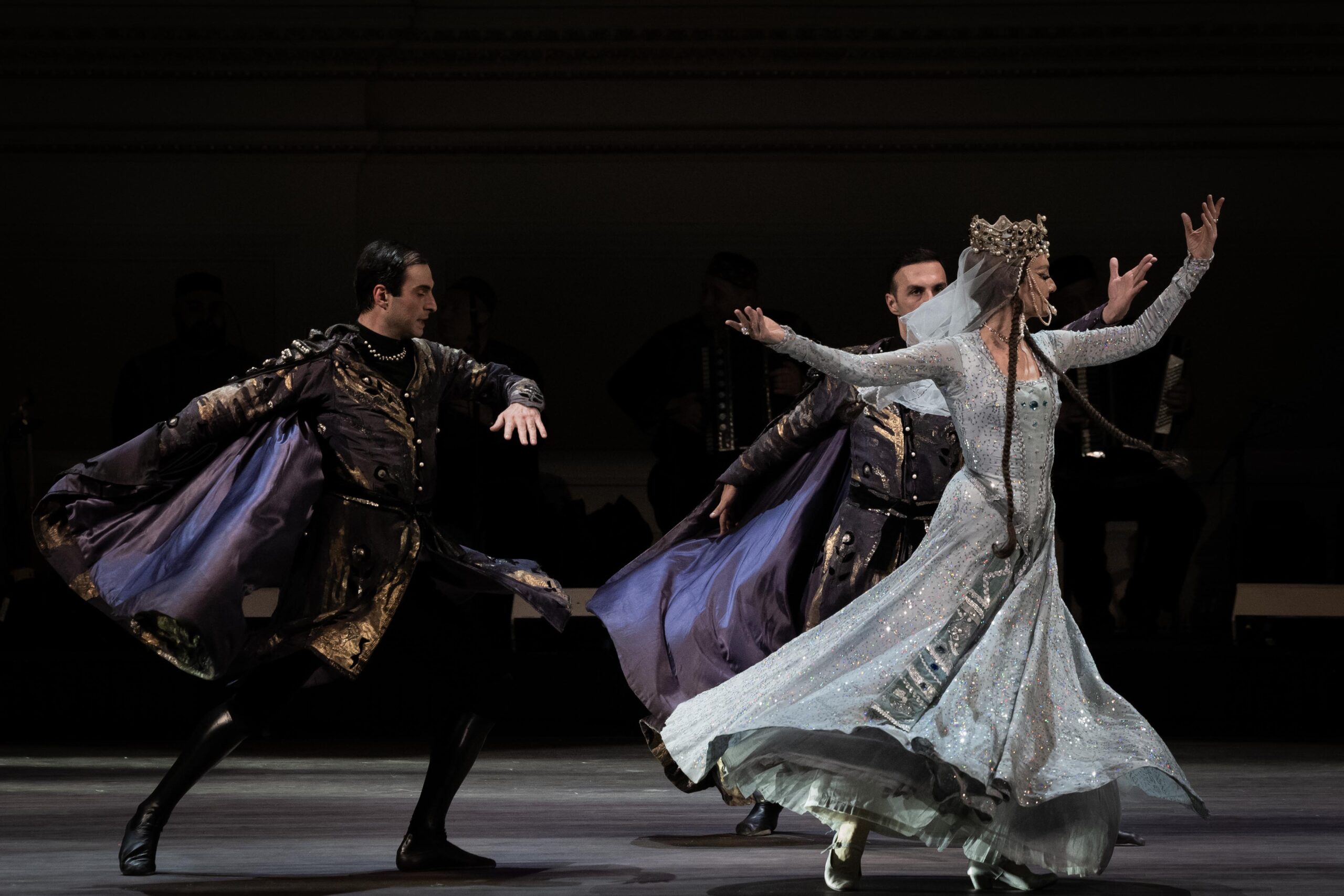
Although Potskhishvili is not a member of the Sukhishvili Georgian National Ballet, the company that recently performed at Carnegie Hall, many of the most exciting features of his dancing could be seen throughout this company of around fifty folk dancers (despite the ensemble’s name, it has little relation to classical ballet) who presented eighteen short dances from various regions across the country, as well as from different social classes and occupations. We met aristocrats and huntsmen, servants and shepherds, fierce warriors and elegant courting couples from the highlands, lowlands, and royal courts, all decked out in lavish regional costumes.
First called the Georgian State Dance Company, the troupe was founded in 1945 by Iliko Sukhishvili (1905–85), a folk dancer and choreographer, and his wife, Nino Ramishvili (1910–2000), a ballet dancer, both of whom worked with the Tbilisi Opera and Ballet before breaking out on their own. Like folklorists going from village to village to record local tales, the couple gathered traditional dances and adapted them to ensure they played to the back row of a big theater, but they also created all-new works that built on traditional techniques and made good use of Ramishvili’s knowledge of ensemble work in ballet, in particular the geometric formations of the corps. Today, the company is run by their grandchildren, Nino Sukhishvili, a costume designer, and Iliko Sukhishvili Jr., the artistic director, who helps keep the art form alive by choreographing new dances and reworking old ones.
Carnegie Hall, a venue intended primarily for music concerts and thus lacking curtains and backdrops, was adapted with a large square nonslip surface and colored lights aimed at the ceiling positioned in recesses along the back wall, with spotlights used sparingly to great effect in several of the dances. Lining the back of the stage were seven musicians playing traditional music on regional instruments, including a panduri, a lute-like string instrument, and a duduk, a double-reeded wind instrument, plus accordions, drums, and a bass guitar. Dancers entered and exited through large open doors on either side of the stage.
In Georgian dance, the male and female roles are even more differentiated than in ballet, and the spirit is highly chivalric. (To quote C. S. Lewis, the men seem able to “deal in blood and iron” while also being “meek in hall.”) Not only did the men soar in the air and land hard on their kneecaps, which seemed only slightly protected by what appeared to be light padding, but also every so often they proceeded to execute an almost unbelievable series of jumps launching from the knees, sometimes completing a full revolution in the air. The most daring male solos were often performed in the center of a semicircle and accompanied by a single, fast-beating drum, the rest of the music temporarily suspended, creating a thrilling, high-wire effect.
It is hardly a circus, however. These displays of power and skill serve a dramatic purpose, conjuring an atmosphere befitting a band of fighters needed, for instance, in the popular dance “Khorumi,” which purportedly originated among ancient warriors fending off invaders. The men each entered the stage with a leap, formed circles and tight lines, crouched and moved stealthily as if creeping up on an enemy, paused in what looked like a yoga “sun salutation,” and performed spins that landed in kneeling poses—among other thrilling steps—frequently keeping their hands to one hip, as if about to draw a weapon.
Once in the company of women, the male dancers appear demure, even skittish, as seen in the courting dance “Kartuli,” in which the man faces the woman while performing small and rapid straight-leg kicks out front or stepping gently on the balls of his feet, while maintaining a straight back and stiff arms parallel to the floor or at his sides. The female dancers, icy and celestial, are challenged to work within a very limited range of movements. Instead of jumping, they glide: like sophisticated adult versions of the little angels in Balanchine’s Nutcracker, they often wear floor-length skirts and perform tiny shuffling steps beneath that give them the illusion of sailing phantomlike across the stage. Their posture is straight and balletic, with expression portrayed softly through the arms, hands, and twists of the back and head.
Among the most striking dances was “Samaia,” choreographed by the founder Iliko Sukhishvili, featuring three women elaborately costumed and headdressed like Orthodox icons. Spotlit on a dark stage, they rotate facing outwards in a tight circle before dispersing around the stage to slow, mysterious music, sometimes pausing, with arm positions inspired by a medieval fresco of Tamar the Great (r. 1184–1213), the powerful Queen of Georgia who was later canonized. “Jara,” a fascinating 2025 creation by Sukhishvili Jr., isolates and slows down some of the fierce steps in the warrior sequences seen earlier in the night. “Simdi,” the penultimate showpiece, originating as a wedding dance, features long lines of men dressed in black and women in white advancing hand in hand, forming lines and crosses that rotate with razor-sharp accuracy that puts other dance companies to shame.
Happily for New York admirers of both this style of dance and ballet, there is currently a small but blossoming network of traditional Georgian dance academies in Brooklyn, as the dance critic Marina Harss recently reported. Perhaps a future ballet principal, and even a future star of the Sukhishvili, is training there now, perfecting his lunges, jumps, and courtly dances so that he can one day slay Tybalt and woo Juliet with equal believability.