The Château of Maisons in Maisons-Laffitte, an attractive suburb of Paris, is one of the region’s lesser-known gems. Designed in the seventeenth century by François Mansart, the château was owned under the monarchy by the Count of Artois (1757–1836), Louis XV’s grandson, Louis XVI’s brother, and the future King Charles X; he ruled France from 1824 until a second French Revolution in 1830 forced him to abdicate, making him the last of Bourbon King of France. (His successor, Louis-Philippe, was merely King of the French). The château, once owned by Artois, is a fitting locale for an exhibition centered on this playboy prince, a collector of antiquarian books and other curiosities and patron of the palace, who embellished it from 1777 until the deluge of 1789. The show, mounted by France’s Centre des monuments nationaux in conjunction with the Château de Versailles, concentrates on the prince’s early life and ends with his exile during the French Revolution.
As the third and youngest son of the Dauphin Louis de France, Charles Philippe of France, the Count of Artois, was considered unlikely to reign. When he was sixteen years old in 1773, he married Maria Theresa of Savoy and fathered a son whom Louis XVI created the Duke of Angoulême in 1775; by this point, the king and his Austrian queen, Marie Antoinette, had yet to produce any children. Artois had another son, the Duke of Berry, in 1778, the same year Marie Antoinette gave France a daughter, a consolation prize in a country where only males could inherit the throne. The exhibition includes portraits of the homely but worthy Maria Theresa, including Charles Le Clerq’s painting of the Countess of Artois and her children. The count was the best-looking member of his family, and “few beauties were unkind” to him, as the Count of Hézecques observed. He enjoyed other amorous companions and a lifelong love in Louise de Polastron, the sister-in-law of Marie Antoinette’s best friend, the Duchess of Polignac. Artois was close to Marie Antoinette, who shared with him a love of games, amateur theatrics, and music. He was a frequent guest at the queen’s Petit Trianon.
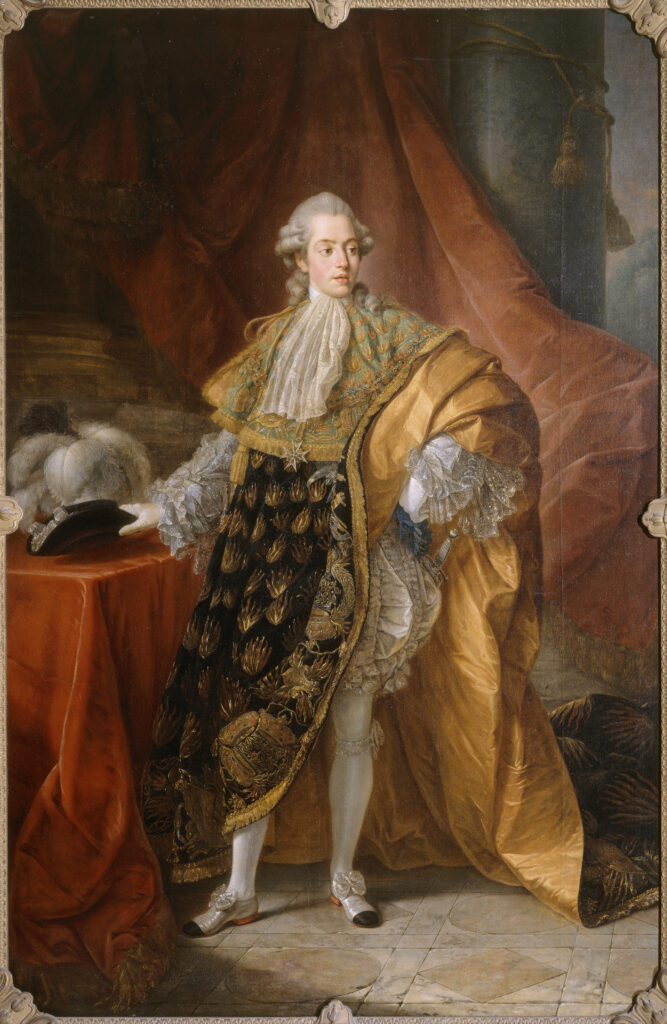
Younger royal sons were expected to be useful to the realm, and so Artois became a soldier. A 1773 portrait of him, The Count of Artois as the Colonel General of the Swiss Guard, by Jean-Martial Frédou, shows him as the young boy he then was rather than a grizzled colonel. He was not given many chances for gallantry. His brother, the king, prevented him from fighting in the American War of Independence and instead posted him to several military theaters in Europe where he was kept at a safe distance from the action. His career as a soldier ended at the failed Franco-Spanish Siege of Gibraltar (1779–83). He may have been a chocolate soldier, but he showed himself a Bourbon through and through in his hunting habits, and the exhibition displays his rifle and several books about hunting from his library. Other books, at least partly intended for his children’s education—a great concern of his—dealt with medicine, science, history, and drama. He also collected curiosities—again, for the edification of his offspring—such as an Eskimo canoe and shells, on view here. In the 1770s and 1780s, he was one of the first members of France’s royal family to buy paintings by such contemporary artists as Fragonard, Greuze, David, Vernet, and Vigée Le Brun.
In 1777, Artois began to show himself a patron of architecture. Marie Antoinette challenged him to erect a new building in a mere ninety days, and he answered with the Château de Bagatelle, a pocket-watch-sized pavilion located in Paris’s Bois de Boulogne, which continues to attract visitors with its gardens. That same year, in addition to his rooms at Versailles and his Parisian residence, Artois acquired two new residences: the Château de Maisons and Saint-Germain-en-Laye’s Château-Neuf. His preferred architect was François-Joseph Bélanger (1744–1818), already known for building houses for courtesans in Paris’s Chaussée d’Antin neighborhood. Bélanger assembled a team of the best sculptors, gardeners, furniture makers, and painters to be had in France to collaborate with him on Bagatelle and other projects, including the summer dining room of the Château de Maisons. Bélanger’s luscious View of the Pavilion at Bagatelle gives an idea of the sweet life of the aristocracy, later extolled by Talleyrand, during the last years of the ancien régime. Bélanger also drew up plans for Saint-Germain-en-Laye’s Château-Neuf, begun under Henry II and expanded under Henry IV only to be abandoned in the second half of the seventeenth century. The property was given to Artois by the king, and the count had the uncompleted building demolished. Unfortunately, Artois failed to get the necessary funds from his brother to realize Bélanger’s plans.

The exhibition’s centerpiece is the summer dining room of the Château de Maisons, built between 1779 and 1782, where niches contain sculptures of the four seasons, each by a different sculptor, Spring by Jean-Joseph Foucou, Summer (Pomona) by Louis-Simon Boizot, Autumn by Clodion, and Winter by Jean-Antoine Houdon. In his redesign, Bélanger took care to respect the preexisting structure constructed by Mansart in the previous century.
Artois and Bélanger intended to create a new neighborhood near the Avenue des Champs-Elysées. Other than Artois’ stable, this plan came to nought for lack of funds. Artois’ love of building unnerved Louis XVI, who perhaps sensed the coming chilly winds. The prince’s extravagant life and his forthright opposition to any attempt to alleviate the difficulties of less-fortunate subjects made him the most hated member of the royal family. Great princely patrons, lauded by posterity, are rarely loved in their lifetimes.
The chilly winds did come, albeit in midsummer, in 1789. On July 16, 1789, a mere two days after the fall of the Bastille, Artois and his family wasted no time in fleeing, on Louis XVI’s orders, to Turin, Savoy, ruled by Artois’ father-in-law. The king, who still hoped to keep a lid on the revolution, had no wish to have his controversial brother on hand. Artois, for his part, hoped to launch a counterrevolution from abroad. Marie Antoinette urged prudence, and Artois soon moved to Brussels and then Koblenz before settling in Edinburgh in 1795, where George III provided him with a handsome pension. Britain and the young United States were full of French emigrants in those dark years, with both countries serving as refuges. It is just as well that Artois had not fought much against Britain during his soldiering days.
Artois was able to return to France in 1814 during the Bourbon Restoration and succeeded his brother, Louis XVIII, ten years later. His reign as Charles X, though not without historical interest, is not discussed in the exhibition. The show is well worth a visit, as the château itself deserves to be better known. Monuments nationaux would do well to invest in some amenities to make the visit easier for the less mobile and to replenish the bookstore, which lacked even the exhibition’s catalogue during my visit.