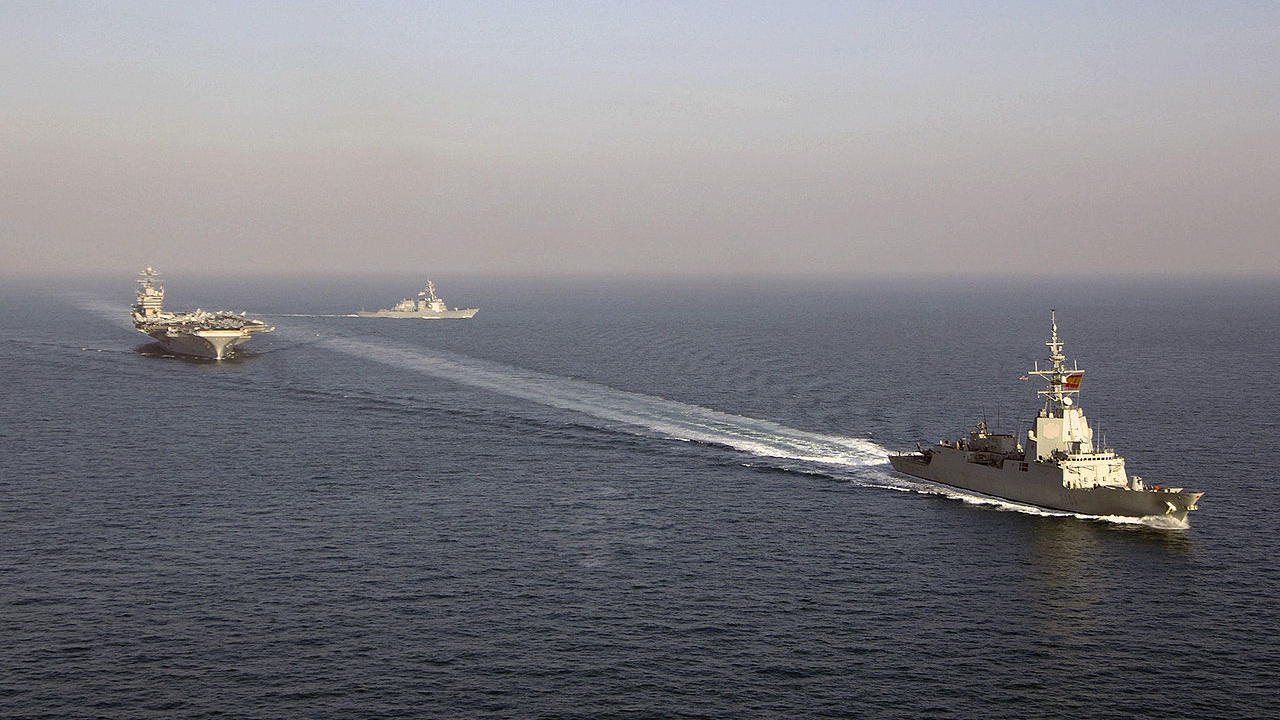
In spite of budget woes, Spain has announced a plan to overhaul its five aging F-100 frigates to ensure better interoperability with other NATO fleets.
NATO member Spain has been heavily criticized for seeking an exemption from the alliance’s goal of having members spend 5 percent of their respective gross domestic products (GDP) on defense. Madrid further aroused America’s ire after it announced in August that it would back out of a planned deal to adopt the Lockheed Martin F-35 Lightning II.
However, Spain isn’t entirely shirking its defense responsibilities, and it has announced it will invest in a key area—namely, its navy.
The Spanish Armada of the 21st Century
In September, Admiral General Antonio Piñeiro, Chief of Staff of the Navy (AJEMA), reportedly explored options for Spain to build a new aircraft carrier similar in size to the French Navy’s Charles de Gaulle flagship, but conventionally powered rather than nuclear. One issue with this plan is how Spain plans to fund both the carrier and the aircraft to operate from it, given its limited defense budget.
Amid lingering doubts around this program, the Spanish government recently announced that it had also approved plans to modernize its five F-100 Álvaro de Bazán-class frigates. Navantia, the Spanish state-owned shipbuilding enterprise, will carry out the work on the warships at its Ferrol shipyard on the north coast of Spain.
The frigates—the first European warships to integrate the AEGIS system, including the AN/SPY-1D radar—were delivered to the Spanish Navy between 2002 and 2012, and are thus in the middle of their operational service lives. The work, which is expected to take around 120 months (10 years) to complete, has been valued at 3.2 billion euros ($3.7 billion). It will allow the vessels to remain in service at least until the 2040s.
“Navantia will collaborate closely with the Spanish Navy to modernize the F-100 frigates, internationally recognized as one of the best multipurpose vessels in the world, in order to maintain their capabilities at the forefront of technology,” said Navantia President Ricardo Domínguez in a statement per Naval News. “Together with the F-110 frigates already under construction, Navantia will thus contribute to providing Spain with the best defensive capabilities at sea.”
The F-100 Frigate’s Specifications
- Year Introduced: 2002
- Number Built: 5 (6 planned, 1 canceled)
- Length: 146.7 m (481 ft)
- Beam: 18.6 m (61 ft)
- Displacement: 5,900 to 6,594 tons (full load)
- Engine(s): Combined Diesel or Gas (CODGO) propulsion, including two GE LM2500 gas turbines and two Caterpillar 3600 engines
- Top Speed: 28.5 knots (32.8 mph, 52.8 km/h)
- Range: 4,500 nautical miles (5,178 mi, 8,334 km) at 18 knots
- Armaments:
- Vertical Launch System (VLS)
- Surface-to-air missiles (RIM-162 ESSM, SM-2MR Block IIIA)
- Eight Boeing Harpoon anti-ship missiles (to be replaced by Naval Strike Missile)
- Two Mk 32 triple torpedo launchers with Mark 46 torpedoes
- One Mk 45 mod two gun naval gun
- Meroka 2B Close-In Weapons System (CIWS)
- Helicopter: One Sikorsky SH-60B LAMPS III helicopter (or NH-90 in F-105)
- Crew: 201 (officers and enlisted personnel)
The Upgrades Will Help Spain Integrate Better with NATO
The lead vessel and class of the F-100 frigates were named for Spanish nobleman, Admiral Álvaro de Bazán y Guzmán, 1st Marquis of Santa Cruz, who led the Holy League’s fleet at the famed Battle of Lepanto in October 1572. The last significant engagement in the Western world fought primarily between rowing vessels, including galleys, saw the near-total destruction of the Ottoman fleet, resulting in the stagnation of Ottoman territorial expansion and eventually its decline.
“Designed to operate in the most demanding environments, the F-100 frigates combine advanced air, anti-submarine, and anti-surface warfare capabilities. They serve as flagships in battle groups and provide comprehensive fleet protection and international projection capabilities,” Navantia explained.
According to the international open-source military intelligence firm Janes, the modernization of the F-100 frigates could “increase commonality” with Spain’s future F-110 Bonifaz-class frigates. The Álvaro de Bazán-class could be retrofitted to operate with the Kongsberg Naval Strike Missile (NSM) Block 1A anti-ship missiles, the Standard Missile-2 (SM-2) Block IIIA/B/C variants, and an upgrade to the ESSM Block II standard.
“NSM, SM-2, and ESSM Block II are all planned for the F-110 class. Similarly to the F-100s, the F-110s will also feature Lockheed Martin’s Aegis combat system and Mk 41 vertical launch system (VLS),” Janes reported.
About the Author: Peter Suciu
Peter Suciu has contributed over 3,200 published pieces to more than four dozen magazines and websites over a 30-year career in journalism. He regularly writes about military hardware, firearms history, cybersecurity, politics, and international affairs. Peter is also a contributing writer for Forbes and Clearance Jobs. He is based in Michigan. You can follow him on Twitter: @PeterSuciu. You can email the author: [email protected].
Image: Wikimedia Commons.