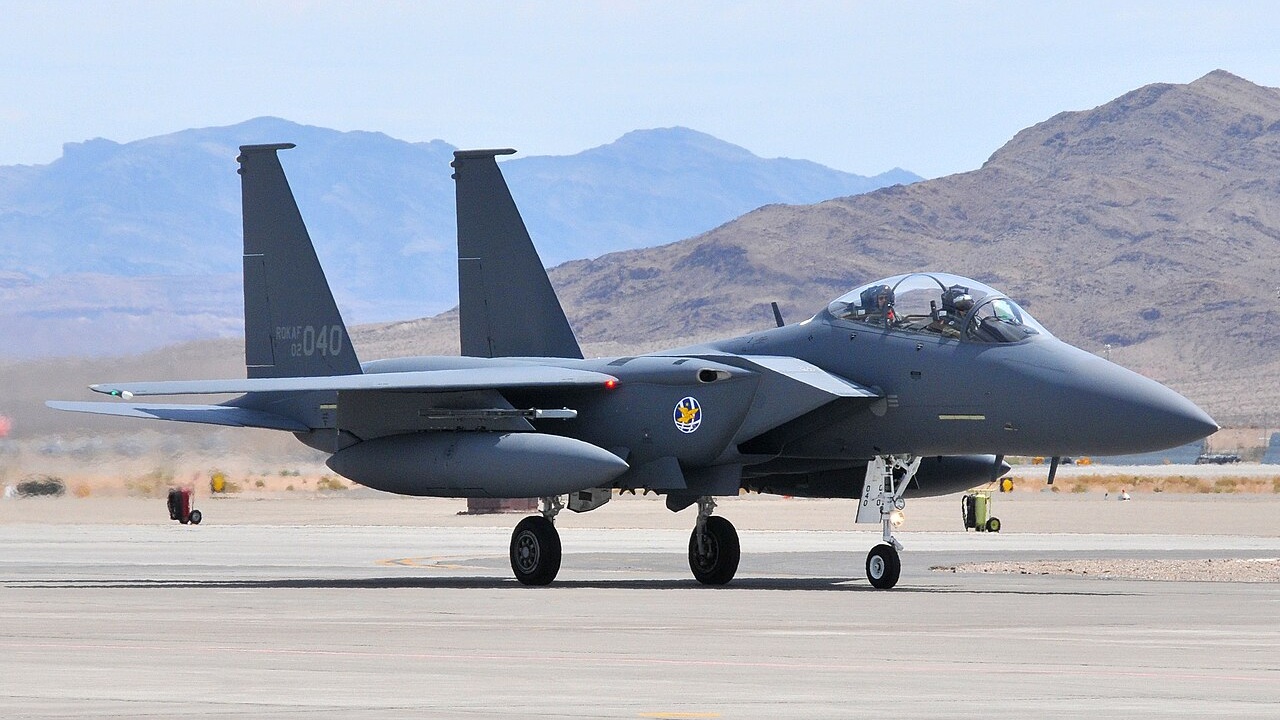
The upgrade package for South Korea’s F-15K fighters—altogether worth nearly $3 billion—is expected to keep them flying until at least 2060.
Aerospace giant Boeing has been awarded a $2.8 billion contract to modernize South Korea’s fleet of F-15K Slam Eagle jet fighters. The existing aircraft will be upgraded to the United States Air Force’s F-15EX Eagle II standard—following a similar effort undertaken by the Japan Air Self-Defense Force (JASDF), which modernized its F-15Js to the F-15JSI (Japan Super Interceptor) standard.
The United States Department of Defense (DoD) announced the contract award at the end of last month. The award was issued via the Foreign Military Sales (FMS) program, with the Air Force Life Cycle Management Center at Wright-Patterson Air Force Base, Ohio, serving as the contracting activity. The work will be conducted at Boeing’s St. Louis, Missouri, facility—the same site that originally produced the fighters—and will run through the end of 2037.
South Korea currently operates 59 Slam Eagles, and it is unclear how many will be rotated to the United States for modernization. However, once completed, the aircraft is expected to remain in service with the South Korean air force until the early 2060s.
What to Know About South Korea’s F-15K Fighter Jet
- Year Introduced: 2002
- Number Built: ~61 (59 in service)
- Length: 63.8 ft (19.43 m)
- Wingspan: 42.8 ft (13.05 m)
- Max Takeoff Weight: 81,000 lb (36,700 kg)
- Powerplant: Two Pratt & Whitney F100-229 afterburning turbofans
- Top Speed: Mach 2.5+ (1,650 mph, 2,650 km/h)
- Combat Radius: ~790 miles (1,270 km) with a typical load
- Service Ceiling: 60,000 ft (18,200 m)
- Loadout: AN/APG-63(V)1 Active Electronically Scanned Array (AESA) radar; 20mm autocannon; >13,000 kg (29,000 lb) payload, including Taurus KEPD 350 bunker-buster missiles, AGM-84D Harpoon, AIM-9 Sidewinder, AIM-120 AMRAAM
- Aircrew: 2 (pilot and weapon systems officer)
Seoul first adopted the F-15K in 2002 as part of a $4.2 billion deal to modernize its aircraft. The Boeing-made variant of the F-15E beat out competing options, including the Eurofighter Typhoon and the French Dassault Rafale. Although assembly was completed in St. Louis, nearly 40 percent of the components were built by Korean firms, including fuselage, wings, and much of the avionics.
As the Slam Eagle was developed more than a decade after the F-15E entered service, the aircraft was outfitted at the outset with then-new technologies, including flat-screen displays in the cockpit that are compatible with night-vision goggles, and a Joint Helmet Mounted Cueing System permitting a pilot to acquire aerial targets for short-range AIM-9X missiles merely by pointing his or her head at them. The F-15K was also among the first F-15 variants to replace the original F-100 engines with F-110 turbofans, which delivered roughly 10 percent more thrust.
A second batch of F-15Ks was acquired in 2008 as part of the second phase of South Korea’s modernization efforts. Those models were equipped with Sniper-XR targeting pods but reverted to F100 PW-229 engines to leverage parts commonality with the engines on the RoKAF’s KF-16 fighters.
Unlike its American F-15E counterpart, the F-15K also features an AAS-42 Infrared search-and-track system, enabling the Slam Eagle to track aircraft at shorter ranges without activating its radar. The F-15K also initially benefited from a superior APG-63 (V)1 radar, which boasted a sea-search and target-identification mode to facilitate the F-15K’s use in a naval strike role.
Boeing’s F-15 Eagles Keep Soaring
F-15 Eagle variants will be a familiar sight at the aerospace firm’s St. Louis facility for at least the next decade. In addition to the F-15K Slam Eagle modernization, Boeing received an $8.6 billion contract at the end of 2025 to produce 25 F-15IA aircraft for the Israeli Air Force.
The F-15IA is a customized variant of the F-15EX, which will replace the IAF’s aging F-15I aircraft that have been in service for decades.
About the Author: Peter Suciu
Peter Suciu has contributed over 3,200 published pieces to more than four dozen magazines and websites over a 30-year career in journalism. He regularly writes about military hardware, firearms history, cybersecurity, politics, and international affairs. Peter is also a contributing writer for Forbes and Clearance Jobs. He is based in Michigan. You can follow him on Twitter: @PeterSuciu. You can email the author: [email protected].
Image: Wikimedia Commons.