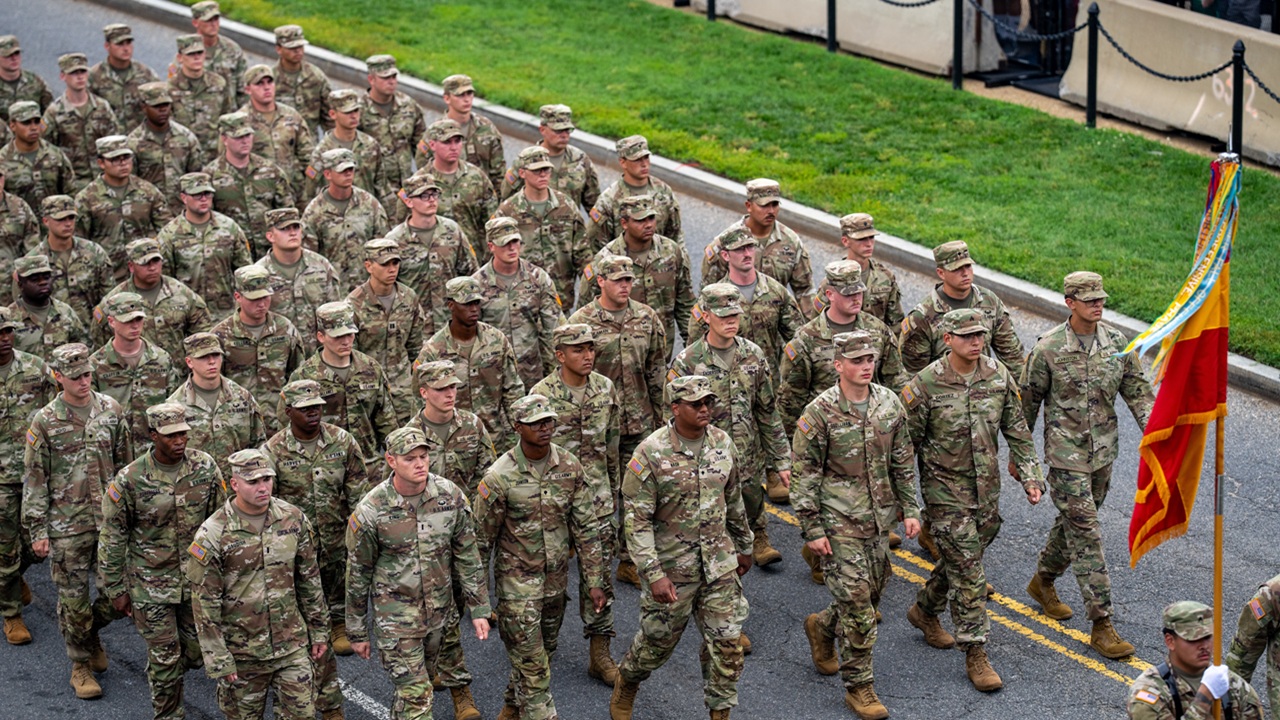
As wealthier (and disproportionately white) Americans have lost interest in military service in the volunteer era, minority groups are serving in steadily greater numbers.
Since taking his post nearly a year ago, Secretary of Defense Pete Hegseth has waged a war against everything he viewed as “woke” within the Pentagon, most notably its “DEI” programs. The “Diversity, Equity, and Inclusion” efforts that began under President Joe Biden were intended to make leadership within the United States Armed Forces more closely reflect the changing dynamics of the United States.
However, try as he might, Hegseth cannot reduce the military’s diversity, as it has been on a course towards increasing diversity since it desegregated in the aftermath of World War II. Ironically, as The Wall Street Journal reported this week, DEI initiatives created the recruitment crisis that the military faced in recent years—but in their absence, the historical norm has returned.
The Military Has Long Been a Path of Upward Mobility
A newly published paper from the US Naval Institute also suggested that “The US Military is Becoming More Diverse, and Not by Design.” The authors, Captain David Smith, US Navy (Retired), and Brad Johnson, wrote, “While current policy forbids efforts to intentionally make the military more diverse, a more ethnically and racially diverse military force is inevitable because of demographic realities and recruiting challenges.”
As a nation of immigrants, the US military has been far more diverse than it might have appeared in black-and-white photographs from the late 19th and early 20th centuries. Smith and Johnson noted that since 1973, the US military has been an “all-volunteer force,” which has only increased its diversity. That coincided with “military service as an obligation of citizenship,” the authors added.
Slowly, too, barriers of entry were lowered, while the opportunities for minorities within the service increased. “For many working-class and lower-income Americans, military service became a reliable means of upward mobility and a route to securing their share of the American Dream,” suggested Smith and Johnson.
Wealthy Americans Are Losing Interest in Military Service
At the same time, middle- and upper-class children have increasingly strayed away from military service, pursuing more lucrative careers elsewhere. College admissions steadily increased with Baby Boomers and Generation X, with each generation more educated than their parents. Among Millennials, college enrollment increased from 15.3 million in 2000 to 21 million in 2010.
The services have struggled to meet recruitment goals, partly because interest among middle-class youth is low and partly because many interested individuals fail to meet the physical requirements. Recent studies have found that fewer than a quarter of Americans aged 17 to 25 are even eligible to serve without a waiver due to physical or mental reasons. The services have increasingly looked past prior drug use, accept individuals with tattoos that would have previously barred service, and have offered pre-boot camp training to physically prepare potential recruits.
Those efforts have begun to pay off. Yet Hegseth’s renewed demands that the US military return to a “warrior ethos” may impact recruiting, which in turn could impact readiness in areas like drone warfare, cyber warfare, psychological operations, and other asymmetric warfare roles.
At the same time, this push could continue to make the service more “diverse” in the process. The white middle-aged kids who grew up playing Call of Duty video games may be less inclined to join the actual military. This is hardly new; a 2007 study found that Black Americans were “overrepresented” in the military during the entire era of the all-volunteer force. Similarly, in 2022, Latino service members accounted for 25 percent of all new enlistees.
Women have likewise been underrepresented in the Armed Forces, yet a 2019 Pew Research study found that, as the military shrank following the Cold War, women held more leadership positions. The number of female officers increased from 5 percent in 1975 to 18 percent in 2017, and that figure likely rose further during the Biden years.
Hegseth and President Donald Trump have not yet sought to reduce the number of women in leadership roles. If they did, such a move could harm retention rates, and the services may again struggle to meet recruiting goals.
“The real choice is whether leaders will meet that future deliberately—by strengthening opportunity, representation, and trust—or allow hesitation, archaic notions of masculinity, and nostalgia to erode the very foundation of the All-Volunteer Force,” suggested Smith and Johnson.
Hegseth’s Anti-DEI Initiatives Aren’t Doing Much Good
Many critics of DEI share Hegseth’s view that “firsts” and similar milestones didn’t improve the military’s ability to wage war. Yet, as with many facets of the Trump administration, the response has been disproportionate to what it sought to address. That has included the renaming of military bases again, reverting to “similar” names as those that were replaced.
Yet the question remains: what was actually accomplished by doing so?
Bases like Fort Bragg, which was formerly named for a Confederate general—and a notoriously incompetent one at that—was changed to Fort Moore, to honor General Hal Moore, the first soldier in his West Point graduating class of 1945 to be promoted to brigadier general, major general, and lieutenant general. The Naming Commission spent $21 million to change all the names, only to spend even more to revert them after Trump returned to office.
Yet, because Congress would disapprove of the new changes, the installation now honors Private First Class Roland L. Bragg, who was awarded a Silver Star for actions during the Battle of the Bulge in World War II. The latter Bragg’s connection to the base was even more tenuous than Moore’s. Although the general was a native of Kentucky, he trained at the base while assigned to the 82nd Airborne Division, whereas PFC Bragg was from Maine and likely never visited the base.
Hegseth has argued that DEI didn’t make the military more effective or more lethal. Using the same rubric, did the name changes yield any measurable effects—or was it merely about undoing something undertaken by the Biden administration?
About the Author: Peter Suciu
Peter Suciu has contributed over 3,200 published pieces to more than four dozen magazines and websites over a 30-year career in journalism. He regularly writes about military hardware, firearms history, cybersecurity, politics, and international affairs. Peter is also a contributing writer for Forbes and Clearance Jobs. He is based in Michigan. You can follow him on Twitter: @PeterSuciu. You can email the author: [email protected].
Image: Shutterstock / Volodymyr TVERDOKHLIB.