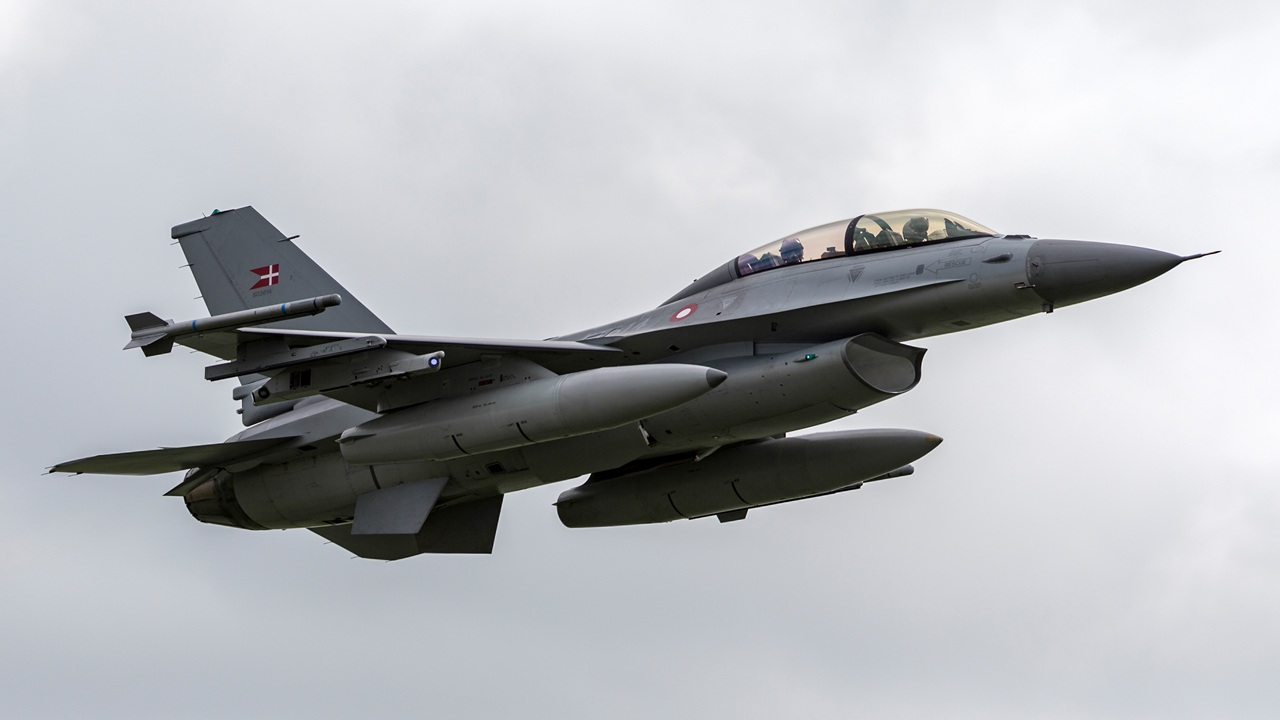
The Argentine Air Force has purchased six secondhand F-16 Fighting Falcon fighter jets from Denmark, following regulatory approval from the United States.
The migratory distance from some falcons can be extreme, with the peregrine falcon making an annual round-trip migration of upwards of 25,000 km (15,500 miles). This is even farther—and far more taxing on the bird—than the roughly 12,000 km (7,450 miles) that six Fighting Falcons will take from Denmark to Argentina.
However, while the peregrine falcon returns north in summer, for the American-made F-16s, it was a one-way trip, as they are slated to enter service with the Fuerza Aérea Argentina (Argentine Air Force). Moreover, unlike the exhausted bird, the Fighting Falcons will have support along the way, including transport and tanker aircraft.
About the F-16 Fighting Falcon
- Year Introduced: 1978
- Number Built: 4,600+
- Length: 47 ft 8 in (14.52 m)
- Wingspan: 31 ft (9.45 m)
- Weight (MTOW): 37,500 lbs (16,875 kg)
- Engine: One Pratt & Whitney F100-PW-220 afterburning turbofan (23,000 lbf thrust static sea level)
- Top Speed: 1,319 mph (2,122 km/h) / Mach 1.73
- Range: 1,260 mi (2,027 km)
- Service Ceiling: 50,000 ft (15,240 m)
- Loadout: One (1) General Electric M61A1 20mm six-barrel cannon; up to 15,200 lbs on nine hardpoints, including air-to-air missiles (AIM-9 Sidewinder on wingtip rails; alternatives include the MATRA Magic 2 or Rafael Python 3)
- Aircrew: 1 (F-16A) or 2 (F-16B)
There are approximately 3,000 operational F-16s in service today with more than 25 countries, a testament to what is easily the world’s most successful, combat-proven multirole jetfighter ever produced.
The fast and agile F-16 Fighting Falcon is one of the world’s best fighter jets, but is also among the most cost-effective. While it lacks the range and payload of the larger twin-engine F-15 Eagle, it also costs less than half as much. That is why the fourth-generation F-16 has been in service since the late 1970s—and will likely remain so for many more years.
This “warbird” has been battle-tested, having engaged in more than 400,000 combat sorties and accumulated a combined 19 million flight hours. It has been adapted to complete a number of missions, including air-to-air fighting, ground attack, and electronic warfare. As a combat fighter, the F-16 has proven to be highly maneuverable, while its combat radius exceeds that of its potential threats.
A Pre-Holiday Delivery of Secondhand F-16 Fighter Jets
The six former Danish Air Force F-16s are the first batch of the 24 aircraft that Copenhagen sold to Buenos Aires as part of a $300 million deal finalized in April 2024, after Washington approved the sale. In addition to the two dozen F-16A/B mid-life upgrade (MLU) modernized jets, the South American nation will also receive spare parts and training equipment.
Last December, the Argentine Air Force received an F-16B Fighting Falcon two-seat trainer just in time for the holidays. As with many purchases made during the holiday season, some assembly was required. Unlike the half-dozen Fighting Falcons now en route from Northern Europe to South America, the F-16B could be transported in pieces inside a KC-130H cargo plane, as the Block 10 aircraft was a non-flying unit used for ground-based training.
The South American nation had been exploring numerous options, including aircraft from China and Russia—notably the Sukhoi Su-24 (NATO reporting name “Fencer”) and the Chinese-Pakistani JF-17 Thunder fighter jets. Washington certainly didn’t want to see Beijing gain a foothold in the South American nation’s defense and security infrastructure, which could have led Buenos Aires to opt for other Chinese military hardware.
About the Fighting Falcons’ Migration Pattern
This first full batch of aircraft, including four two-seat F-16BM and two single-seat F-16AMs, departed from Denmark on Friday, November 28, and flew to Zaragoza, Spain, for refueling and flight checks. This week, the aircraft is continuing to Gran Canaria, the largest of the Canary Islands—then on a long flight across the Atlantic to Brazil, before arriving in Córdoba, Argentina, on December 5.
Along the way, the Argentine Air Force will deploy a Boeing 737-700 (T-99) and a C-130 (TC-69), with the United States Air Force also providing a KC-135 tanker to refuel the Fighting Falcons during the flight across the Atlantic Ocean.
Once officially handed over to the Latin American nation, the aircraft will be operated by the Brigada Aérea IV (4th Air Brigade). It will restore the country’s supersonic jet capability for the first time since 2015, when Buenos Aires officially retired the last of its Dassault Mirage III fighters.
NATO member Denmark had been among the earliest European operators of the F-16, part of the European allies’ consortium that selected the single-engine F-16A/B as the standard lightweight fighter. Since its adoption, the Royal Danish Air Force has employed the Fighting Falcon in national air policing, NATO Baltic Air Policing (BAP), Arctic patrols over Greenland, and international missions, including the Balkans in the late 1990s and Afghanistan, Iraq, and Libya during the Global War on Terrorism.
Over time, the two dozen Danish F-16s underwent multiple MULs that upgraded numerous systems.
About the Author: Peter Suciu
Peter Suciu has contributed over 3,200 published pieces to more than four dozen magazines and websites over a 30-year career in journalism. He regularly writes about military hardware, firearms history, cybersecurity, politics, and international affairs. Peter is also a contributing writer for Forbes and Clearance Jobs. He is based in Michigan. You can follow him on Twitter: @PeterSuciu. You can email the author: [email protected].
Image: Shutterstock / Ryan Fletcher.