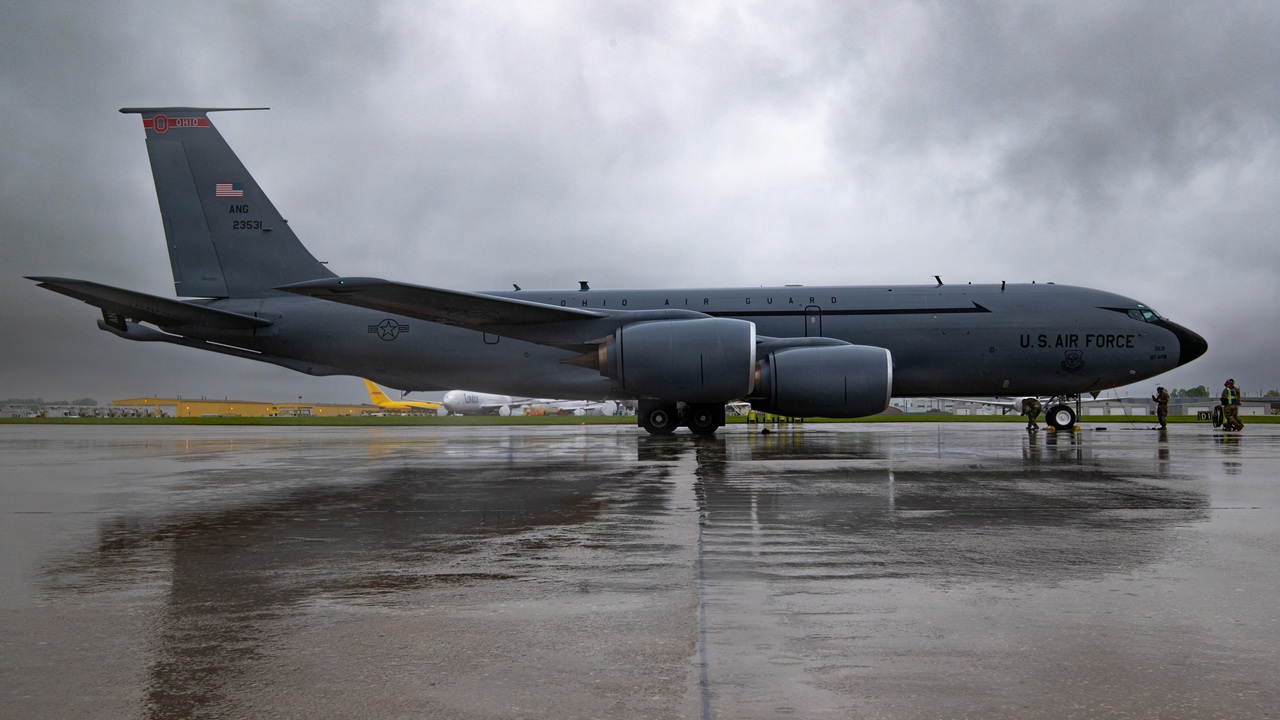
US Central Command confirmed the deaths of the six aircrew on board the KC-135 Stratotanker—bringing the US death toll in Operation Epic Fury up to 13.
The United States Central Command (CENTCOM) confirmed on Thursday evening that a Boeing KC-135 Stratotanker aerial refueler had crashed in western Iraq, killing its six crewmembers.
Although CENTCOM provided few details on the crash, it stressed that it had not been a result of either enemy or friendly fire, and said it would provide additional information as it became available.
“The incident occurred in friendly airspace during Operation Epic Fury, and rescue efforts are ongoing. Two aircraft were involved in the incident. One of the aircraft went down in western Iraq, and the second landed safely,” CENTCOM announced in a statement.
The service confirmed in a subsequent media statement that all six crewmembers had been killed in the crash.
The KC-135 is the fourth US aircraft lost in the ongoing Operation Epic Fury, after three F-15E Strike Eagles were shot down in a friendly fire incident last week. All three F-15E pilots survived the shootdown with minimal injuries.
The tanker crash brings the confirmed US death toll from Operation Epic Fury up to 13. In addition, the Pentagon announced on Tuesday that around 140 soldiers had been injured.
The rising death toll will likely bring greater scrutiny to the conflict’s timetable and conditions for victory. Soon after President Donald Trump announced the first strikes against Iran on February 28, he speculated that the conflict could last four to five weeks. On Monday, he described it as “very complete”—but quickly clarified that he did not mean US strikes would imminently end.
Later, on Thursday, during an event at the White House, Trump claimed that Operation Epic Fury was “moving along very rapidly”—but did not provide any clarification on an end date.
About the KC-135 Stratotanker
- Year Introduced: 1957
- Number Built: 803
- Length: 136 ft, 3 in (41.53 m)
- Wingspan: 130 ft, 10 in (39.88 m)
- Weight (MTOW): 322,500 lb (146,285 kg)
- Propulsion: Four CFM International CFM-56 turbofan engines (21,634 lbf each)
- Top Speed: 530 mph (853 km/h)
- Range: 1,500 mi (2,419 km) with 150,000 lb (68,039 kg) of transfer fuel; ferry mission, up to 11,015 mi (17,766 km)
- Service Ceiling: 50,000 ft (15,240 m)
- Loadout: Up to 200,000 lb (90,700 kg) fuel; 83,000 lb (37,648 kg) cargo; 37 passengers
- Crew: 3 (pilot, co-pilot, boom operator); some KC-135 missions also require a navigator
The KC-135 Stratotanker is based on the Boeing 707, the aerospace manufacturer’s first intercontinental passenger jet. It has provided the Air Force with its core aerial refueling capability since entering service with the United States Air Force in June 1957. The KC-135 allows the US military to accomplish its primary mission anywhere in the world.
A total of 803 Stratotankers were produced between 1955 and 1965. 417 of the original KC-135As have been updated with new engines, enabling them to serve as flying fuel stations for the US military and its allies for decades to come.
According to the Air Force, the Stratotankers equipped with the new CFM-56 engines, and redesignated as the KC-135R or KC-135T models, are 25 percent more fuel-efficient, 96 percent quieter, and can offload 50 percent more fuel than the base model.
The Crash Was the US Military’s Second Mishap of the Day
The crash involving the KC-135 was reported just hours after a fire broke out on the United States Navy’s USS Gerald R. Ford (CVN-78), which is now operating in the Red Sea. The fire occurred in the laundry facility. Two sailors suffered non-threatening injuries.
About the Author: Peter Suciu
Peter Suciu has contributed to dozens of newspapers, magazines and websites over a 30-year career in journalism. He regularly writes about military hardware, firearms history, cybersecurity, politics, and international affairs. Peter is also a contributing writer for Forbes and Clearance Jobs. He is based in Michigan. You can follow him on Twitter: @PeterSuciu. You can email the author: [email protected].