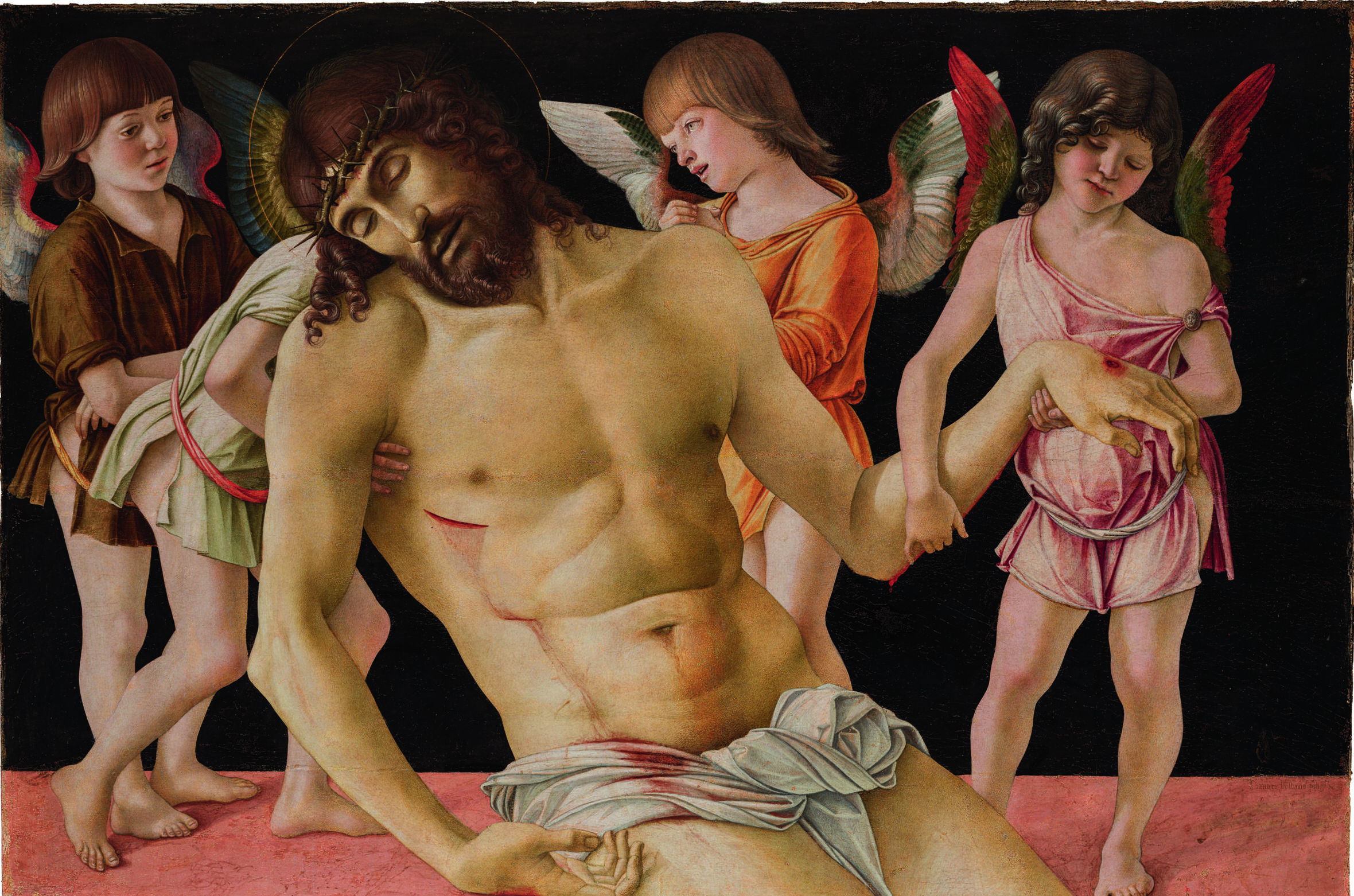
In 1910, J. P. Morgan was sure he had finally gotten his hands on a bona fide Bellini, and he promptly hung Virgin and Child Blessing a Kneeling Donor, with Four Saints (ca. 1500) in his private study. Unfortunately for Morgan, later analysis conclusively proved that the picture was misattributed and was in fact executed by a disciple of Bellini, Marco Bello. Now, Marco Bello has been replaced with the genuine article: Giovanni Bellini’s freshly restored Pietà (ca. 1470), on loan from the city museum of Rimini, has come to the Morgan Library.
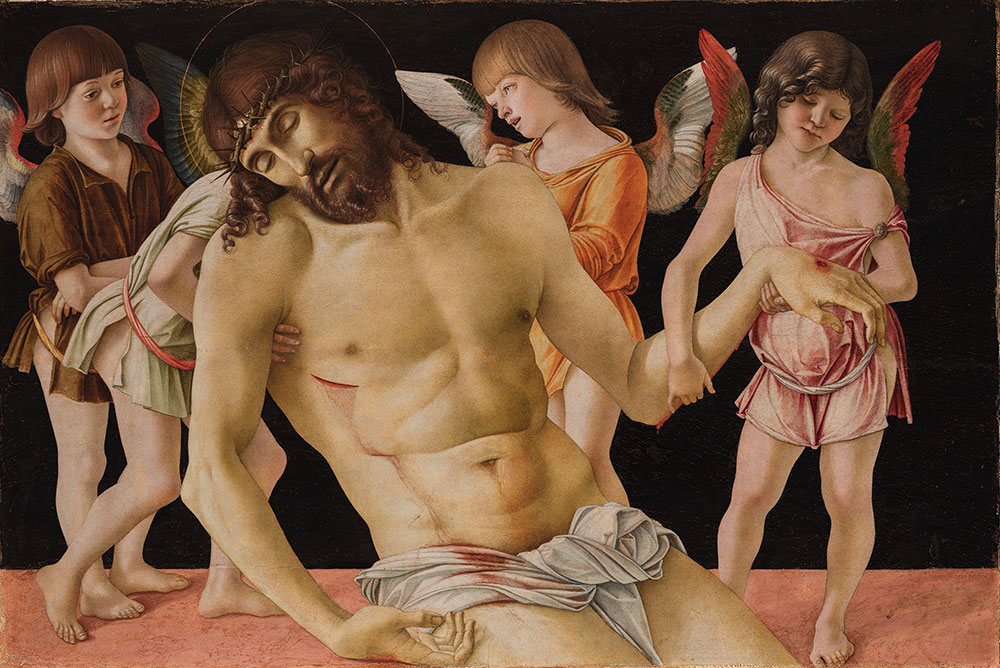
Those expecting something akin to Michelangelo’s famous sculpted masterpiece are in for a surprise. Indeed, the Rimini Pietà is unusual even by the standards of Bellini himself, who was no stranger to the subject: Mary, a staple of the genre, is nowhere to be seen, and Bellini’s signature flowing landscapes are here replaced by a simple black background. The emptiness removes any temporal and spatial particularities, making the work a timeless devotional icon—an imago pietatis, a picture of the dead Christ meant to inspire piety.
Bellini shows Christ in the typical guise of the Man of Sorrows: half-length, eyes closed, nude but for a loincloth, with one small wound on the chest. His idealized body, supported by four boyish putti, projects into the viewer’s space and draws us in. The composition is strikingly asymmetrical: Christ’s body and three of the cherubs are crammed together, while the last angel, isolated and quietly contemplating Christ’s pierced hand, takes up a good third of the work.
The Rimini Pietà, reminiscent of an ancient frieze, is remarkably classical. The color scheme—the black background, the white of Christ’s sculpted body, and the reddish orange of the blood, the boys’ clothes, and the ledge—reminds one of an Attic red-figure vase. Bellini has clearly borrowed from the classicizing Donatello bronze relief (1449–50) adorning the high altar of Padua’s Cathedral of Saint Anthony, in which a half-length Christ is enveloped in a shroud by two putti, who hold their heads in their hands in visible shock and horror. Donatello’s relief is pleasingly symmetrical, and its influence is detectable in the closest parallel for the Rimini Pietà, Bellini’s Dead Christ supported by Two Angels (ca. 1475), at the National Gallery in London. Unlike Donatello’s baby-faced putti or the London painting’s dejected cherubim, the winged boys in the Rimini Pietà seem somewhat detached from the tragedy at hand. In fact, Bellini’s figures are probably not angels—they lack the characteristic red and blue flowing robes of the seraphim—and are now understood as spiritelli, the playful imps often sculpted on ancient Roman and Renaissance sarcophagi.
Bellini’s Pietà was commissioned by Rainerio di Lodovico Migliorati, a noted humanist and consigliere to the Malatesta dynasty that ruled Renaissance Rimini. According to Migliorati’s will, the painting was meant to be displayed in his private funeral chapel but ended up in Rimini’s Tempio Malatestiano, the magnificent Church of San Francesco partly rebuilt by Leon Battista Alberti. There Bellini’s work was admired by Giorgio Vasari, the great art historian, who singles out this specific Pietà in his biography of Giovanni Bellini (1550), and one can see why: it is an extraordinarily moving reflection on the incommensurate and incomprehensible nature of death. The lack of the explicit lamentation typical of the imago pietatis makes this picture all the more poignant.
Bellini’s picture is not the only Renaissance painting of the dead Christ now on display at the Morgan. On the other side of Morgan’s study hangs Pietro Perugino’s Man of Sorrows (1495), on loan from the National Gallery of Umbria, located in the artist’s hometown of Perugia. As with the Bellini, this is the first time that this work has ever traveled to the United States.
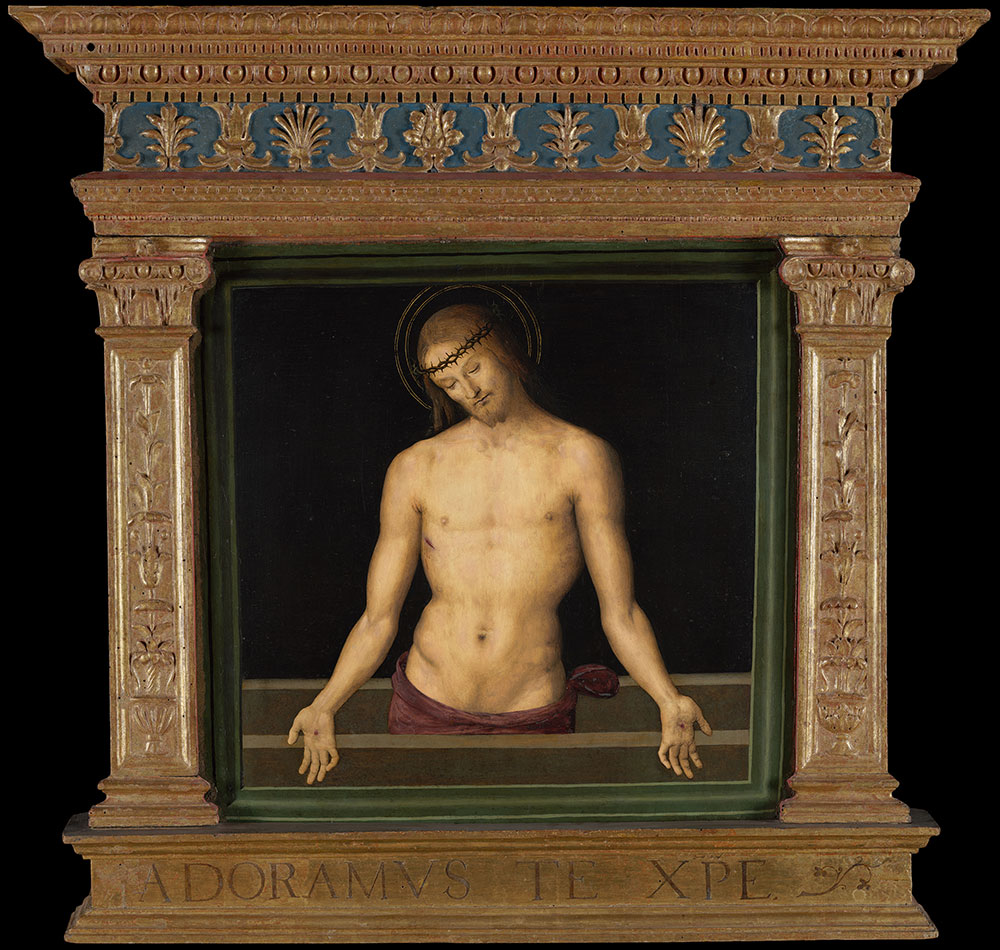
Just as in the much larger Bellini panel, the subject of Perugino’s Man of Sorrows is shown at half-length, with eyes closed, and on a black background. Perugino’s symmetrical composition, however, could not be more different, and his Christ, all alone, is perfectly centered, arms splayed out on either side. Perugino’s Christ also lacks the defined musculature, luscious beard, and carefully rendered curls of Bellini’s, giving Perugino’s figure a gaunter look. Adding to the sense of desolation, Christ’s body has seemingly risen from the grave of its own accord, with no external support propping it up.
The Man of Sorrows originally served as the crowning topmost panel (cimasa) of an altarpiece commissioned by the Decemviri—the ruling magistrates of Perugia—for the chapel of the Palazzo dei Priori (the city hall). During the Napoleonic Wars, it was separated from the main panel (also by Perugino), showing an enthroned Virgin and Child surrounded by saints, which ended up in the Vatican Museums. Perugino intended the viewer first to take in the massive, majestic scene of the Madonna and Christ, before lifting his eyes to witness the tragic culmination of Christ’s life on Earth.
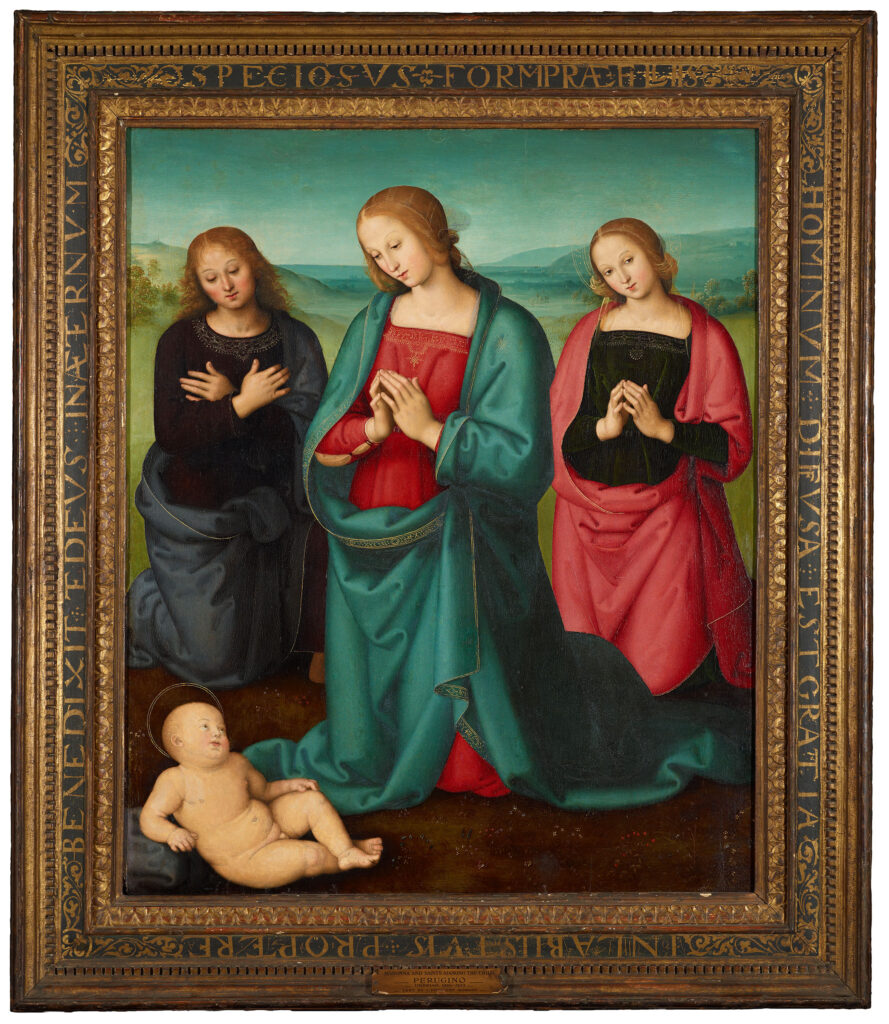
Visitors to the Morgan can still get a taste of the jarring juxtaposition that Perugino intended by simply walking around Morgan’s study. On the other side of the room from the Man of Sorrows hangs Perugino’s Virgin and Saints Adoring the Christ Child (1500), part of the Morgan’s permanent collection. Showing Mary, a feminine-looking John, and another female saint kneeling before the Christ child, the painting exudes the harmony and serenity that became a hallmark of the oeuvre of Perugino’s most famous disciple, Raphael. The deep, vibrant hues of the flowing clothes and of the rolling landscape are typical of Perugino’s “grace of coloring” (in Vasari’s words); there could not be a greater contrast with the limited palette and somber austerity of the Man of Sorrows.
What Perugino articulates in two paintings, Bellini captures in one: the contrast between innocent beauty and unimaginable suffering, eternal life and untimely death, the alpha and the omega.