Russia’s systems are not designed to be perfect, as American ones are. But they are good enough—and can punch far above their weight in engagements with the West.
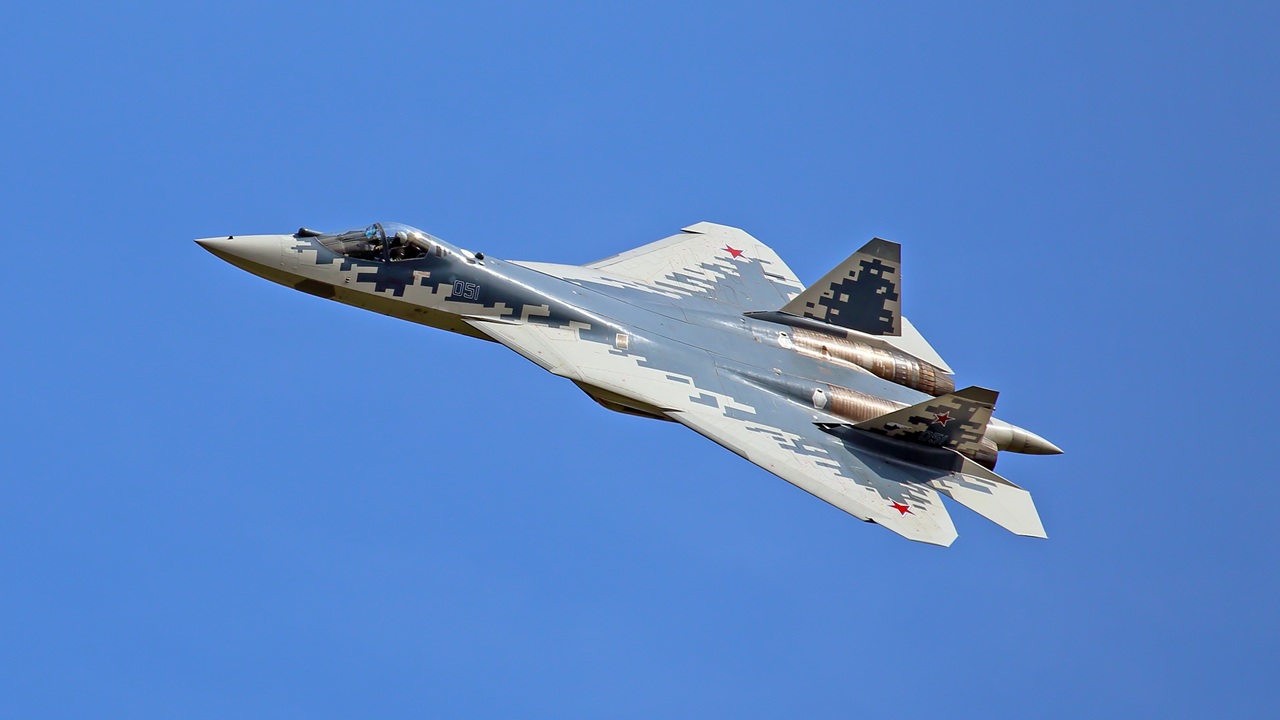
For years, the US national security establishment laughed off the Su-57 “Felon,” Russia’s much-touted fifth-generation fighter jet. Beltway experts dismissed the fighter as a Potemkin airplane—an overhyped, underproduced, malfunction-prone symbol of Moscow’s declining aerospace sector in the post-Cold War era. But Russia is the one laughing at the Americans and their NATO partners.
In fact, the Su-57 matters significantly.
No, the Kremlin isn’t trying to build a clone of the F-22 Raptor. It’s building something uniquely Russian—and quite dangerous to the West.
Comparing Russia’s Su-57 Felon to America’s F-22 Raptor
| Aircraft | Su-57 Felon (Russia) | F-22 Raptor (USA) |
| Year Introduced | 2020 | 2005 |
| Number Built | ~32, including prototypes | 195 (including 8 prototypes) |
| Length | 20.1 m (65 ft 11 in) | 18.9 m (62 ft 1 in) |
| Wingspan | 4.6 m (15 ft 1 in) | 13.6 m (44 ft 6 in) |
| Weight (MTOW) | 35,000 kg (77,162 lb) | 37,900 kg (83,500 lb) |
| Engine(s) | Two Saturn AL-41F1 afterburning turbofan engines (19,900 lbf thrust each) | Two Pratt & Whitney F119-PW-100 afterburning turbofans with thrust vectoring |
| Top Speed | 2,135 km/h (1,327 mph) / Mach 2 | 2,414 km/h (1,500 mph) / Mach 2.25 |
| Range (Ferry Range) | 3,500 km (2,200 mi) | ~2,960 km (1,839 mi) |
| Service Ceiling | 20,000 m (65,600 ft) | 20,000 m (65,600 ft) |
| Loadout | One 30 mm Gryazev-Shipunov GSh-30-1 autocannon; 12 hardpoints (6 internal, 6 external); 7,500 kg (16,500 lb) total payload capacity | M61A2 20mm rotary cannon; up to six AIM-120 AMRAAMs and two AIM-9 Sidewinders in internal bays; external hardpoints |
| Aircrew | 1 | 1 |
How American Analysts Have Misjudged the Su-57
Washington’s analysts constantly judge the Su-57 through an F-22 or F-35 lens. Russia doesn’t fight that way. Their defense strategy—as seen in Ukraine thus far—is fundamentally one of attrition: using old, simple technology that can be reliably built to overwhelm the designer platforms of the West.
Russia’s model is all about good enough. The Su-57 has good enough stealth, good enough avionics—and overwhelming missile performance, brutal maneuverability, and an aggressive electronic warfare capability, as well as battlefield adaptability.
American planes are aspirational, whereas Russian birds are practical. US warplanes, like the F-35, depend upon whizbang gadgetry to stylishly win an engagement. The Su-57 relies upon brute force and guile. It’s a Klingon Bird of Prey compared to the Starship Enterprise.
Russian designers understand that they cannot match America’s sensor fusion or stealth manufacturing. So they simply built an asymmetrical capability designed to slash at America’s most vulnerable arteries. They did what all worthy adversaries do: they matched their strengths against our weaknesses.
Of course, the Su-57 has certain disadvantages compared to American fighters. It has less advanced stealth than American birds do. Its production numbers are also extremely small (at least for now). And the fighter is having engine issues. However, dismissing the Su-57 is typical of the hubris one often finds in Washington. That same hubris told the Pentagon in the early 2000s that China would not be able to build its own competitive stealth jets for generations…right before China began to crank out the Chengdu J-20 “Mighty Dragon” stealth fighters at an industrial scale.
The Su-57 is built around one, enduring strategic truth: Russia doesn’t need to beat American fighters in a fair fight—because there never will be a fair fight!
What Is the Su-57 Good For?
Moscow needed a high-end air superiority jet that can launch extreme-range hypersonic and Mach-6 missiles from deep inside Russian airspace, while using its “good enough” stealth to complicate US targeting—all while massive Russian surface-to-air missile (SAM) batteries create a lethal umbrella round it. Suddenly, the math looks very different.
Essentially, the Su-57 is a missile truck with wings. The real danger of the Su-57 isn’t the airplane itself, but what it carries in its internal bays. Weapons like the R-73—a Mach 6, 200–400-kilometer monster—were designed to erase AWACS planes, tanker aircraft, and critical enabling platforms from the skies. In a war with Eastern Europe, American fighters would be forced to push farther forward, with less airborne support.
This means that there would be shorter time on station for the American birds, less ability to network, more vulnerability, degraded radar coverage, and reduced command-and-control coherence. The Su-57 doesn’t need to kill 100 F-35s. It only needs to destroy a few essential enablers to collapse the whole American/NATO air war architecture (which may be the real reason behind why Moscow has held back its Su-57 fleet from the frontlines of the Ukraine War).
Indeed, this is the same logic behind Russia’s massive investments in its Zircon, Kinzhal, and S-400 systems. These weapons aren’t designed to fight the US symmetrically. They are made to cut the tendons of the US defense apparatus.
Anyway, Ukraine is a massive weapons laboratory for both sides. In this lab, Russia is testing Su-57 radar modes. Moscow is calibrating electronic countermeasures (ECM) against NATO-supplied systems. They’re launching standoff weapons under real, wartime pressure.
Further, Russia is integrating unmanned aerial vehicle (UAV) reconnaissance to feed Su-57 strike missions. And over time, the Russians are learning how to use Su-57s without exposing them to Ukrainian SAMs.
China doesn’t have this ability to test its equipment in real-world conditions. America hasn’t enjoyed that ability since Iraq. Russia, meanwhile, does—and is enhancing its aircraft every day.
The Su-57 Forces America to Spend a Lot More to Counteract It
Therefore, even a handful of Su-57s can force the US to spend billions responding. Because the jet demands that America and NATO make adjustments to their AWACS positioning, tanker routes, intelligence, surveillance, and reconnaissance (ISR) orbits, early warning radars, NATO air-defense layouts, forward-deployed F-35 tactics, and naval strike group air-defense postures.
The Su-57 is a cost-imposing weapon for the US military and the allied militaries seeking to do battle with Russia.
What’s more, the Su-57 matters because it is part of a wider, combat-tested ecosystem. For example, the Russians employ the S-400/S-500 integrated air defense system; massive, long-wave radars; hypersonic strike weapons, and other systems that augment the Su-57’s reach—making the Felon a scalpel rather than a battering ram for this ecosystem when squaring off against American and NATO forces.
Air wars among great powers, like Russia and America, aren’t fought in sterile environments. They’re ugly, with overlapping layers of jamming, missile swarms, long-range fires, degraded communications, AWACS hunting, fuel-tanker ambushes, and contested infrastructure. In that world, the Su-57 is far more dangerous than most in Washington have given it credit for.
About the Author: Brandon J. Weichert
Brandon J. Weichert is a senior national security editor at The National Interest. Recently, Weichert became the host of The National Security Hour on America Outloud News and iHeartRadio, where he discusses national security policy every Wednesday at 8pm Eastern. Weichert hosts a companion book talk series on Rumble entitled “National Security Talk.” He is also a contributor at Popular Mechanics and has consulted regularly with various government institutions and private organizations on geopolitical issues. Weichert’s writings have appeared in multiple publications, including The Washington Times, National Review, The American Spectator, MSN, and the Asia Times. His books include Winning Space: How America Remains a Superpower, Biohacked: China’s Race to Control Life, and The Shadow War: Iran’s Quest for Supremacy. His newest book, A Disaster of Our Own Making: How the West Lost Ukraine is available for purchase wherever books are sold. He can be followed via Twitter @WeTheBrandon.
Image: Shutterstock / Kosorukov Dmitry.