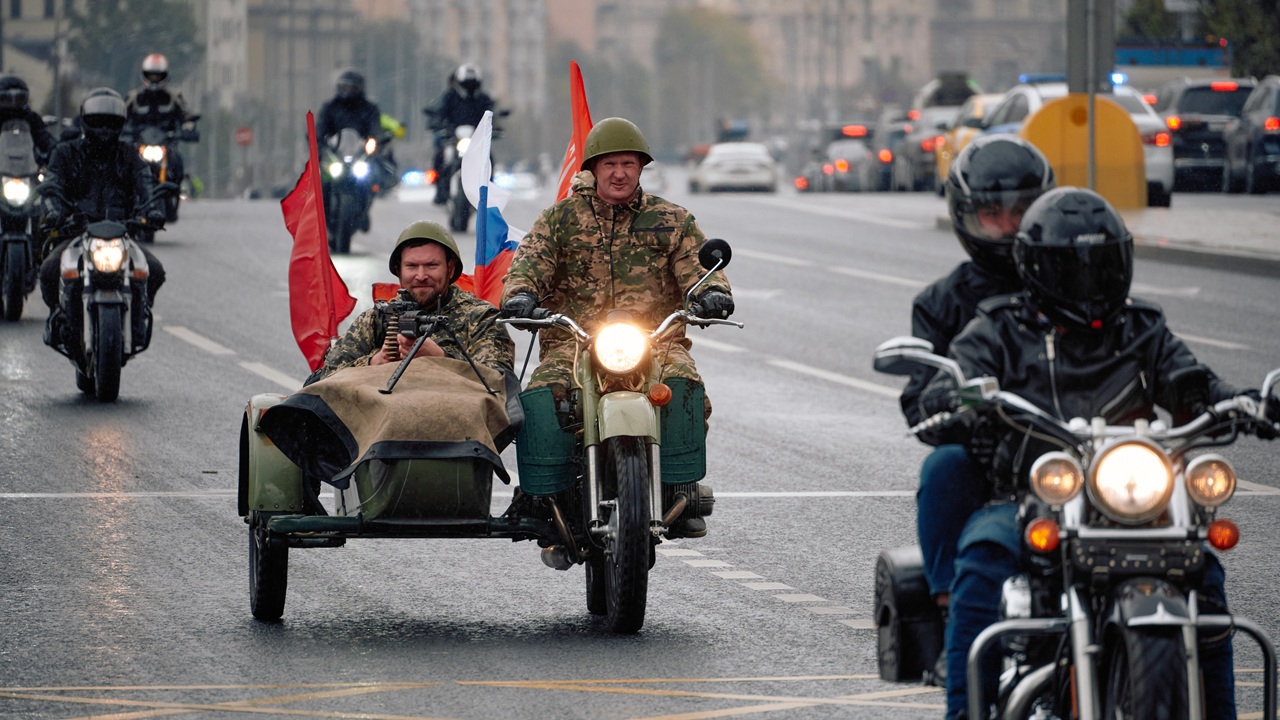
The motorcycle is not really “silent”—but it is far quieter than its existing gas-powered counterparts, allowing Russian scout troops to move quickly with less risk of detection.
From the moment the motorcycle was invented, the military saw a use for the fast-moving vehicles. Motorcycles continue to be employed by modern militaries in remote locations, including over rough terrain where larger vehicles might be too slow or conspicuous.
However, one major issue with their use has been noise. Motorcycles are typically much louder than cars, as their engines and exhaust systems are more exposed and their smaller mufflers provide less sound suppression. It has only been in recent years, with the development of electric motorcycles, that the issue has been addressed with any reasonable degree of success.
Can Kalashnikov’s Izh-Enduro Electric Motorbike Really Run Silent?
Russia’s state-owned Kalashnikov Concern announced this month that it has developed a new model of its Izh-Enduro motorcycle, which is available today for both military and civilian use. A lithium-ion battery powers a brushless Interior Permanent Magnet Synchronous Motor (IPMSM), which can operate in both constant-torque and constant-power regions. The motorcycle offers a high power-to-weight ratio, with a traditional manual transmission featuring a clutch and four gears.
This allows the electric motorcycle to reach speeds of up to 100 km/h (62 mph) on level terrain, still tackle rough terrain, and climb hills at lower speeds. It has a range of approximately 100 km (62 miles), depending on operating conditions, enough to ferry gear or conduct a scouting mission. The new Izh-Enduro weighs around 100 kg (220 lbs) and has a load capacity of 200 kg (440 lbs), with an optional trailer.
“The new Izh-Enduro with a trailer is designed for use as a silent, highly maneuverable military transport or for the needs of the Ministry of Emergency Situations with a payload in the trailer, as a commercial vehicle for recreational areas and recreation centers, for airfield personnel and environmental organizations, and also as a low-noise, high-speed patrol vehicle,” the press office of the Kalashnikov Concern said in a statement, according to TASS.
Although Kalashnikov claimed that the motorbike would be “silent,” this is likely a slight embellishment, as the Izh-Enduro’s IPMSM will still generate some vibration and audible noise. Still, the noise will be significantly less than an internal combustion gasoline engine.
The Russian military defense contractor highlighted that the electric motorcycle could be adapted for specific law enforcement and civilian roles—but there is little doubt that it will be the sort of vehicle the Russian military needs in Ukraine, where it has long struggled to scrape together adequate mobile transport.
Due to a shortage of transport, the Kremlin has relied on civilian cars and, in at least one instance, golf carts to move troops and equipment to the front!
Many Militaries Are Going Electric
Russia isn’t alone in recognizing the benefits of EVs. Indeed, some NATO members are experimenting with the platforms as well. The Belgian Army conducted tests of the STRiX Hard Enduro electric motorcycle earlier this year, following earlier evaluations by the US Navy—likely for use by SEAL operatives—and by the special forces of other NATO members.
Swedish-owned, Spain-based electric motorcycle manufacturer Stark Future, which developed electric motorcycles for the civilian market, has sought to enter the defense sector. Its light, fast, and very quiet bikes are also being tested by NATO nations.
For centuries, mounted troops served in a scouting role, ahead of a leading force. Without the roar of the gasoline engines, electric motorcycle troopers could fill a similar role.
About the Author: Peter Suciu
Peter Suciu has contributed over 3,200 published pieces to more than four dozen magazines and websites over a 30-year career in journalism. He regularly writes about military hardware, firearms history, cybersecurity, politics, and international affairs. Peter is also a contributing writer for Forbes and Clearance Jobs. He is based in Michigan. You can follow him on Twitter: @PeterSuciu. You can email the author: [email protected].
Image: Shutterstock / Truba7113.