Some have feared that Bryn Terfel is nearing the end of his career. A year ago, The New York Times reported as much in a story on the Welsh bass-baritone’s return to the Metropolitan Opera in what were said—incorrectly, as it turns out—to be his final performances as the villainous Scarpia in Giacomo Puccini’s Tosca. We need not have worried. At sixty, Terfel appears to be as active and capable as ever, appearing in a six-performance run of another of his signature roles, the title character in Mussorgsky’s Boris Godunov, in a revival of Richard Jones’s production for the Royal Opera. Though his Russian remains noticeably accented, the voice still booms with power and, when necessary, contracts to expose the deepest fears of the opera’s haunted tsar. “Who am I to say no?” he said, when the company asked him to return despite his suggestion that they cast a new singer.
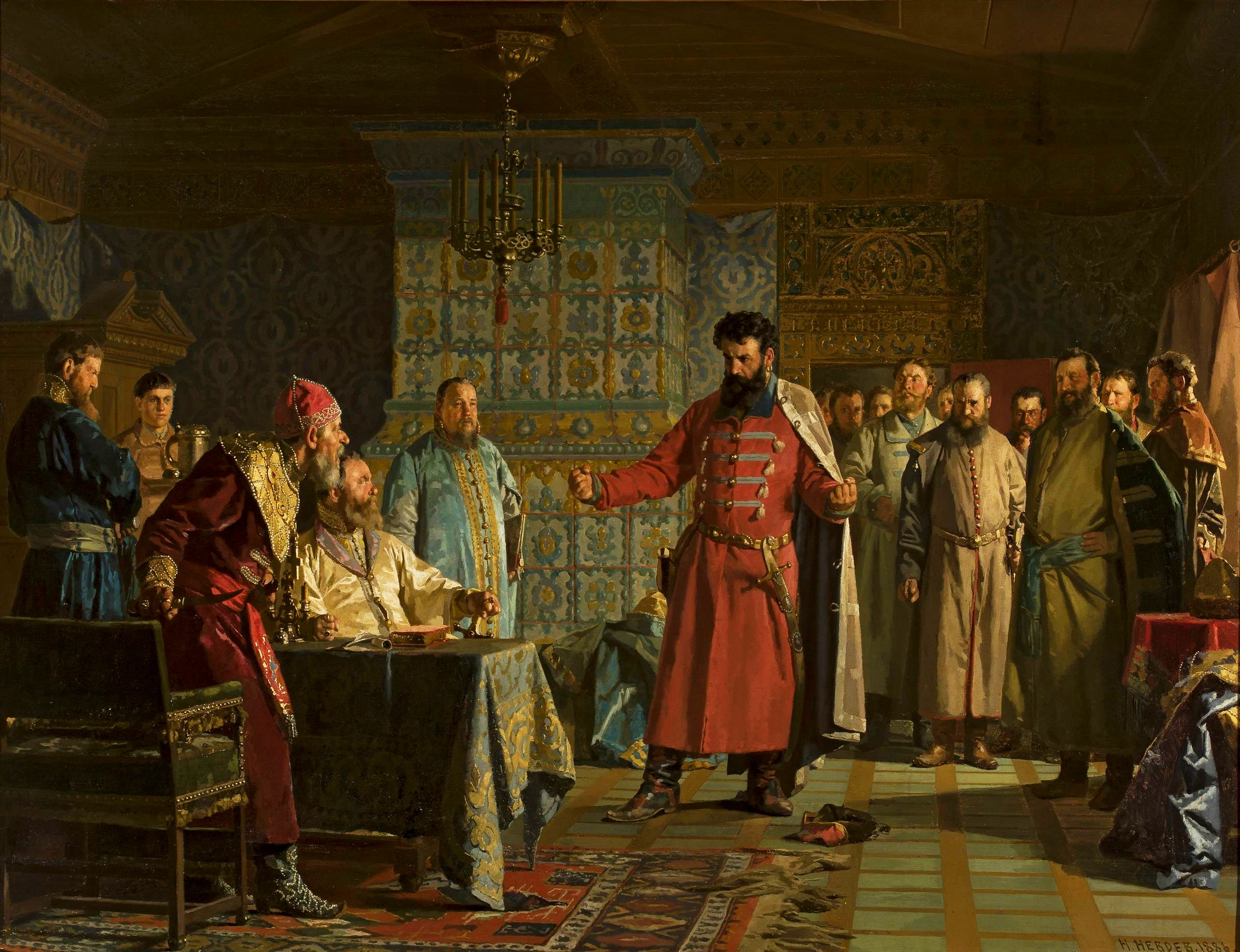
Once derided as unfit for opera because it offered no obvious romance, Boris Godunov defied expectations to become one of Russia’s quintessential national operas. Mussorgsky based his work on a play by the national poet Alexander Pushkin, which was for many decades banned from performance (though not publication). Subject to multiple revisions, the opera dramatizes Boris’s troubled reign and attains Shakespearean heights in its exploration of guilt and fear.
These days, most directors, including Jones, present Mussorgsky’s original rendering of 1869, discarding the later alterations as impurities. While the 1869 version gives a heightened sense of Boris’s insecurities, it reduces the role of opera’s unofficial second character, the chorus, which represents the Russian people at their most determined. While the later, four-act versions give the chorus freer rein, the original confines it more to supplication and subservience. The revised versions also add a love story, which brings complexity to the opera’s political plot. Boris, who is believed to have ordered the death of the rightful heir to the Russian throne, is challenged by a runaway monk who takes on the murdered child’s grown-up identity. The plot of the shorter original makes it seem like the pretender to the throne is pursuing his campaign almost on a lark, without the deeper motivations one finds in the revisions.
Jones’s production, now in its third outing at the Royal Opera with additional runs at the Deutsche Oper Berlin, has worn thin over the years. It opens with a reenactment of the rightful heir’s murder and then repeats the scene several times throughout the drama, unnecessarily for anyone who has been paying attention. Beyond the first instance, the pantomime’s only truly moving effect arrives at the end, when the pretender silently returns to the stage with a dagger drawn to do away with Boris’s own sixteen-year-old son, charitably known in the annals of Russian history as Fyodor II for the two months in which he succeeded his father as tsar in 1605. Miriam Beuther’s sets are dominated by warm colors and bells—reminiscent of Russian cathedrals—that summon Boris to the throne in the powerful coronation scene. Nicky Gillibrand’s costumes stick to a more traditional look, but the contrast with the stage decor is stark.
Terfel is larger than life on stage and dominates the drama from the start to the finish, when he dies a difficult but apparently natural death, albeit possessed by a tremendous fear of the horrific vengeance to come. The opera’s talented supporting cast also excelled. The Polish bass Adam Palka superbly counterpoised Boris’s brooding with the righteous indignation of his character, the monk Pimen, who uses the tale of a miraculous cure to taunt the dying Boris with darting reminders of his misdeeds. The young American tenor Jamez McCorkle sang the pretender’s brief role with ardor and ambition. Singing the sneaky courtier Vasily Shuisky, who historically took the throne in 1606, John Daszak was by turns ingratiating and scheming. The fine young Russian bass Alexander Roslavets prefigured what could be an excellent Boris in his performance as the wayward monk Varlaam.
The conductor Mark Wigglesworth mastered the orchestra in some moments, but at times his tempos slowed to a glacial pace. The chorus director William Spaulding demonstrated a thorough knowledge of Mussorgsky’s colorful and varied choral writing.