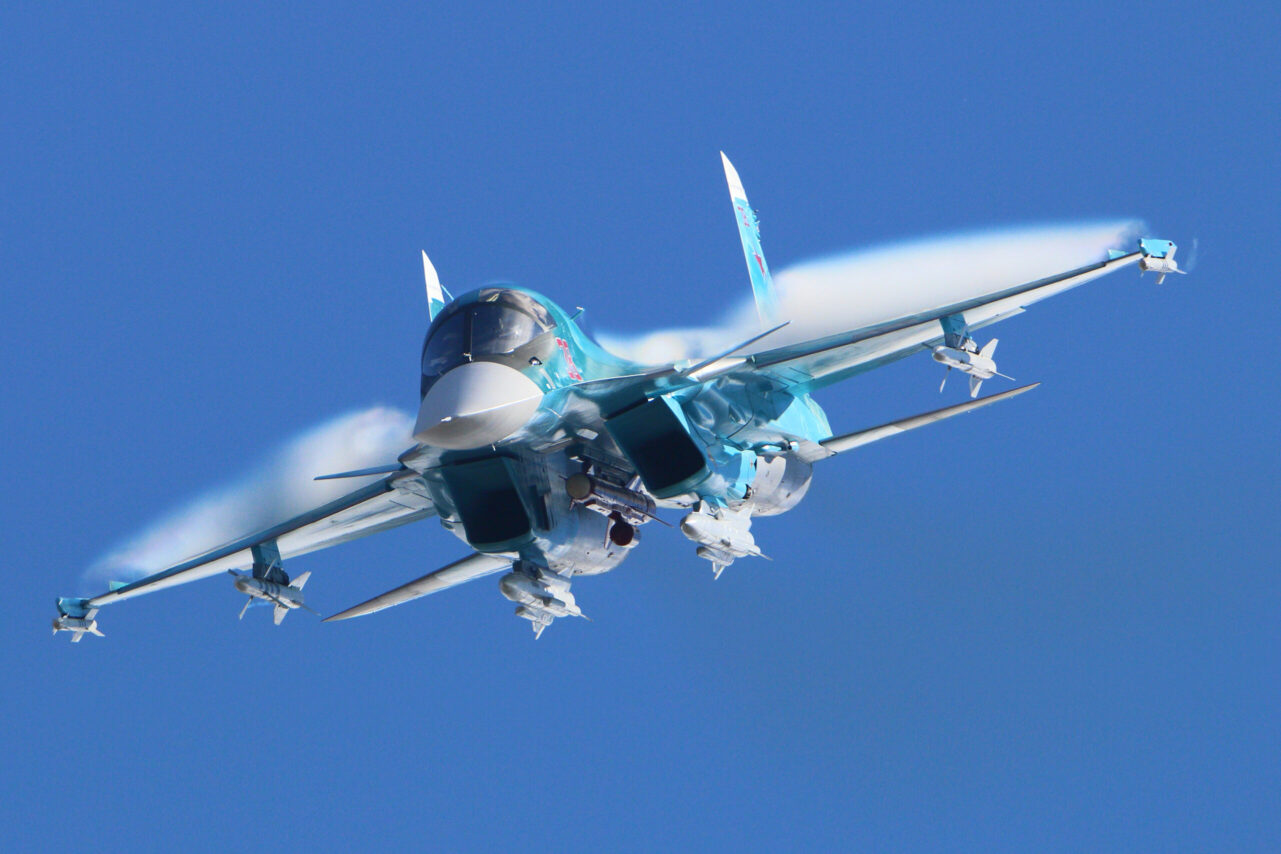
The aircraft involved in the incident was either a Su-34 Fullback or a Su-24 Fencer.
The Russian Aerospace Forces lost a bomber crew after the aircraft’s ejection system was activated while the bomber was inside a shelter, according to Russian reports.
A Catastrophic Accident for the Russian Air Force
The aircraft was on standby inside a hardened shelter when its ejection system was activated, rocketing the pilot and weapon systems officer into the bunker’s roof, according to the Telegram channel Fighterbomber, a pro-Russian military blogger. Both aviators were reportedly killed in the incident.
“Yesterday, in one of the bomber aviation regiments, an ejection system was triggered on an aircraft standing in a shelter,” the pro-Russian blogger wrote on Monday.
In the heavily censored Russian society, a significant amount of news circulates through social media and Telegram channels like the one that reported the incident.
“A state commission is working on the scene,” the Fighterbomber Telegram channel added without specifying when the incident took place.
According to Ukrainian sources, the aircraft involved in the incident was either a Su-34 Fullback or a Su-24 Fencer. Both of these aircraft have a crew of two and are designed for tactical bombing operations.
For an accident like that to take place, a lot of things would need to go wrong. There could be a catastrophic failure in the ejection seat system due to improper maintenance. Moreover, an accident like that can be the result of human error during the pre-flight checks. Right now, however, there have been no reports of Ukrainian sabotage.
A Series of Unfortunate Events
The loss of the two Russian pilots is another incident in the Russian Aerospace Forces’ relatively poor performance in the war in Ukraine. When the Kremlin invaded its neighbor in force on February 24, 2022, the expectation was that the Russian armed forces would establish air superiority over the battlefield relatively easily. That never materialized in practice, however.
It is very likely that one of the main reasons the Russian military failed to defeat the Ukrainian forces in the opening days and weeks of the war was that the Russian Aerospace Forces could not wrestle control of the skies from the weaker Ukrainian Air Force. Kyiv also cleverly dispersed its Soviet- and Russian-made anti-aircraft systems around the country, saving most of them from pre-designated strikes in the opening hours of the conflict.
Then, as the war progressed, opportunities to assert air superiority faded as a result of an influx of military aid to Ukraine from the United States and NATO. Today, the Ukrainian Air Force operates one of the most advanced and experienced air defense umbrellas in the world. To be sure, Kyiv might not have all the weapon systems and radar it wants, but it operates advanced air defense weapons like the MIM-104 Patriot, IRIS-T, and the National Advanced Surface-to-Air Missile System. Moreover, the Ukrainian Air Force operates an increasingly large number of Western fighter jets, including F-16 Fighting Falcons and Dassault Mirages.
In light of these developments, the Russian Aerospace Forces have taken a back seat in air power operations over the battlefield, preferring instead to launch long-range missiles against Ukrainian urban centers from far away.
About the Author: Stavros Atlamazoglou
Stavros Atlamazoglou is a seasoned defense journalist specializing in special operations and a Hellenic Army veteran (national service with the 575th Marine Battalion and Army HQ). He holds a BA from the Johns Hopkins University and an MA from the Johns Hopkins’ School of Advanced International Studies (SAIS). His work has been featured in Business Insider, Sandboxx, and SOFREP.
Image: Shutterstock.com / Fasttailwind