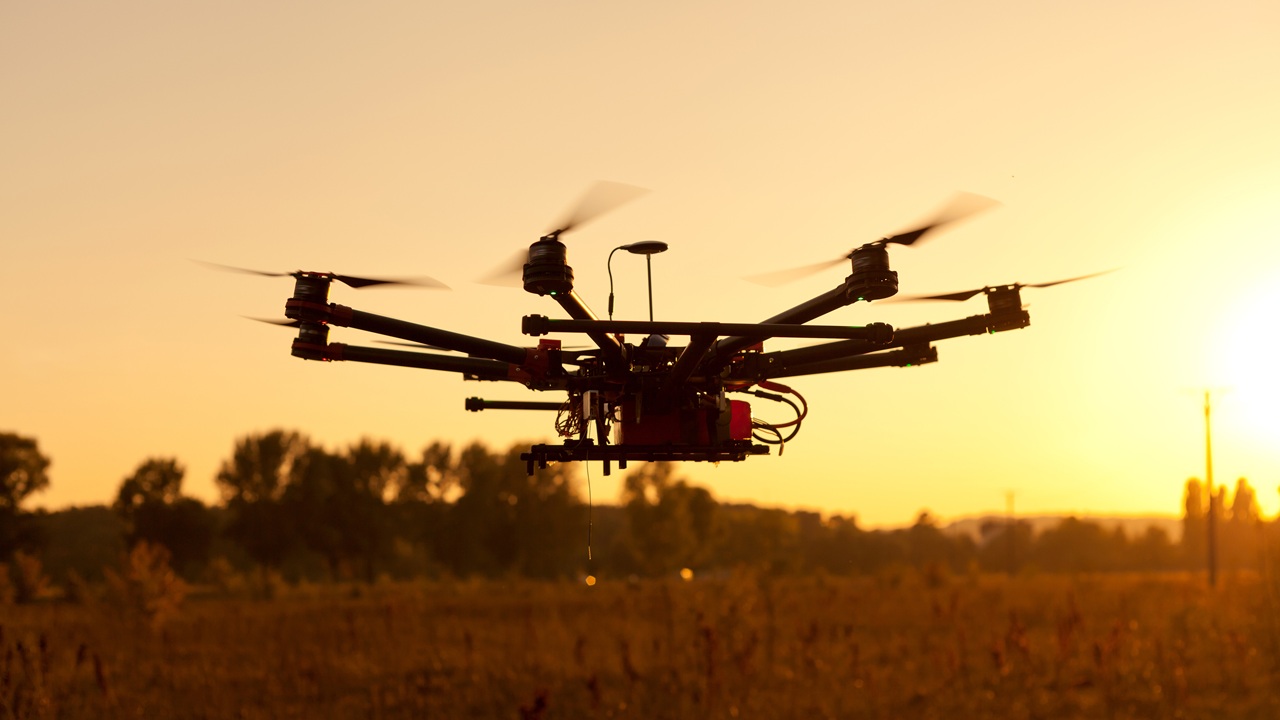
Though little is known about the “Vorobey-10” octocopter drone so far, its creators insisted that it would see battlefield use in the near future.
The Russian Army has repeatedly employed a variety of weapons capable of firing “thermobaric” munitions, also known as vacuum or aerosol bombs. These weapons use atmospheric oxygen to create intense, long-duration blast waves with both extreme heat and high pressure.
In addition to the TOS-3 Drakon, a tracked thermobaric rocket launcher, the Kremlin has announced it has developed a new class of unmanned aerial system (UAS) that could drop thermobaric munitions on enemy positions. The Vorobey-10 octocopter will soon be tested in combat along the line of contact in Ukraine, according to state news agency TASS.
“Our new Vorobey-10 is designed to drop thermobaric munitions and can also be used as a delivery vehicle,” said Andrey Bratenkov, executive director of the Spektr Design Bureau. “The drone is built with the 3115-900kV brushless motors, manufactured by Gorny TsOT.”
In addition to being able to carry the incendiary ordnance, the Vorobey-10 was developed with redundancy to ensure it can accomplish its mission.
“It’s a fully-fledged octocopter, powered by eight motors,” said Bratenkov. “Therefore, if one motor is disabled, the drone will still fly. The aircraft is very reliable, durable, and easy to repair – all components are Russian-made.”
About the Vorobey-10 Octocopter Drone
Neither the Kremlin nor the Spektr Design Bureau has provided detailed information about the Vorobey-10. TASS reports that it will have eight independent engines, allowing it to carry a payload of up to 10 kg (22 lbs), with a range of approximately 15 km (9.3 miles).
That could allow the octocopter to operate beyond the front lines. Moreover, if the drones could be used in tandem, several of them could deliver a significant amount of incendiary ordnance to a target.
“This operating range will allow us to provide assault groups with an octocopter that isn’t as heavy-duty as our Vorobey-15, but still a drone with sufficient payload capacity and range,” added Bratenkov. “Our capacity allows for a monthly production of about 1,000 aircraft. If necessary and demand exists, production can be increased to 10,000 items per month. The aircraft trials are currently underway in the special military operation zone.”
The Spektr Design Bureau had previously announced that its Vorobey-15 multirole bomber drone had entered serial production. It is also being used in the ongoing war in Ukraine in both logistics (e.g. delivery to friendly troops) and attack roles.
It is unclear whether the Vorobey-15, which can carry up to 15 kg (33 lbs), will also be outfitted to deploy thermobaric ordnance.
How Thermobaric Weapons Work
Most explosives used in combat are reliant on combustion, or fire. Because fire requires oxygen in order to burn, these explosives must have an “oxidizer” chemical as a source of oxygen. For example, one of the key ingredients in gunpowder is potassium nitrate (KNO3), allowing it to detonate even in airless or air-restricted environments.
Thermobaric weapons, on the other hand, are designed to work by using the air around the explosion as its own oxidizer. This typically requires them to be dispersed as an aerosol before detonation. The same physical principle is on display during dust explosions, periodically affecting grain siloes and other enclosed environments.
The weapons do not work in space, underwater, or at high altitudes with thin air—but under normal conditions, they can be far more powerful than conventional explosives because they are composed purely of fuel, without the need for an oxidizer. They are particularly dangerous in enclosed areas such as bunkers or armored vehicles, where the lack of access to air can create a deadly and destructive vacuum.
It was nearly two years ago that Human Rights Watch issued a call for the banning of such incendiary weapons, highlighting that the fire cloud created by such ordnance could reach temperatures of 2500–3000 degrees C (4500–5450 degrees F).
In addition to certainly killing anyone within the blast radius, the heat from the weapon can cause significant damage to structures and vehicles—igniting any fuels and lubricants, as well as setting off any ordnance. Many targets are essentially vaporized.
About the Author: Peter Suciu
Peter Suciu has contributed to dozens of newspapers, magazines and websites over a 30-year career in journalism. He regularly writes about military hardware, firearms history, cybersecurity, politics, and international affairs. Peter is also a contributing writer for Forbes and Clearance Jobs. He is based in Michigan. You can follow him on Twitter: @PeterSuciu. You can email the author: [email protected].