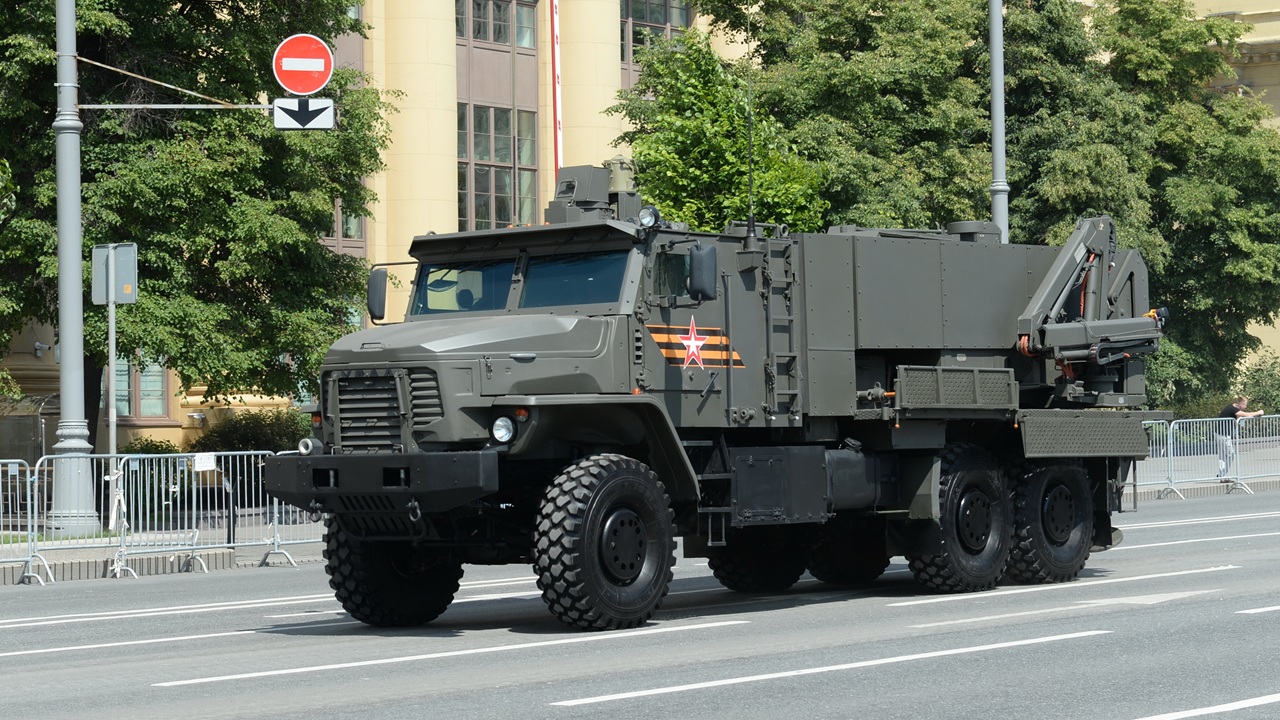
The TOS-2 heavy flamethrower is reminiscent of the Soviet Union’s “Katyusha” rocket artillery—but instead of lobbing unguided rockets at enemy targets, it shoots thermobaric bombs.
Few militaries around the world employ “flamethrowers” anymore. The conventional thinking is that such weapons are not only “inhumane” to their targets, but also highly dangerous to the operator.
The Russian military has recognized the shortcomings of its weapons, notably their short range and limited fuel capacity, and has addressed them by developing large, heavy flamethrowers mounted on vehicles. These include the TOS-1A Solntsepek (“Scorching Sun”), a multiple rocket launcher platform mounted on a T-72 tank chassis to launch thermobaric rockets, and the even more insidious TOS-2 “Tosochka.”
The latter began its trials in 2020. Six years later, it could be close to seeing widespread adoption later this year.
“Units of Russia’s Nuclear, Chemical and Biological Protection Troops in the Moscow Military District will receive several dozens of military and special-purpose hardware by the end of 2026 including TOS-1A Solntsepyok and TOS-2 Tosochka heavy flamethrower systems, RKhM-6 chemical, biological, radiological and nuclear (CBRN) reconnaissance vehicles, TDA-3 smoke-generating vehicles, armored reconnaissance scout vehicles and ARS-16 mobile spray station vehicles,” the military district wrote in a statement on Tuesday, according to the state news agency TASS.
Russia’s TOS-2 Heavy Flamethrower in the Crosshairs
Unlike its predecessors, which were mounted on a tank chassis, the TOS-2 is mounted on the 6×6 wheeled chassis of the Ural-63706 truck, which offers greater speed and improved fuel efficiency while still ensuring cross-country capability.
It has roughly the same appearance as the infamous BM-13 multiple-launch rocket system developed during World War II, which was lovingly nicknamed “Katyusha” (“Little Kate”) after a popular wartime Red Army song. Also known as “Stalin’s Organ” (“Stalinorgel”) by the Germans, the BM-13 was used to great effect on the battlefield.
The TOS-2 could well be a 21st-century version of that infamous weapon. In addition to its increased range, the Tosochka has fully automated sighting, firing, and fire control systems. The heavy flamethrower is outfitted with a crane, eliminating the need for a transporter-loader vehicle to reload ordnance. The TOS-2 further features an electronic warfare system against precision weapons.
Although it has less armored protection than its predecessors, with only an armored cab to protect the crew from small-arms fire, it has the potential to rain down fire on an enemy from afar.
An undisclosed number of Tosochka heavy flamethrowers have been employed in the ongoing war in Ukraine, and it was just over a year ago that a TOS-2 was confirmed destroyed near Pokrovsk.
Thermobaric Weapons Are Extremely Controversial. Russia Loves Them.
When deployed, thermobaric ordnance is a devastating weapon, as it employs oxygen from the surrounding air to generate a high-temperature explosion. Also known as “vacuum bombs,” these weapons create a massive shockwave followed by a fire cloud, with temperatures reaching 2500–3000 degrees Celsius (4500–5450 Fahrenheit) in the near vicinity. In addition to certainly killing anyone within the blast radius, the heat from the weapon can cause significant damage to structures and vehicles.
The weapons are not prohibited outright by the Geneva Convention, but their use on civilian targets violates the law of armed conflict (LOAC). Thermobaric weapons are “likely to cause civilian casualties due to their indiscriminate and uncontained nature,” the Center for Arms Control and Non-Proliferation has warned.
The first reported deployment of thermobaric weapons in Ukraine occurred in the early stages of the ongoing conflict, when some 70 Ukrainian fighters were killed in the northeastern town of Okhtyrka. Russian doctrine appeared to be that the best way to attack people in buildings in urban combat was to ensure that people inside could never make it out, or would be wounded so badly they could not continue to fight.
About the Author: Peter Suciu
Peter Suciu has contributed to dozens of newspapers, magazines and websites over a 30-year career in journalism. He regularly writes about military hardware, firearms history, cybersecurity, politics, and international affairs. Peter is also a contributing writer for Forbes and Clearance Jobs. He is based in Michigan. You can follow him on Twitter: @PeterSuciu. You can email the author: [email protected].