General Sir Gwyn Jenkins acknowledged the Royal Navy’s current shortcomings, but stressed that it would be ready for an armed conflict by 2030.
On April 2, 1982, Argentina invaded the Falkland Islands. The United Kingdom ordered the assembly of a task force, and the main fleet—including the Royal Navy aircraft carriers HMS Invincible and HMS Hermes—departed from Portsmouth, England, on April 5. More than 100 warships eventually traveled 8,000 miles to liberate the Falklands and St. George’s. The conflict lasted 74 days and ended when Argentina surrendered on June 14.
Fast forward by 46 years, and it might not be possible for the Royal Navy to send two carriers to sea in 74 days—if at all.
The Royal Navy is not ready for war in April 2026, according to First Sea Lord General Sir Gwyn Jenkins.
The US Has Mocked The British—with Good Cause
Since the United States and Israel launched Operation Epic Fury, President Donald Trump has directed his personal fury not only at Iran and its Islamist regime, but at European NATO members reluctant to support the United States. Trump has singled out the UK for criticism, possibly due to its past naval strength and its willingness to support the United States in other Middle East military missions in the past.
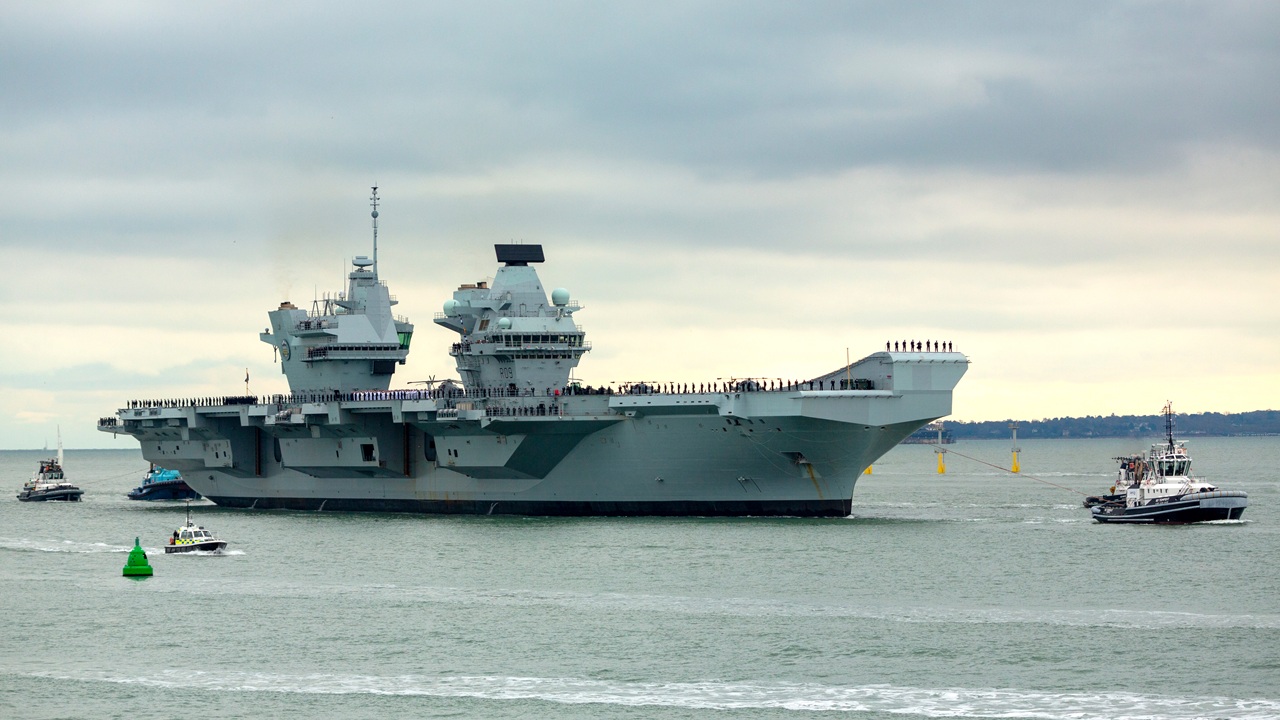
Trump’s remarks have vacillated between criticizing the UK and other NATO members for refusing to assist in Epic Fury and claiming that their contributions would be insignificant anyway. Last week, for example, Trump derided the Royal Navy, labeling its two Queen Elizabeth-class aircraft carriers “toys” and telling Prime Minister Sir Keir Starmer not to “bother” deploying them to the Middle East.
Secretary of Defense Pete Hegseth also mocked the UK’s limited naval capabilities.
“Last time I checked, there was supposed to be a big, bad Royal Navy that could be prepared to do things like [opening the Strait of Hormuz] as well,” Hegseth said sarcastically during a news conference at the Pentagon.
Hegseth’s comments came as the UK struggled to send a single Type-45 guided-missile destroyer to the eastern Mediterranean to protect British interests on Cyprus.
Sir Gwyn has heard the criticism loud and clear.
“There is still work to do,” the UK’s highest-ranking naval official told the Swedish newspaper Svenska Dagbladet—though he maintained that the Royal Navy could still conduct “advanced operations right now” if pressed.
Does Britannia Rule the Waves? Not Really
The UK now has more admirals in the Royal Navy than it has combat-ready warships. One of its two aforementioned aircraft carriers is now sidelined, undergoing repairs, and its future frigates and destroyers are years behind schedule.
Moreover, France, its now-close ally (and one-time chief rival) recently deployed its own flagship aircraft carrier, the Charles de Gaulle, to the region—a development that served to highlight the Royal Navy’s own dysfunction.
Sir Gwyn remains committed to correcting what has been years of decline and neglect throughout the British military’s “senior service.” The Royal Navy might not be able to liberate the Falklands in 2026, but the First Sea Lord has made it a goal that will be possible in the not-too-distant future.
“My orders are clear. According to the defense investigation that was completed last year, I will be ready for war by the end of this decade,” Sir Gwyn said. “I would say that we can conduct advanced operations right now, and if we were told to go to war, of course, we would. That is my military duty. But are we as ready as we should be? I don’t think we are. We have work to do, and I am completely dedicated to the mission.”
British leaders have made clear that they do not want the UK to be dragged into another war in the Middle East, especially one that lacks a clear objective or timeline.
Yet the First Sea Lord acknowledged that the Royal Navy might fill a role once the fighting is concluded, however long that might take.
“It is entirely possible that there will be a scenario where the main conflict is over, but where there is still a complicated security situation, and ships need protection to get world trade going – that is what we are discussing,” Sir Gwyn said.
The UK has also pledged to increase its defense spending, but it still falls short of the NATO goal of 5 percent of a nation’s GDP for several more years. Even then, it may not be enough to restore the Royal Navy to the levels it was at in 1992, after the end of the Cold War—let alone the levels it had in 1982, when it swiftly defeated Argentina and retook the Falkland Islands.
About the Author: Peter Suciu
Peter Suciu has contributed to dozens of newspapers, magazines and websites over a 30-year career in journalism. He regularly writes about military hardware, firearms history, cybersecurity, politics, and international affairs. Peter is also a contributing writer for Forbes and Clearance Jobs. He is based in Michigan. You can follow him on Twitter: @PeterSuciu. You can email the author: [email protected].