For most people, prayer is a struggle. Rightly does the Catechism of the Catholic Church compare the life of prayer to Jacob wrestling with the angel (CCC 2573), as most people find prayer to be a challenge that requires consistent effort to persevere in. Yet, as a wrestler trains himself to overcome through consistent, disciplined effort, so a fruitful and consistent prayer life can be attained through the same discipline.
Today I am going to speak a bit about my own long journey of prayer, specifically how it relates to learning to fruitfully utilize the traditional memorized prayers of the Church, like the Pater Noster and Ave Maria.
When I was a young Catholic, I remember being a little bit disappointed in the Catholic Tradition on prayer. I would pick up books by spiritual masters who were renowned for their rich inner lives, saints and mystics, all in hopes of gaining some insight into how to pray as a Catholic. When it came to lay people seeking spiritual growth, they’d inevitably recommend saying the Our Father, Hail Mary, Glory Be, Memorare—basically just repeating memorized prayers.
I always found this advice a little deflating for a few reasons:
For one thing, these are prayers you learn as a little kid. I found it difficult to accept that a spiritual master of the caliber of, say, St. Alphonsus Liguori, had developed his vibrant interior life by saying “baby prayers.” I could not understand how a celebrated mystic could have become so advanced by repeating Hail Marys. It seemed a tad…disingenuous? Or maybe just not believable, like when a fitness influencer all jacked up on steroids tells you he got his physique by doing a basic ab circuit on a mat for ten minutes a day. It just didn’t add up.
Second, while I certainly did not doubt the pedagogical value of these prayers for catechesis, I never found them particularly rich or satisfying to say. It was difficult for me to feel like the full expression of my inner life could be encapsulated so formulaically, to feel that these prayers adequately expressed my own struggles and desires. In other words, I found them too impersonal.
To be honest, I found it a struggle to commit to any form of fixed daily prayer, be it the Rosary, novenas, or the Divine Office. By disposition, I am not a Benedict but more of a Jeremiah; I am much more comfortable going to a lonely place and offering my prayers in a string of extemporaneous utterances rather than sitting quietly with a prayer book or Rosary.
And so I didn’t put much stock in the memorized prayers. Sure, I still said the Rosary out of a sense of duty, but I felt like the real fruit of my prayer time was born in the habit of extemporaneous prayer that I developed. And in time I became quite comfortable expressing the movements of my soul, verbally or in writing. I could speak to God in great detail about what was going on within me, in my own words, and I was very at home praying like this. So, for a long time, it seemed as if I didn’t need the memorized prayers.
But then something happened that I did not expect.
This comfort with spiritual discourse bore fruit in a greater sensitivity and depth to my spiritual life. The words of my prayers became more impactful, and in time I felt I could say more with less. I still prayed extemporaneously, in the woods, or open fields, or in dark rooms, but my words dwindled. I was still communicating with the Lord—even more vibrantly than before—but it just required fewer words.
I felt like each word meant more. Just saying something like, “Lord, keep me, and I shall be kept,” expressed so much beyond mere vocabulary. I suppose this is the fruit of spending more time with God. When you start to really know someone, you can communicate with less verbosity, and this is just as true in spiritual relationships.
I suppose it was fortuitous that this happened, because around the same time I noticed that my extemporaneous prayers began to run out of steam. When you’re young and idealistic, you’re very verbose, and it seems like you could never run out of ways to express yourself. But after twenty years, I found that I’d said everything that could be said—and even though I always had new people and concerns to pray about, I noticed my extemporaneous prayers became increasingly formalized. I was still saying my own words, but I was going back to the same phrases with more frequency. In other words, my extemporaneity was becoming formulaic.
I was pleasantly surprised. Yes, my spoken prayers were briefer and more formulaic, but more fulfilling. And because they were more fulfilling, I noticed I could pray longer. In the past I’d struggled to pray continually for longer than, say, 20 minutes, and even that was a stretch. But as the prayers became richer, it was easier for me to pray for 45 minutes or even an hour—and a lot of that was in repetition.
I think it was during Mass that I first started going back to the memorized prayers. Sometimes at Mass I would just mouth the Pater Noster over and over again, or an ejaculatory prayer like, “Jesus, Son of David, have mercy on me,” and to my delight and surprise, I found that I derived considerable nourishment as a result.
When I was younger, I had respectfully passed over these little prayers and even wondered how the saints could apparently get so much out of them. But now I began to see. I revisited the memorized prayers every Catholic learns in childhood, but now from a position of spiritual maturity, seeing them no longer as prayers for beginners, but as treasures of immense value.
Like Chesterton’s boy in the Everlasting Man who walks around the entire earth only to return to his backyard and see it from a strikingly new perspective, I found that the memorized prayers were a lot bigger than I’d given them credit for. The words have not changed, but experience and maturity have caused them to mean so much more.
I also came to understand a passage from St. Patrick’s Confession that I’d always found a little curious. Describing his spiritual awakening during his slavery, Patrick wrote:
I prayed frequently during the day, and the love of God, and His faith and fear, increased in me more and more, and the spirit was stirred; so that in a single day I have said as many as a hundred prayers, and in the night nearly the same. (Confession, 16)
I always thought this passage sounded too mechanical, but now I began to understand. When you start to feel at home with the shorter prayers of our tradition, it becomes second nature to utter them in every circumstance. It’s not a predetermined, “I must pray a hundred times today,” as if you’re sitting there keeping a tally; it’s more like the cycle of breathing. And just as each breath goes into the lung and from there into the blood stream replenishing our body’s oxygen stores, so each prayer gives us access to grace that floods into our innermost being and restores our spirit. The prayers become fruitful and living.
I’d say last year was the year I really fell in love with the Pater Noster. Of course, as a faithful Christian I’d always understood its importance as the formally perfect prayer, but in time I began to really experience it as such. This prayer is absolutely my go-to these days—and why not? It says everything that needs to be said.
I started rereading all the writings of St. Francis of Assisi recently for the Year of St. Francis and was delighted to see that St. Francis viewed the Pater Noster similarly and encouraged all his friars to pray it regularly. There is even a Franciscan office, called the Office of the Twelve Our Fathers, where one commits to praying the Our Father twelve times per day.
I would never presume to suggest your spiritual journey is the same as mine; we all have our own unique journey to the heights God wants to show us. But I would say that, while plateaus in prayer are real, they’re never final—there’s always another level, another room God wants to take you into. And sometimes the movement to that new level comes so slowly and gradually that you only recognize it in retrospect.
If you’ve been struggling in prayer, remember the wrestling metaphor. A wrestler does not get good overnight, nor by doing the same things without challenging himself. Prayer, like wrestling, requires commitment, discipline, and the will to break through. Your journey will certainly look different than mine, but God is faithful and will help you find your way.
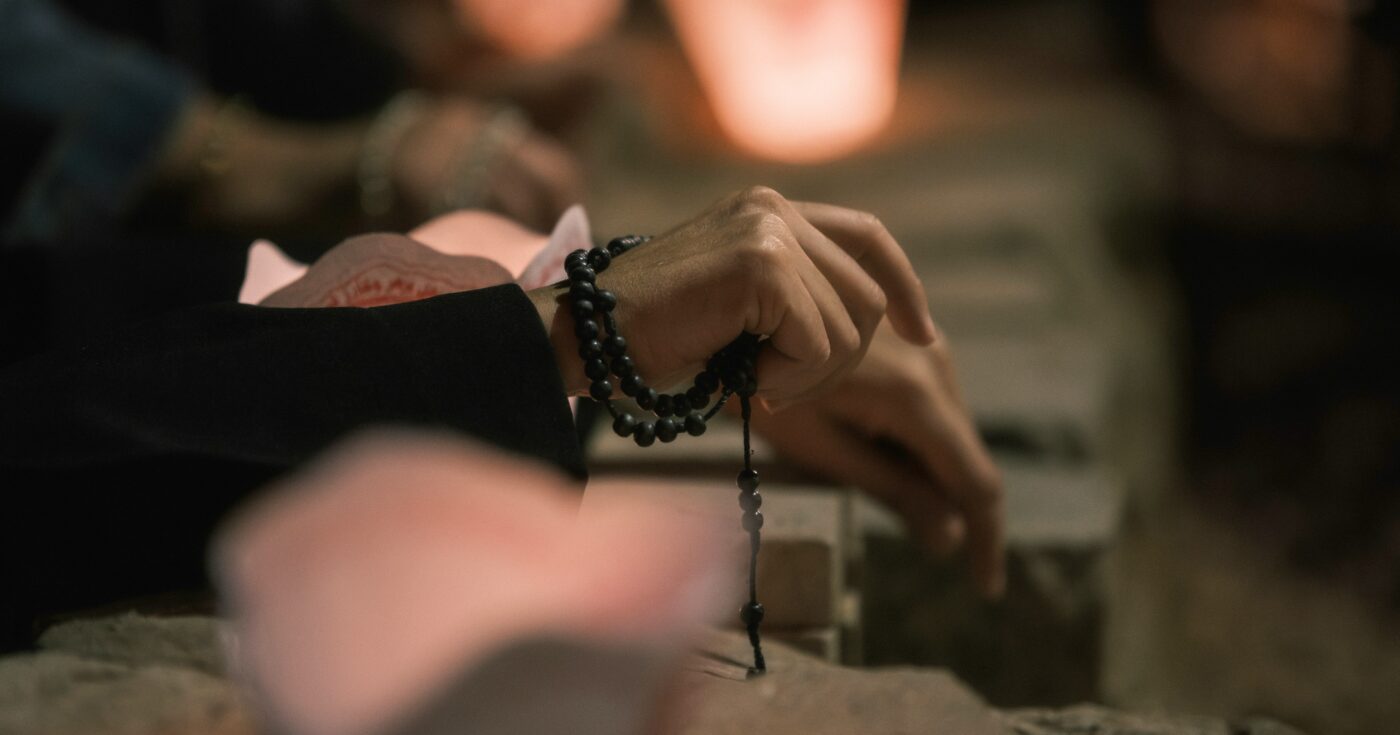
Photo by Christian Harb on Unsplash