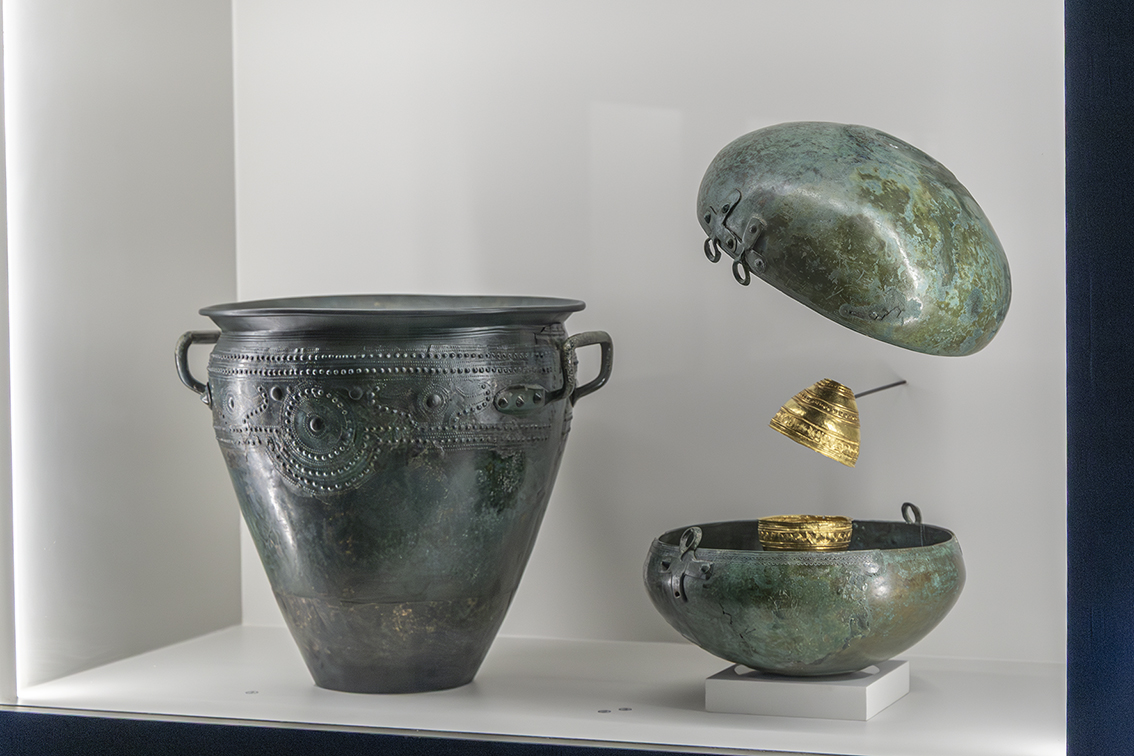
When we call the Bronze Age (2300–800 B.C.) prehistoric, that does not apply to ancient Egypt, Mesopotamia, and the ancient Israelites, whose history was recorded in written texts still available for consultation today. Compared to these civilizations, Western Europe was backwards and still many centuries away from developing writing, and therefore truly prehistoric. Nevertheless, an enlightening exhibition at France’s National Archaeological Museum, situated in Saint-Germain-en-Laye’s château (once home to James II after he was forced to forfeit the English crown in 1688), shows that the European Bronze Age was more dynamic than one might assume. Trade all over Europe was booming, facilitated by advances in maritime technology, as attested by a replica of a Bronze Age boat discovered in Dover in 1992, on view outside of the chateau; France, situated between northern and southern Europe, was a strategic crossroads. At the same time, men and women were finding ways to use new materials such as bronze (an alloy made of copper and tin), as well as gold and silver, to make cauldrons, jewelry, weapons and armor. Burial sites indicate that the Bronze Age in France saw the rise and fall of chiefs and warriors, heroes and villains whose names are lost for the lack of scribes to record their deeds.
The exhibition opens with a copy of the famous Mask of Agamemnon discovered in 1876 in Mycenae by Heinrich Schliemann. The archaeologist’s attribution was wishful thinking, since the death mask’s date (1550–1500 B.C.) means it was made some three centuries before the most likely date for the conflict, that some scholars believe, later became known as the Trojan War. The copy is meant to the influence of Aegean art on Western Europe, a connection made possible through trade. In the next room, we hear the sounds of the forge as the newly discovered bronze is being produced. Axe-heads found in the Bény-sur-Mer hoard in Normandy and a bronze sword found at Pont-sur-Seine testify to the flourishing of a warrior culture. The exhibition speculates that the hammer was a symbol as well as a weapon, just like Thor’s hammer in Norse mythology. A bronze wheel (1300–900 B.C.) from the site of Fa in the south of France attests to the proliferation of chariots during the Bronze Age’s last centuries. The wheel is hollow and lighter compared to previous iterations and allowed for more mobility compared to wagons. These chariots were often decorated with religious symbols such as the sun or waterbirds.
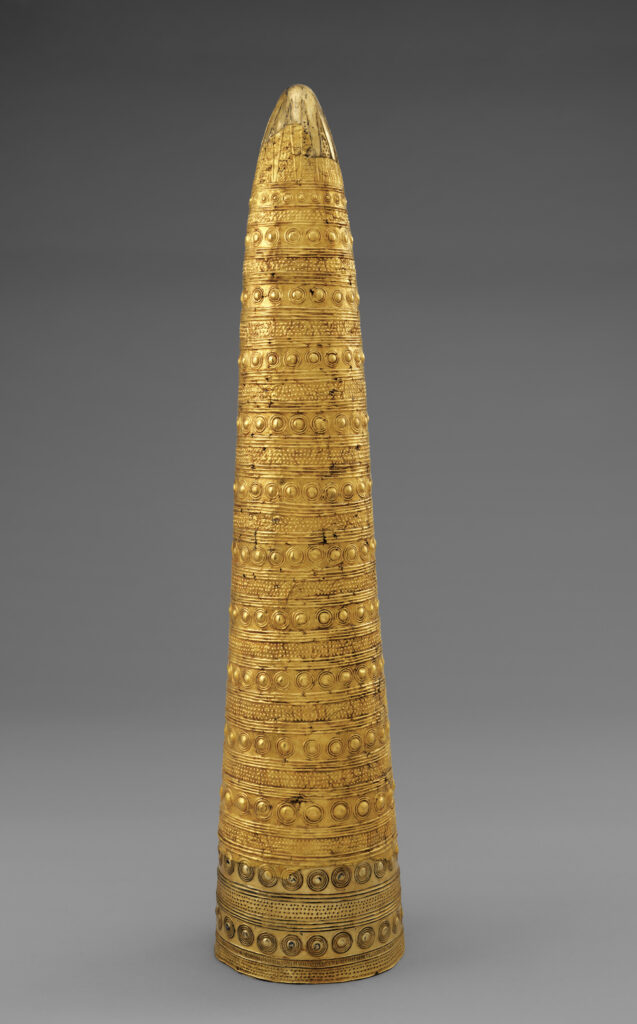
To this day, we remain intrigued by the stars above us. For Bronze Age peoples, the sky was full of symbols in the shape of crosses, stars, and circles, which frequently appear in their ornaments. The exhibition centers the striking Avanton Cone (1500–1300 B.C.), found near the French city of Vienne, an elongated twenty-two inch long “golden hat.” Its phallic shape was originally interpreted by archaeologists as relating to fertility, but nowadays its repoussé décor, composed of concentric circles and a star at the very tip, is understood as astronomical symbolism and maybe even a calendar. The sun was a predominant cult object and features prominently in Bronze Age art: a pendant in the form of a comb (900–800 B.C.) from the Jura region of France both serves a practical function and has the shape of a woman seemingly greeting and worshipping the sun with upraised arms. A large bronze ring used for chariot harnesses from the Loire region (900–800 B.C.) is interpreted as symbolizing the solar cycle and the renewal of life after death. Bronze, especially when polished, reflected the sun’s golden rays.
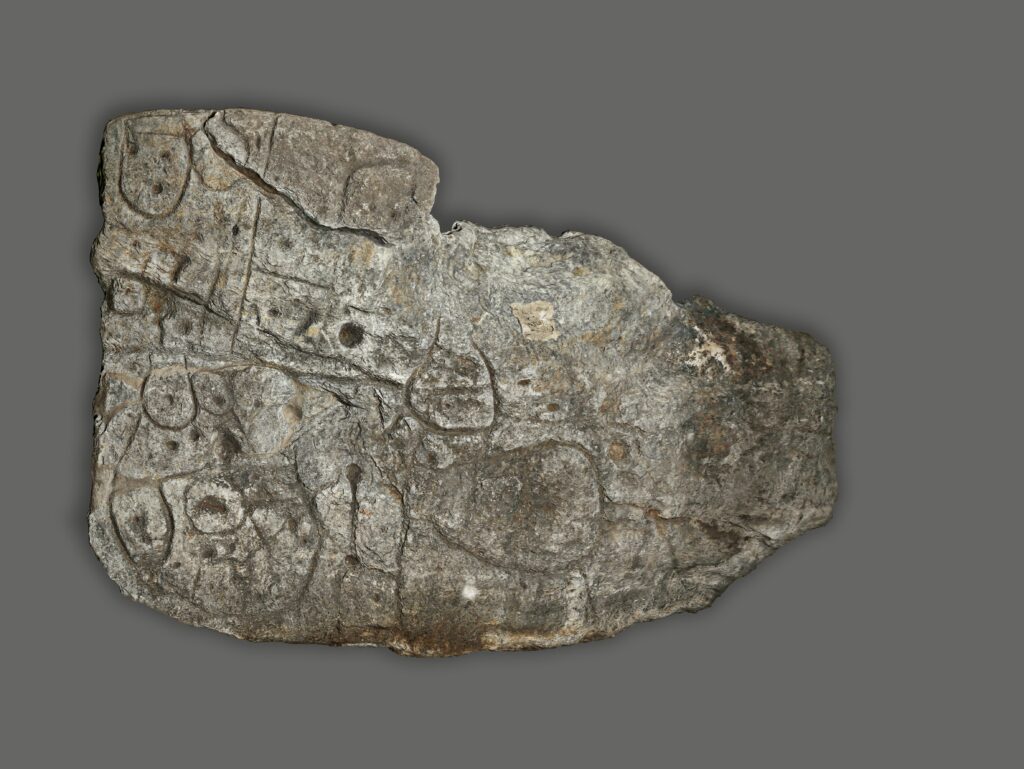
The Bronze Age reshaped the European landscape. Megalithic monuments associated with sun cults, such as Stonehenge and the Carnac stones in Britanny, continue to impress to this day, represented in the exhibition by a Corsican statue-menhir (standing stone). Agriculture was also on the rise, which meant that land began to be parceled out and divided. A carved schist slab found in the tumulus of Saint-Bélec in Brittany (1880–1630 B.C.) is thought to be one of the oldest maps in Europe, schematically representing local topography, attesting to how competition for control over land intensified.
Tumuli point to the emergence of a stratified society, where conspicuous consumption was becoming more prevalent. These tombs often contained splendid treasures, such as gold torcs, for which the Iron Age Celts became famous. Towards the end of the Bronze Age, inhumation gave way to cremation, perhaps relating to the idea of purification by fire. The exhibition’s last room features a startling audio-visual simulation of leaping flames.
The exhibition has much to tell us about this distant age, whose importance cannot be underestimated, not least because the Bronze Age laid the foundation for all later European civilizations. Visitors would do well to visit in April or May when fairer weather allows for a pleasant tour of the château’s park, where the exhibition continues with a garden of common Bronze Age crops, such as wheat, flax, barley, millet and spelt, and other plants as widespread in the ancient word as they are today, such as strawberries, raspberries, blueberries, nettle, linden, and flax.