|
Forwarded this email? Sign up for free to have it sent directly to your inbox.
|
|
|
Good morning,
Today, we’re looking at America’s need for skilled immigrants, a recent conference where activists celebrated armed resistance, HHS’s peer-reviewed report about gender dysphoria, and why free buses in New York would fail.
Write to us at editors@city-journal.org with questions or comments.
|
|
|
Meta generated lots of buzz this year for offering astronomical pay packages to its new computer scientists and AI researchers. The attention intensified when an employee leaked a roster revealing that nearly all of them are immigrants.
“For the U.S., this marks both a vulnerability and an opportunity,” writes Jordan McGillis. “At the highest levels of science, technology, engineering, and mathematics (STEM), market choices indicate that American talent alone is not enough.”
Thankfully, the U.S. remains the premier destination for the world’s top talent, and President Trump has spoken favorably about skilled immigration. But much of the MAGA coalition opposes it. “Resolving this tension is now vital to charting the country’s course forward,” McGillis argues.
Read more from his article in our Autumn issue.
|
|
|
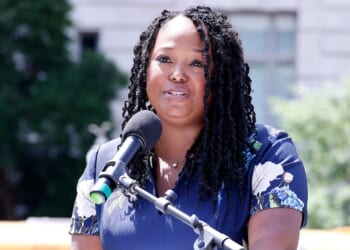
Last month, the National Alliance Against Racist & Political Repression (NAARPR) hosted its annual conference, where attendees discussed resisting ICE and confronting the Trump administration. Chicago mayor Brandon Johnson spoke, claiming that he had “inherited a white supremacist system.” He said that health care, education, policing, and public housing were part of that system, and suggested higher taxes on the wealthy as a solution to the problem.
Other speakers called for abolishing the billionaire class and celebrated armed conflict—and they even passed a resolution endorsing armed resistance.
“NAARPR may not be a household name,” Stu Smith writes, “but its chapters are embedded in cities across America. Communities and political leaders should shun this rhetoric.”
|
|
|
The Department of Health and Human Services released a peer-reviewed version last month of its previously published report about pediatric gender care. “Notably, the reviewers praised the report’s methodology and declined to challenge the finding of its umbrella review (a systematic review of reviews) that only ‘low certainty’ evidence exists for benefits of hormonal and surgical treatments,” Joseph Figliolia writes. He notes that the report stands on scientific merits and offers an opportunity to place treatment itself on strong scientific footing, too.
Read more about the review.
|
|
|
Yes, Iowa City’s free bus pilot program has been a success, but that doesn’t mean it’s a model for New York, Shawn Regan and Matthew E. Kahn write. Iowa City’s buses provide 1.6 million rides each year; New York City buses carry more than 400 million riders.
“But the more fundamental problem is that fare-free transit often fails to achieve its intended policy goals (such as reducing pollution and cutting traffic),” they point out, “while sacrificing the qualities big-city bus riders value even more than price: speed, reliability, and safety.”
Read more on why free buses in a big city like New York would fail.
|
|
|
“Minnesota’s welfare system meets Somali clan politics—and taxpayers get robbed blind. Importing cultures that glorify piracy into a welfare state isn’t diversity, it’s disaster.”
|
|
|
Photo credit: Jeff Chiu/AP Photo
|
|
|
A quarterly magazine of urban affairs, published by the Manhattan Institute, edited by Brian C. Anderson.
|
|
|
Copyright © 2025 Manhattan Institute, All rights reserved.
|
|
|
|
Source link