Let’s go back to Judea and die with Him.
We are not sure if the Apostle Thomas was cracking wise or being serious when he said that. What we are sure of is this: Thomas was nowhere to be found on Good Friday. He hid or perhaps was delayed somehow in making it to Christ’s crucifixion.
Proof of Lazarus’ Raising
Speaking of being delayed, Bishop Sheen wrote:
God’s delays are mysterious; sorrow is sometimes prolonged for the same reason for which it is sent. God may abstain for the moment from healing, not because Love [with a capital L] does not love, but because Love never stops loving, and a greater good is to come from the woe. Heaven’s clock is different than ours. (Sheen, LOC, 291)
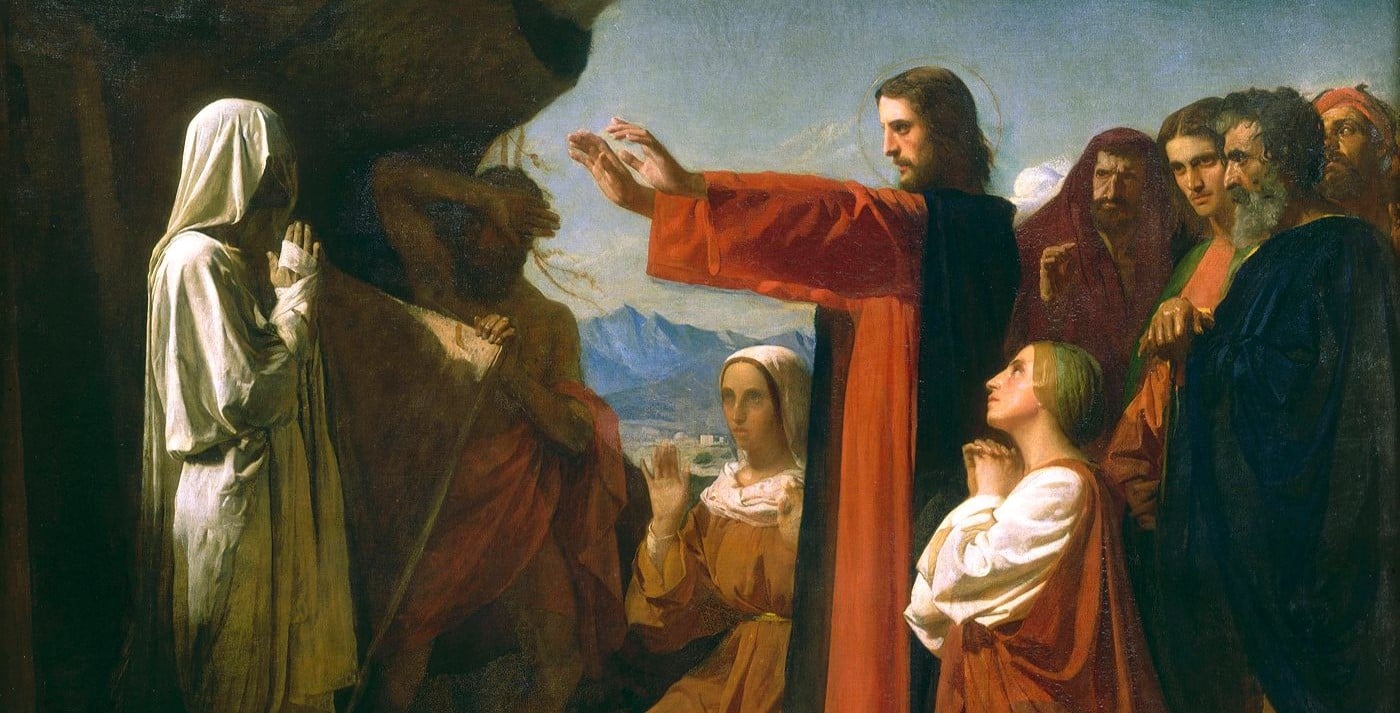
Christ’s delay in getting to Bethany was planned in order to erase all doubts about His upcoming miracle. Christ had earlier, on separate occasions, raised a girl and a widow’s son from the dead. But skeptics could have argued (and still do today) that those revived people could have just been in comas, for they hadn’t been dead that long. Jews believed that a man’s soul hovered around the dead body for three days, with the chance it might re-enter the body. When decay began, around the fourth day, it was clear the dead person was not coming back.
The raising of Lazarus from the dead was Christ’s last and greatest miracle before His own death. Yet doubts still persist. Modernists, who do not believe in miracles, claim the rising of Lazarus was most likely a made-up story, a literary device, or an allegory. They argue: if raising Lazarus really happened, then why didn’t the other three gospel writers mention it?
Well, we know Matthew, Mark, and Luke wrote their gospels early, and John wrote later. Perhaps the first three did not mention the miracle to protect Lazarus, who was probably still alive when they wrote. Lazarus was evidence—and the evidence needed to be destroyed. That’s not conjecture. A few verses after the end of Sunday’s passage, we read that the chief priests planned not only to kill Christ, but to kill Lazarus, too, for many Jews were converting to Christ because of him (Jn. 12:9-10).
The Believers and the Skeptics
Those early Jews were converting because of the miracles that John called “signs.” The signs were credible because they were found prophesized in the Jews’ sacred scriptures. Ezekiel, one of the Jews’ four major prophets, wrote about the sign of Lazarus 600 years before it happened:
Then you shall know that I am the LORD, when I open your graves and have you rise from them, O my people! I will put my spirit in you that you may live…I have promised, and I will do it, says the LORD.
There were two kinds of Jews present when Lazarus was raised. There were those who believed, and those who did not. Some, totally stunned and amazed at what they witnessed, came to believe Christ was the promised Messiah. Others ran back to Jerusalem and informed the Pharisees. Now, what kind of person would do that after seeing what Christ did? Only a blind person would do such a thing—a person blind to reality—one who walks at night and stumbles because the light is not in him.
And so some believed; others not so much…
On the other hand, those who had subordinated their brains and hearts to their membership in a party were concerned only with the triumph of that party and immediately ran off to denounce Jesus. The history of mankind is full of similar examples of paradoxical partisan stubbornness, but none has ever been so dense and massive as that of the Pharisees. Let the world crumble to ruin, but Pharisaism must remain at any cost. (Ricciotti, LOC, 503)
Do you believe this? That was Christ’s question to Martha. What about you? Do you believe it? Or do you think it is just a story, an allegory—the representation of an abstract idea?
God is everything, and we are nothing. Christ said as much the night before He died: “Without me you can do nothing” (Jn. 15:5). Lazarus was nothing. He was dead, and his corpse went into a dark tomb.
When you are dead due to sin, you can go into a dark confessional. After confessing and telling Christ you are sorry, and perhaps you’ve been somewhat delayed in getting there, He will tell you the best words you will ever hear in your life. He will say, “I forgive you.” Your dead, decaying soul then comes back to life. The Spirit is put back in you, that you may live. Christ then says, “Untie him, and let him go.”
Go Be the Evidence
My friends, you were dead, and there was no coming back. But Christ gave you a new lease on life. What then should you do but live the rest of your life with a spirit of gratitude, knowing that Love never stops loving, that Christ delays answering your prayers so a greater good can come from your woe?
And so, are you ready to be evidence? If so, let us go back to Judea. Yes, let us go to Judea—and die with Him. We don’t say that as a wise crack, but with joy. We die with Him mystically every time we make ourselves present for Holy Mass. Unlike Thomas and all the Apostles save John, we will be found there on Good Friday, which is made present at Mass on Sunday, because Heaven’s clock is different than ours.
Good Friday was a public execution—and so is the Holy Sacrifice of Mass, where the Lamb of God is slain, only to rise again by His own power. He then gives you His Body and Blood, not in symbol or allegory, but a real physical event—just as the raising of Lazarus was a real, physical event.
Do you believe this? Instead of subordinating your brain and heart to a non-believing world crumbling to ruin, answer “Amen.” Answer that you have come to believe that Christ is the Son of God. Then live the rest of your life for Him who is Love. Go be evidence that Christ is the resurrection and the life. Do that, and after you die, Christ will open your grave and have you rise. He has promised, and He will do it.
Image from Wikimedia Commons