A Brazil presidential election poll found for the first time a lead for Senator Flavio Bolsonaro, son of former President Jair Bolsonaro, in a runoff vote against incumbent socialist Luiz Inácio Lula da Silva.
The Futura/Apex poll, released on Thursday, found that Lula was likely to win the first round of voting, expected to take place in October, but that a runoff eliminating all other candidates but Lula and Bolsonaro would put the younger senator at a significant advantage. About 48 percent of respondents said they would vote for Sen. Bolsonaro in a runoff against Lula, while only about 42 percent would choose the 80-year-old incumbent. In Brazil, a host of presidential candidates compete in the first round of voting; if no candidate obtains 50 percent or more support in the first round, the top two candidates go on to a runoff election with only two candidates.
In the first round, the poll found the situation less favorable to Sen. Bolsonaro, particularly in the event that multiple conservative candidates split the vote while Lula runs unchallenged to his left. The senator appears to defeat the incumbent president in polls exclusing conservative Sao Paulo Gov. Tarcísio de Freitas, but Lula wins when including Tarcísio. Both Bolsonaro and the governor have publicly stated they would not compete against each other and agree that Bolsonaro should be the main right-wing candidate. The Sao Paulo governor is a formidable candidate himself, however, beating Lula in a runoff 46 to 41 percent in the same poll.
The Futura/Apex poll is the first to show any scenario where Flavio Bolsonaro defeats Lula, though past polls had indicated that conservative support for the former president’s son was consolidating. A survey by the AtlasIntel Institute published on Wednesday, a day before, showed Lula’s lead against Bolsonaro narrowing significantly, though not enough to give the senator the win.
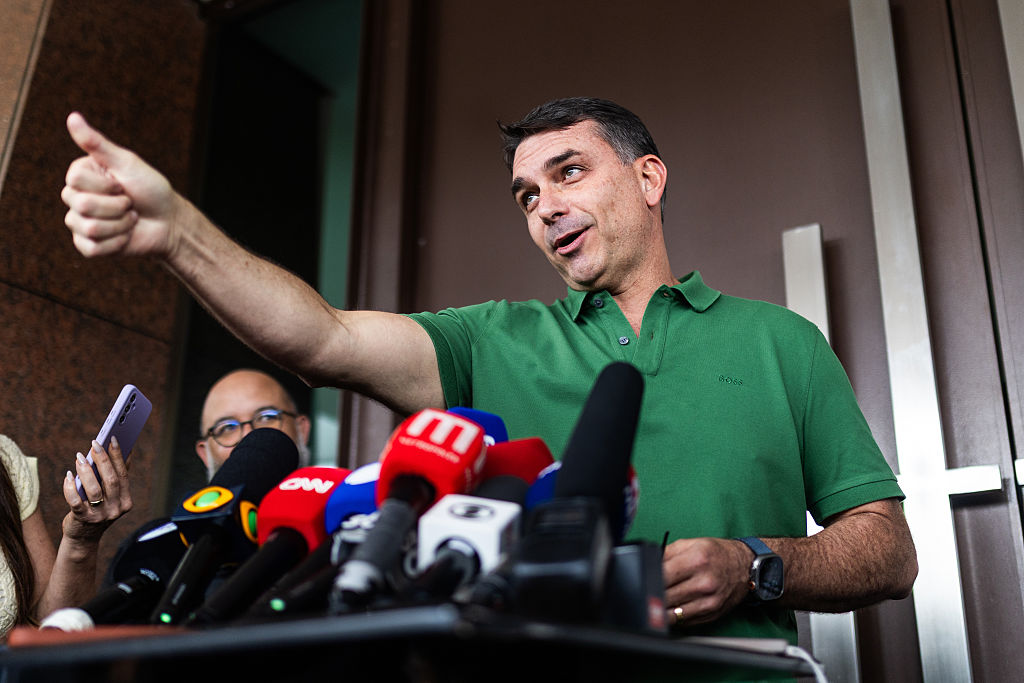
Senator Flavio Bolsonaro, son of former Brazilian President Jair Bolsonaro, said his father has backed him to run in the country’s 2026 presidential election, dashing the hopes of investors who had another candidate in mind to unseat President Luiz Inacio Lula da Silva. (Arthur Menescal/Bloomberg via Getty)
This year’s election promises to be a contentious one following the dramatic events of the 2022 presidential race. At the time, Jair Bolsonaro was in office and Lula had served two presidential terms from 2003 to 2011. Lula was succeeded by his protege Dilma Rousseff, who was expelled from office in disgrace in 2016 and has gone on to lead the anti-American BRICS coalitions investment bank.
Bolsonaro lost the 2022 election in circumstances his followers deemed unfair. The Superior Electoral Tribunal (TSE), which dictates election rules, banned the Bolsonaro campaign and independent journalists from mentioning the fact that Lula had been convicted and sentenced to over 20 years in prison for misappropriation of government funds during his time as president. The TSE allowed Lula, however, to disparage Bolsonaro as a “cannibal” and a “pedophile” without evidence. The Supreme Federal Tribunal (STF), the nation’s top court and an affiliate of the TSE, allowed Lula to run despite the conviction by overturning it on a technicality, despite no new evidence suggested that the multiple convictions were based on inaccurate evidence.
Following Jair Bolsonaro’s defeat in 2022, Lula moved rapidly to weaponize the STF to silence and ultimately imprison his rival. On January 8, 2023, supporters of Bolsonaro organized a protest in Brasilia objecting to what they considered unfair court meddling in the election and an illegitimate president who was rightfully convicted of corruption on multiple appeals. That protest resulted in significant property destruction at the Brazilian Congress, STF offices, and presidential palace. Lula rapidly moved to brand the protest a coup attempt and the STF prosecuted Jair Bolsonaro, who had traveled to the United States at the time, on charges of organizing and leading a “failed coup.”
Bolsonaro was convicted in September of the alleged “coup” charges and sentenced to 27 years in prison. The elder former president is 70 years old and suffering from a variety of serious medical issues, including a cancer diagnosis and recurring digestive issues as the result of surviving a stabbing assassination attempt during his successful 2018 presidential campaign. With Lula’s government blocking a Bolsonaro re-election bid, conservative Brazilian leaders are consolidating around a campaign for his eldest son, himself a popular senator.
Flavio Bolsonaro announced his candidacy in December as his father’s will, following a visit to prison to meet with the former president.
“It is with great responsibility that I confirm the decision of the greatest political and moral leader of Brazil, Jair Messias Bolsonaro, to trust me with the mission of continuing our national project,” he wrote on social media, sharing a photo of himself kissing his father.
“I cannot, and will not, resign myself to watching our country walk through a time of instability, insecurity, and discouragement. I will not stand idly by while I see the hope of families being extinguished and our democracy succumbing,” he said in his statement confirming his candidacy.“Our country is living through difficult days in which many feel abandoned, retirees are robbed by their own government, narco-terrorists dominate cities and exploit workers, state-owned companies have returned to being plundered, new taxes never stop being created or increased, our children have no expectations for the future. No one can take it anymore!”
Flavio Bolsonaro has stated that he would withdraw from the presidential race only if his father is freed from prison and allowed to run for a second term. Both he and Tarcísio also announced they had discussed the election and the governor would not run against Bolsonaro.
Follow Frances Martel on Facebook and Twitter.