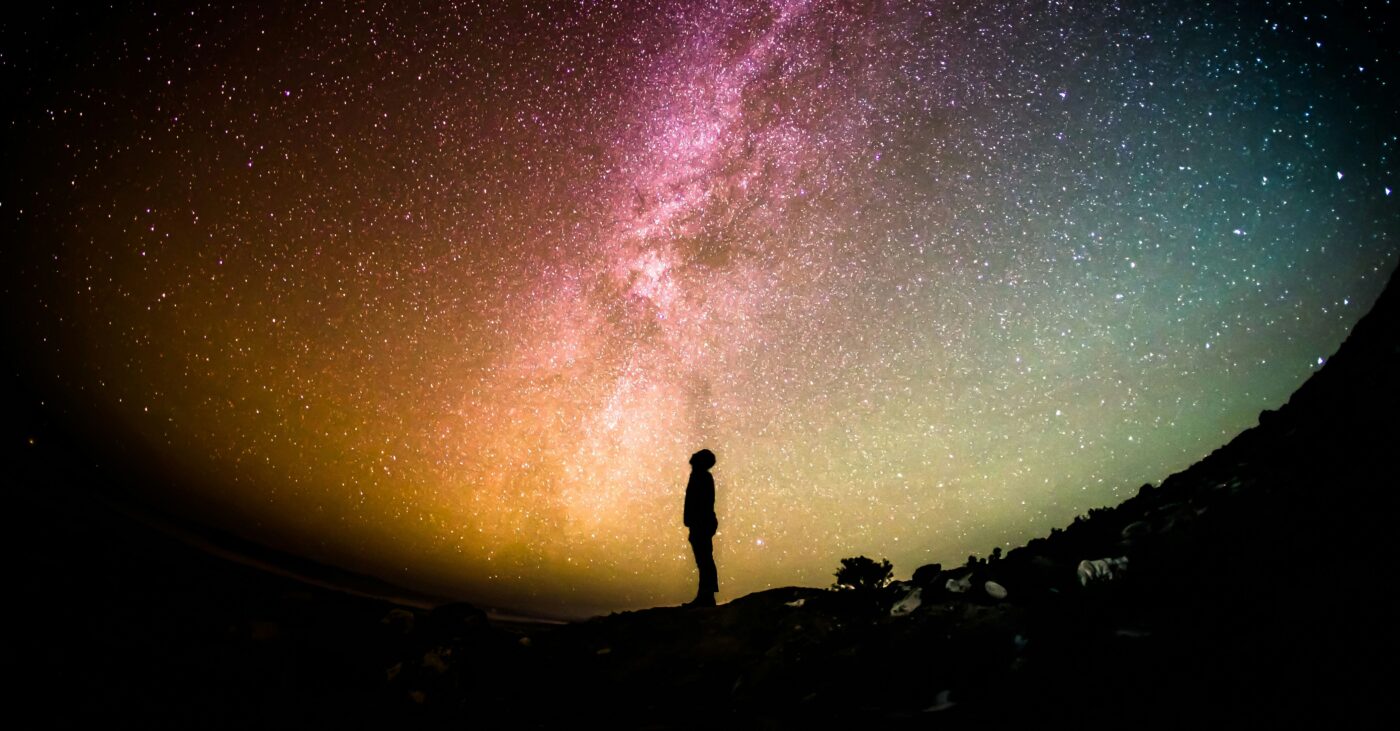
Records of the human quest for knowledge have existed for four to five thousand years, revealing that as humans have confronted the vastness of the cosmos, as they have watched and listened and felt the natural environment, their response has been an awe, a wonderment, a sensation of the grandeur of creation—sensations, and thoughts, which are captured by the word piety.
For thousands of years, and even today, nature has captivated humans as an overwhelming entity of mystery that dwarfs any one of us, generating a pious response, demanding reverence, humility, dedication to protect, and faith in its continuation.
Until only recently in the history of civilization, scientific and religious thought were complementary not contradictory. Scientists prior to the modern age were convinced that their research into nature shed light on the divine. The most valid response to God the Creator was a pious attempt to understand His Creation. Implicit in the piety of thinkers was an awareness of the profundity of existence, of life, and the role of the Creator in making and sustaining it. Not all these thinkers had the same view about life, but they all respected and had piety towards it in many, if not all, of its forms.
The Pious Scientists
Examples are many of great thinkers of the past who brought piety to their scientific inquiries. The ancient Greek thinkers Anaxagoras, Socrates, Plato, and Aristotle were pious philosophers. Until the Scientific Revolution of the past 300-400 years, philosophers and scientists were one in the same: pious scientists.
Socrates, Plato, and Aristotle embraced Anaxagoras’ conception of a spiritual, nonmaterial being that creates what is good, what is just, what is beautiful, and all that is. Socrates and Plato were more philosophers than scientists, yet they believed that to understand the forms (especially the Good) thinkers must engage in years of—what today we would call today—the liberal arts.
Plato’s student Aristotle embraced these ideas but with a more empirical approach than his teachers. Aristotle utilized experimentation, observation, data collection, analysis, induction, and deduction in books such as Metaphysics and Physics. He understood the basis of reality as an incorporeal transcendent being that, by studying creation in all its forms, the scientist could come to know and understand.
Aristotle’s impact on subsequent thinkers was immense: the Hellenistic Age, the Roman Empire, the Middle Ages, the Renaissance, and the Age of Science. During the Hellenistic Age (330-30 BC), Hebrew thinkers were heavily influenced by Greek scientific philosophers. For example, Philo of Alexandria brought his piety to bear in some of the great questions facing students of nature.
After the Fall of Rome in the Middle Ages, pious scientists such as the late Roman philosopher Boethius, the Spanish encyclopedist Isidore of Seville, the Carolingian philosopher-scientist John Scotus Eriugena, the English philosopher Anselm of Canterbury, the Franciscan philosopher Bonaventure, the Parisian professor Albert Magnus, the Italian-French scientist-philosopher Thomas Aquinas, and the English Franciscan William of Occam intermixed classical inquiries with Christian faith, seeking a pious understanding of God the Creator.
One of the founders of the Scientific Revolution in Europe, Nicholas Copernicus, brought his pious understanding of the cosmos to bear in arguing for the heliocentric universe. Michel de Montaigne, the French Catholic aristocrat, and Raymond Sebonde, the Spanish Catholic philosopher/scientist, continued to bring the new thinking of the Renaissance to answer old questions about the creation of the world, predating Christian Scripture.
As the New Science, focusing on the ideas of Copernicus and Galileo, began to preoccupy European scientists, even skeptics such as Rene Descartes still dutifully practiced his Catholic faith, and Blaise Pascal asked some of the most penetrating questions about life, nature, and God.
By the 19th century, while many scientists began to abandon their Christian faith, others, such as the French-Mexican scientist Jean Louis Berlandier, embraced piety in all of his scientific inquiries.
But by the 20th century, human knowledge, creativity, and technology were eclipsing the millennia-long relationship between piety and science. Even still, George Lemaître, the astronomer-priest, suggested the idea of the Big Bang, the instantaneous beginning of the universe billions of years earlier, without reference to God’s role as the Creator.
The Break from Piety
As long as humans felt dependent upon nature, hence upon nature’s Creator, piety reigned in thought, culture, society, and science. But when, during the 18th and 19th centuries, humans began to develop machines that overwhelmed the apparent limits imposed on living things by nature and its Creator, they began to reconsider the divine role in the universe, thus discarding the once long-held piety.
Humans came to understand the way nature works, using this understanding to build machines to control it, even to destroy it. Then some went so far as to eliminate the creator from all inquiry, to assume that what is has always been, that it is the result of chance, and that humans are the masters of nature rather than its servants and dependents. As Henry Adams succinctly expressed in his autobiography Education, the artificially-divine electric motor, the Dynamo, replaced in the temples of worship the sublime god of nature, which he called, with religious and naturalistic symbolism, the Virgin.
Those that didn’t do away with the idea of a creator usually acknowledged only a general, anonymous mystery in the universe that might or might not be divine. So over the course of a few hundred years, humans went from a providential God, to a deistic God, to a distant “maybe supernatural” force that has some sort of a role in the vastness and complexity of the universe. As we know, this progression led to agnosticism and atheism, doubting any kind of supernatural agency at work in the universe.
During this time, piety changes too—from a clear sense of a personal God, to a generic sense of a Creator God, to an amorphous mysterious presence, to nothingness.
Does Piety Belong in Science?
How in the space of a little more than a century could scientific thinkers go from the natural theology of Edward Hitchcock, author of The Religion of Geology and Its Connected Sciences, to the nihilism of Richard Dawkin’s The Blind Watchmaker? There has been a revolutionary shift in the understanding of the origins of the universe, hence the origins of life itself, and the origin of the purpose and meaning of life, during the past 150 years.
The drivers of this paradigm shift from piety to nihilism are both inside and outside of science. But where do our existential and metaphysical questions lead us to today? What are the consequences of our modern way of thinking? Through this series on piety and science, we aim to explore the human understanding of God inextricably tied to scientific thought, exhibiting the proper role of piety within our understanding of the universe.
Photo by Greg Rakozy on Unsplash