While some Christians may be unaware that the Sacred Heart of Christ was pierced by a Roman centurion during the Crucifixion (Jn. 19:32-34)—and many who are aware assume it was merely an outrageous act of desecration by a sadistic soldier—the piercing was arguably one of the most cosmically consequential acts in salvation history. In fact, the symbolic emanations and supernatural ramifications of St. Longinus opening the Heart of Jesus resound throughout salvation history with tectonic reverberations.
Part of God’s Saving Plan
This was no random act; it was the way God chose to redeem humanity and renew the face of the earth. We know that it was no random act thanks to many Old Testament prophecies of the piercing and its effects that came to fulfillment.
Even St. John, the inspired Gospel writer, thought it was so important that he stepped out of his narrator’s role to emphatically emphasize, “He who saw it has borne witness—his testimony is true, and he knows that he tells the truth—that you also may believe” (Jn. 19:34). This would be an incredibly odd overstatement if this posthumous piercing was merely a meaningless, merciless act of Roman brutality.
When all but one of Jesus’ apostles denied, betrayed, or otherwise abandoned Him, one Roman centurion stepped up, at the highlight of human history, and stood in their stead to perform a supernaturally significant sacrificial function ordained by God: draining all the precious Blood from this Divine Victim. Amazingly, God chose a man of war to perform a most violent and visceral act through which He brings about unimaginable good for unfaithful, unworthy humanity.
An Act Necessary for Our Salvation
Within this underappreciated act, opening the side and piercing the Heart of the Son of God, are many aspects central to our Faith which are helpful, even necessary, for our salvation.
One such aspect is how the pierced Heart and divine outpouring gave rise to the Sacred Heart and Divine Mercy devotions, which have been more fully unveiled in these latter times.
Another aspect, according to the Church Fathers, is that the Blood and Water which gushed forth from the Heart of the Savior is the supernatural source of our seven sacraments. St. Augustine said that from the pierced side of Christ “flowed forth the sacraments of the Church, without which there is no entrance to the life which is the true life” (St. Augustine, Tractates on John 120.2, ca. 406 A.D).
Yet another of the many ramifications to ponder—and a critical one—Jesus speaks of in His final, painful, utterance: Consummatum est (Jn. 19:30, Douay Rheims). Think about it. If Jesus’ last words were “It is consummated,” to what is He referring? And when and how was it accomplished?
The Wedding Feast of the Lamb
The Crucifixion, and the Holy Sacrifice of the Mass which flows from it, is a foretaste of the Wedding Supper of the Lamb which will occur in heaven, when God will fully and forever be united with His people, in fulfillment of the Scriptures.
If Calvary is where the Wedding Supper of the Lamb would occur on earth, then only a sinless virgin without spot or wrinkle would be a bride worthy of the Son of God. Mary needed to be beneath the “marriage bed of the Cross” (as Blessed Fulton Sheen called it), so that the Mystical Body of Christ could be spiritually conceived in her pierced and open heart through the supernatural substances of Blood and Water which gushed forth from the Heart of Christ.
This is why the Blessed Mother needed to be present and participating in the Passion of her Beloved. It was not because God wanted to inflict unspeakable suffering upon the most faithful, sinless disciple.
The Conception of the Church from the Cross
The Church rightly holds that the Body of Christ (the Church) was born on Pentecost, but it was conceived from the Cross, and Mary is its mother. The Blessed Mother, known for carrying things in her heart (Lk. 2:19, 2:51), carried the embryonic Church in her Immaculate Heart, which was mystically rent open by the centurion, from the Cross to the Upper Room, delivering it in the presence of her divine spouse, the Holy Spirit.
Because the life is in the blood (Lev. 17:11), Jesus gave up His divine/human life by pouring out the last drops of His precious Blood and Water so that His Church might have His life (Eph. 5:25). St. John Chrysostom wrote that the Blood and Water from the Heart of the Savior conceived the Church:
For from His side, when pierced, there flowed forth blood and water, that you might know that these are no common things, but that from them the Church is established. (Homilies on the Gospel of John)
Pope Benedict, in more recent times, confirms this lesser-known teaching: “The Lord’s opened side is the source from which spring forth both the Church and the sacraments that build up the Church” (Joseph Ratzinger, Collected Works Theology of the Liturgy, 261, Ignatius Press, 2014).
Mary needed to be present and give her fiat to become the Mother of the Church, just as she had to be present and give her permission to become the Mother of God, thirty-three years earlier.
The Connection Between Christ’s Conception and Crucifixion
Some claim that the conception and crucifixion of Christ occurred on the same day. Supernatural support for this claim can be found in a church in Andria, Italy, which possesses a relic from the crown of thorns. This holy relic bleeds only when Good Friday occurs on March 25th, the feast of the Annunciation and the conception of Christ.
The belief that the conception of Christ and His crucifixion coincided on March 25th is found as early as the 2nd century, in the writings of St. Irenaeus. Many other Church Fathers, including St. Augustine, also held this belief: “For Christ is believed to have been conceived on the 25th of March, upon which day also he suffered.”
In the Roman Martyrology, both the Annunciation and the Feast of the Good Thief were assigned March 25th, as it was known to be the date of the good thief’s crucifixion. Such an occurrence would be consistent with the ancient Jewish belief that true prophets died on the date they were conceived. The bleeding of the thorn seems to be divine confirmation that Jesus was a true prophet, that He took on Flesh and offered it up on the same day, thirty-three years apart.
Mary, the Offeror of the Sacrifice
Our Blessed Mother needed to be present to offer this salvific sacrifice, for as His mother, she alone had the standing to do so. Mary, as the faithful Daughter of Zion, was able to offer the Divine Victim on behalf of Israel, and as the New Eve she was able to do so on behalf of all humanity. Remember, every sacrifice has a priest, a victim, and an offeror, one who offers up the sacrificial victim taken from among his or her possessions. The Jewish leaders and the crowd had no standing to offer this salvific sacrifice even if they wanted to, which they didn’t. Mary, as the sinless representative of Israel and the Church, willingly did so for our sins and for our salvation, because she alone was sinless and saved in advance at her Immaculate Conception.
The excruciating sacrifice of Jesus made her final fiat much more painful and costly than her first, but she willingly did so, remaining perfectly obedient to the will of God.
St. Longinus as Proto-Priest
With his spear, the centurion opened access for mankind to the sanctuary of the Sacred Heart, unleashing the fecund fluids of Blood and Water which conceived the Body of Christ and remains the source of her sacraments. At that moment, in a mystical way, he also unwittingly opened the Immaculate Heart of Mary, fulfilling the prophecy of Simeon at the Presentation, enabling this spiritual consummation to occur and bear fruit.
In doing so, the future St. Longinus unknowingly participated as a proto-priest in the once-for-all sacrifice from which all Masses subsist, re-present, and draw their power. His later ordination by the apostles as priest and then bishop officially confirmed the supernatural reality of the sacerdotal acts the centurion-saint was prompted to perform on Calvary.
It must be noted that the audacious act of piercing the Heart of God was accomplished according to the will of God and in defiance of a direct order from his superior to break Jesus’ legs. Then, as the divine elements of Blood and Water he released poured out upon him, the centurion, as the ranking Roman authority at Golgotha, publicly proclaimed on behalf of all nations that this dead Galilean, not the living Caesar, was the true Son of God.
Author’s Note: To delve far deeper into this great mystery and to explore other aspects and emanations of the piercing, please consider reading: Rise of the Centurion: Reclamation of a Mystical Masculine Theology, published by Sophia Institute Press.
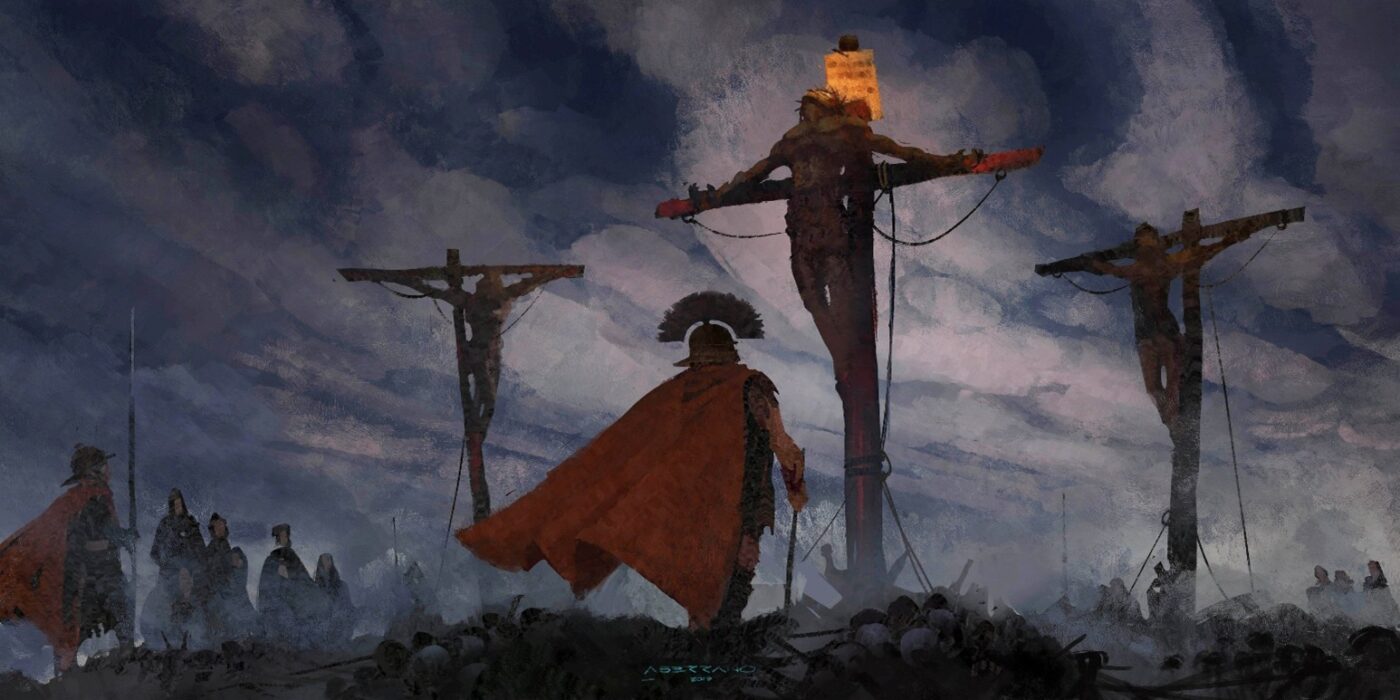
Image titled “It Is Finished” by Armand Serrano